

La pariosse de La Sainte-Famille:
An Acadian Church at Piziquid.
It will be necessary, at the first, to track the early Acadian migration from the original Acadian settlement at Port Royal. 1 (See map.) It will be seen that the original territory of Acadia was fully contained within peninsular Nova Scotia towards its south-western end. With the pressure of English invasions on Port Royal coupled with the ever present desire of the young to spread out and to secure good farming lands for themselves, Acadian growth, spread eastward using the water route of the Baie of Française (Bay of Fundy). Such expansion eventually led these young Acadian families to settle on the protected, accessible and fertile lands as will be found up the rivers and creeks which empty into Chignecto Bay (the furthest extension of Bay of Fundy) and that of the Minas Basin, a place were Piziquid will be found. (See #3 on the map.)
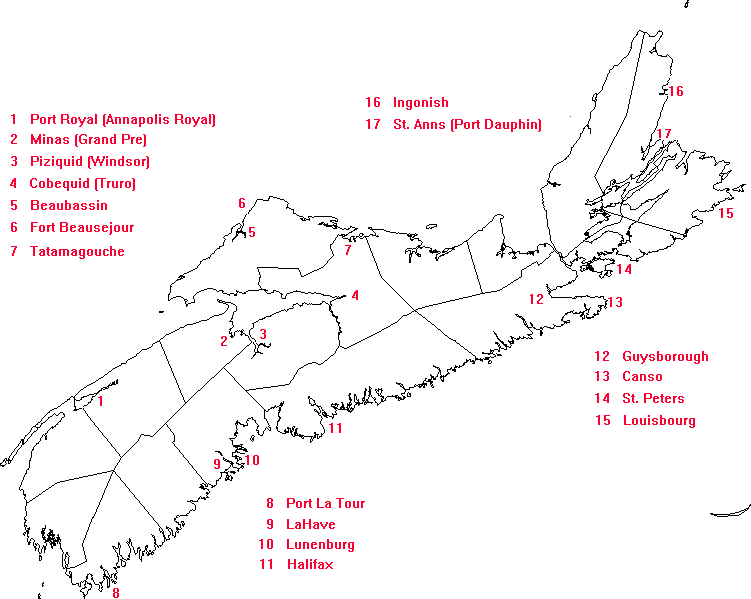
I am in the fortunate position to be able to put names forth of real persons who lived in Acadia during these stirring times. My distant, direct relative, René Landry (b.1618) with his wife Perrine (Bourg) come to Port Royal, c.1640. René and Perrine were to live out their lives at Port Royal. (See my page on the "Landrys of Old Acadia.") They, like most all Acadian couples, had a large family.2 From the two original progenitors, René (b.1618) and René (b.1640 [#11]) there came issue: Pierre (b.1658 [#12]), Antoine (b.1660 [#13]), Claude (b.1662 [#14]), Claude (b.1663 [#111], Jean (b.1666 [#112])14, René (b.1668 [#113]), Germain (b.1674 [#114]), Abraham (b.1678 [#115]), Pierre (b.1680 [#116]), & Charles (b.c.1686 [#117]).
René's sons were to move to stake out farming lands away from the English guns3 as were found at Port Royal. Antoine [#13] picked out a site on the banks of the Riviére des Habitants (Canning area); and, yet, another brother, René [#113] settled at "rivière-aux-Canard." But the Landrys that now attract our attention are those who came to Piziquid. It would appear that Piziquid was to attract more than its share of early Landrys: Pierre [#12], Jean [#112], Germain [#114], Abraham [#115], and Pierre [#116].
The French Acadians that came to first settle Piziquid came over a ten year period from 1690 to 1700. In the analysis, it is worthwhile to consider the information available to us in respect the growth of the Acadian population levels during the last half of the 17th century. At the start, 1641, in all of Acadia, there was but 120 souls4. By 1671, at Port Royal, the only place to contain a viable population, there was to be found 360 persons.5 In 1683, we see 600 persons in all of Acadia6. By 1686, we have our first breakdown of the population levels: Port Royal, Minas,7 Cobequid, Beaubassin: 592, 57, 127, & 885.8 Incidentally, not until 1676 do we see a community spring up to rival that of Port Royal - indeed, it was, in short order, to surpass it. In 1676, Beaubassin9 was founded; and by 1686 Beaubassin's population level stood at 885, viz., Port Royal, 592. In 1686, there was only 57 at Minas and 127 at Cobequid10.
Development at Minas was slow to start on account of jurisdictional disputes that broke out between certain of the French leaders at Port Royal, each asserting seignorial rights. Then, suddenly there was to come among them very important French civil and ecclesiastical officials who far outranked all their underlings at Port Royal. They were soon to settle all disputes. Meules, the Intendant at Canada, visited the Acadian settlements during the years 1685-6; and with him was Bishop St. Vallier (Quebec).11
The impetus to the eastern movement of the Acadian population, was, undoubtedly, increased due to the invasion of Sir William Phips, in 1690. Certain of the families that had the means were able to combine up and likely entered into charters with New England ship captains who, in season, could be found on the coast with trading goods; they would be perfectly willing for a price to run people, tools and farm animals up the bay and land them all, on the shallow and muddy shores of the Minas Basin.12 No doubt the nearest and best lands were taken up first. This general trek continued eastward, until, eventually, 15 miles beyond Grand Pré, the Piziquid and its lands were reached: the banks of the three converging rivers: the Piziquid (renamed by the British to the Avon) the Kennetcook and the St. Croix (as they continue to be named today).
No matter the timing and the mode, we see in fact the population of the larger area of Minas (which includes as one of its subset territories that of Piziquid) pick up from the 57, as reported in 1686; to 307, in 1693; 498, in 1701; and 577 in 1707. This growth was, to some extent, at the expense of the population at Port Royal.
I cannot say when the churches of Piziquid were built, though, today, we can point to the original sites: La Sainte-Famille, to the west of the Avon River (Falmouth); and L'Assomption, to the east of the river (Windsor). Assomption was probably constructed around 1700, at a time when there would have been a sufficient population to support it. By 1722, we see that Famille was built in order to serve the population on the west side of the Piziquid River (where today there is to be found the English community known as Falmouth).
I now make a short excursion to deal with the other churches in Acadia: a short note from Placide Gaudet (FACAR) will suffice: there was, at Port Royal area two churches, the "one in town dedicated to St. Jean-Baptiste, and the other about ten miles above [at or around the current day village of Upper Granville]. ... At Grand-Pré the patron saint of the church was St. Charles; at Riviére-aux-Canards, St. Joseph13 ... At Cobequid, St. Pierre et St. Paul." At Piziquid there were two churches: L'Assomption and La Sainte Famille, the principal subject of this piece. To round things out, there was one other church in old Acadia, Ste. Anne at Beaubassin. As was the case for all catholic churches registers of marriages, births and deaths were kept, but, sad to say, most went missing. As of 1906, two existed: the one from St. Jean-Baptiste covering the years 1702-1755. The other, which was at St. Charles de la Grand-Pré aux Mines, and it was "brought to Louisiana by the Acadians at the time of the expulsion. There were five volumes of them embracing the years 1687-1755. ... Very poor care was taken of them." As Gaudet points out in 1906, only bits and pieces of these five volumes have survived covering the years 1707 to 1748. There is hope that one or more of these old registers may yet show up: if so, then, as Gaudet explains, it will likely be in France as there is evidence that certain of the registers must have found their way to France.
To summarize, then, all of the church records for the Acadian parishes have disappeared, except for those at Port Royal from 1707 onwards, Grand Pré from 1707, and at Beaubassin from 1712. Stephen White, a professor at the University of Moncton, with a special interest in Acadian genealogy, says that "no registers survive at all for Cobequid, the two churches at Pisiquid, the Riviére-aux-Canards, Chipody, the Pointe-de-Beauséjour, Tinamarre, Chebogue, ... or any of the lesser missions of old Acadia."14
But to address the question of who is buried under the fine red earth under the church yard15 of Sainte-Famille: we can now only attempt to put a pre-deportation list of the area residents together and guess which of those people likely died before 1755. We might begin with the year of 1690. This 65 year period, however, can be further broken down into two periods: 1690 to 1722; and, the period between 1722-1755.
In the Pisiquid area there came into being, in 1722, two parishes; la paroisse de l'Assomption and la paroisse de Sainte-Famille. This came about as a result of an edict from the bishop at Quebec. There had been, prior to this time only the one parish, l'Assomption; but those on the west side of the Avon River (as it is named today) wanted their own church (bridges were unheard of, and the tides were high and the mud deep) disputes broke out amongst the residents, such that the bishop had to step in. Thus, on the Falmouth side (western side) of the river, after 1722, the parish of Sainte-Famille was to be founded; on the other side, l'Assomption continued to exist. There was only the one priest to cover both parishes and he use to say mass on each side of the river on alternative Sundays.
Another useful resource in establishing a list of residents, is, a map, which I have scanned in and placed on my site, and which was originally prepared by the British forces before 1755.16 This map is useful in that it apparently gives a snap-shot of the principal residents of the area under review, just before the deportation, c1754; but, no doubt, the family names written down represent the long standing location of these Acadian families who had immigrated, as we have seen, eastward from Port Royal.
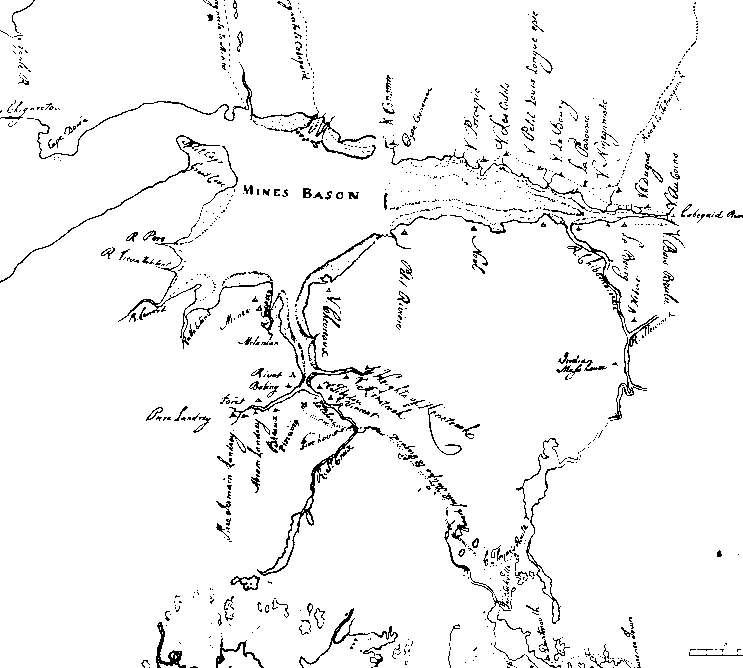
Thus, to answer the question, which first prompted me to write this piece, viz., - Who is Buried at La Sainte Famille? - one needs to list those Acadians who lived west of the Piziquid river and who likely died between the years, 1722-1755. With a copy of Bona Arsenault's Histoire et Généalogie des Acadiens one might be able to come up with a list of names. I can start things off by setting forth what I know of the Landrys who were in La pariosse de La Sainte-Famille; and, in turn, speculate which of them might have been buried there, in the church yard of La Sainte-Famille.
On an old British map we are able to see a number of old French Acadian names. There will be found the homesteads of several Landry families, including: Abraham, Pierre, and Pierre Jermain; but these Landry families were, likely, of the La pariosse de l'Assomption, being located, as they were, on the eastern side of the Piziquid River (now known as the Avon River) where the southern branch of the Avon comes into the main river, handy the small modern day village of Windsor Forks.17 On the western side of the main river we see, writ large, "Pierre Landry."18 Now, which Pierre Landry would this be? My research leads me to believe that this could be either [#116] or [#132], whom Arsenault identifies as within La pariosse de La Sainte-Famille.
Now, in the summer of 1996, it was our pleasure, both Margo and I, to go and examine the farm lands of "Pierre Landry." We were in the company of two well informed gentlemen: John Wilson, the President of West Hants Historical Society (Nova Scotia); and, a local historian and published author, John Duncanson. (We took pictures.) These French Acadian families usually hung together in a pack. Under one roof would be found, often, I suppose, more than two generations. In the case of "Pierre Landry," the on-the-ground evidence would support the theory that there was three or four families living in separate residences. This makes sense, as, in pioneering situations it's well to have gangs of men at the ready for work or defense. Here on this site lived Pierre Landry; indeed, there were two Pierre Landrys ([#116] & [#132]) that likely first came to live there; they were first cousins to one another, born and raised at Port Royal. As of 1755, the one would have been 75 years old and the other 65. We don't know when they died, and my experience is that Landrys are long livers (I hope it continues to hold): could it be that one, or both, are buried in the fine red soil of La Sainte-Famille?19
[1] Port Royal is now called Annapolis Royal, a pretty little town in the Canadian eastern province of Nova Scotia.
[2] There is a controversy as to the first two René Landrys of Acadia. Were they father and son? Or, were the two Renés related in some other way? Or, were they even related at all?
[3] However, at this time, 1686, there was but 30 soldiers at Port Royal, and they were quartered on the inhabitants. (Hannay, p. 221.)
[5] Calnek, p. 31; Hannay, p. 210; Eaton, p. 25.
[6] Calnek, op. cit., p. 34.
[7] Minas, I suggest, covers a large territory occupied by the French lying to the southwest of an usual body of water known as the Minas Basin: includes lands on the shores which stretch from Pereaux River, south, through the Canard and Habitant Rivers. Then, turning, running east; first, Grand Pré then, 20 miles along, to Piziquid. Grand Pré was the first of these Minas villages (maybe better described as farm clusters); it was settled in 1680. The originals founders might be referred to "The Two Pierres": Pierre Theriault and Pierre Melanson. These original families proceeded "independently of each other ..." [p. 24 of Thwaites' book, France in America, 7th vol. of 27, (Harper Brs., 1905); see also Savary's Supplement, History of the County of Annapolis, p. 14; see also Eaton's History, op. cit., p. 26. I should note, parenthetically, that Theriault's wife was Celine Landry.] Soon the inner southern banks of the Minas Basin, up its creeks, away from easy access by English vessels, were to be found the families headed by Jean Theriault, Martin Aucoin, Philippe Pinet, and Francois Lapierre (these last two having come directly from France). (See Eaton, p. 27.)
[8] See the work done by Calnek, Eaton, Hannay, Webster, Patterson. In Webster's work on Villebon, at page 203 and on, we see this careful historian report that, in addition, there were 19 people at Le Heve and Mirliguaiche (Lunenburg), 15 at Cape Sable, 16 at Pentagoet (Castine, Maine) and surrounding area, 6 at Miramichi (New Brunswick), 6 at Nepisiguit (Bathhurst), 26 at Isle Percée and 15-20 at Chedabucto (Guysborough, Nova Scotia). On the St. John were to be found the three Damour brothers, M. Martignon (his wife wife Jeanne LaTour (age 60) and their daughter, Marianne, aged 24. (Parkman, Count Frontenac and New France under Louis XIV, FN at p. 355; Hannay, p. 222; Webster's work on Villebon, pp. 203-4.
[9] Beaubassin: On October, 24th, 1676 Frontenac granted Michael Le Neuf sieur de La Valliére de Beaubassin (1640-1705, the elder) a large piece of land at the Isthmus of Chignecto which was to become known as the Beaubassin seigneury. (See Savary's Supplement, History of the County of Annapolis, p. 14; and see also "The Acadian Seigneury of St.-Mathieu at Cobequid"; by Joan Bourque Campbell, NSHR#9:2(1989).
[10] Cobequid (Truro): This community was founded in 1689 by Matthieu Martin (b.1636). Martin was the first French Acadian child to be born in Acadia; he died, unmarried, about 1724 as the seigneur of Cobequid. (FCAGR, p. 71; and see Savary's Supplement, History of the County of Annapolis, p. 14; Arsenault, p. 674; NSHS#23, p. 50.)
[11] It was on this important occasion, the visit of Intendant Meules and Bishop St. Vallier, 1685-6, that a census is conducted. (See Acadian population levels.) The year before, it should be noted, there had been a cruise carried out by the French naval officer, Captain Bergier. Bergier sailed the waters of Acadia in his two ships, the St. Louis and the Marianne, enforcing the rights of French fishermen as against the New England fishermen. Bergier undoubtedly filed a report with his expense list; this report probably recommended a greater involvement of the church and civil authorities who were located at the principal center of New France, Quebec.
[12] Though, likely, in this period of time, it was difficult to find a willing New England captain to unnecessarily hang around in Acadian waters: there were French war ships about. In the summer of 1684, as we have seen, the French navy (Captain Bergier in his two ships) was cruising the waters of Acadia enforcing the rights of French fishermen. These two French naval ships set out from France on May 11, 1684, and by October they were back at France having successfully impressed on a number of New England fishing captains that they were not wanted in Acadian waters. (Dawson, "Voyage from LaHave: A Journal of Summer, 1684"; NSHR, 4:1 (1984).)
[13] The church of St. Joseph, according to Arthur Eaton in his History of the County of Kings (p. 36), stood at Chipman's Corner, almost on the site of the old Congregationalist-Presbyterian meeting house which was built in 1767 and taken down in 1874; near each church was a burying ground. In writing of the New England Planters, who were to settle in 1760 on lands which the Acadians had occupied but five years earlier, Eaton writes: of "lands set off for public use besides the church and the school lands, and Parades, were, of course, burial grounds. For burial places, Cornwallis at least, the planters seem as much as possible to have chosen French cemeteries. The first burial place at Town Plot, where the Starrs and a few other families buried, and the Congregationalist-Presbyterian churchyard at Chipman's Corner, were both originally French churchyards." (Ibid., p. 82.)
[14] Stephen White, "Acadian Family Names" (Moncton: Acadian Odyssey, 1992); see also Duncanson's work, Falmouth, Ch. II, p. 5.
[15] I have seen the cemetery located at La pariosse de La Sainte-Famille: Saw it in the summer of 1996: Somebody was busy digging it up while in the process of building a house. I took pictures, Pictures of Piziquid.
[16] A reasonably good copy is tipped in NSHS
FOOTNOTES:
[17] What is not shown on the map are the homesteads on the banks of the St. Croix, the Jean Landry [#112] line. This line of Landrys saw the writing on the wall and left their lands in 1751 to immigrate to the French territory of Ile Royale (Cape Breton). Your editor/compiler traces his decent through this line, as is the case for most all Landrys who hail from Cape Breton.
[18] The only other names I see written on the Falmouth side of the map is "Foret" and "Rivet." Who ever is running down the information on these families can come to their own conclusion as which of their ancestors are buried at Sainte-Famille. They might send me the information; again, Arsenault will be of considerable help. Just e-mail me.
[19] I think we might safely speculate that there is a Pierre Landry buried there; and, likely, their wives and certain of their children and grandchildren. Incidently, the listed sons of these "Two Pierres" are: Pierre [#1161] (b.1704), Francoise [#1162] (b.1711), Augustin [#1321] (b.1719), Firmman [#1322] (b.1725), Basile [#1323] (b.1727), and Joseph [#1324] (b.1730): the ages, respectively, as of 1755, if they were then living: 51, 44, 36, 30, 28, and 25: most of these men, the children of the "Two Pierre Cousins," I suppose, would have been part of the Piziquid deportation which was carried out under Captain Alexander Murray.