Significant Historical Happenings By Year: 1730-32.
- -1730-
§The local American authorities are reminded of the provisions of a 1711 act of England which was designed to preserve the trees in North America which might be used for "masting." The big white pines were to be marked as the King's property. Further, Dunbar, the Surveyor of the Woods in the Continent of America, is to take steps to see that the inhabitants are instructed on "the growth and manufacture of tar, pitch, hemp and other naval stores. Pitch-and-tar casks to have name and address of manufacturers on them."
§By 1730 Frenchmen, such as La Vérendrye, strike deeply into the forests of North America.
§The English, under the orders of Philipps, travel throughout Acadia in 1730 proffering the Oath of Allegiance. Except for "six scattering families on the eastern coast" whom he intends to visit the following spring, the English were successful in getting all of them (every man, age 16 years and upwards) to sign. He acknowledges, as the Board had apparently pointed out to him, that the wording of the oath might have been "stronger." (The total Acadian population is estimated at 4,000.)
§August 12, 1730: Armstrong certifies that he together with "two serjeants, two corporals, one drummer and twenty-eight private men" were transported from Annapolis Royal to Canso in Captain Edward How's schooner, Adventure; done without pay to How.
§A determination is made by the French authorities not to send "deserters and criminals" to the French iles and colonies because of the disorders that have been caused.
§The merchants of St. Malo sent a small vessel with biscuits to save Louisbourg from famine.- -1731-
§January 16th, 1731: Armstrong is ordered by Whitehall "to repair to Nova Scotia, with letter for Phillips' recall"; Armstrong is to have Governor's pay as long as he retains office.
§March 11th, 1731: Philipps proclaims that "no vessel trading to or from the province shall carry a greater quantity than two months' provisions. The inhabitants of Minas, Chignecto, Piziquid, Cobequid and other settlements up the Bay are forbidden to ship cattle, sheep or other provisions at Chebucto, Tapenagoock, Chignecto or any other creeks or places to be carried to any foreign settlement "except at this port of Annapolis Royal only under ye penalty of twelve months imprisonment, and forfeiture of 50£."
§March 15th, 1731: Philipps gets the message that he should return to England, but first "to adjust and settle the debts owing to the officers of his regiment."
§Acadians (60 of them) settle at Ile St. Jean on the promise of the French that they would pay the cost of conveying their effects and cattle. The French are of the belief that it was the insistence of the English in respect to the taking of the oath of allegiance that drove these particular Acadian families to give up their Acadian lands and head to French territory. So, too, there is by this time (c.1730), a few settlers on the Saint John, though there never was to be many.
§August 27th, 1731: "Philipps left the Province never to return."
§October, 1731: Mascarene petitions for an eight acre site, a short distance from the fort (Fort Ann, Annapolis Royal) and at the same time seeks leave to go to Boston. (It should be noted that Mascarene's old French grandmother, 89 year old Louise Mascarene died in the old country on Dec 13, 1731.)
§November, 11th, 1731: Though George Mitchell (?-1755), one of his majesty's surveyors in America, was not to come to the province until 1732, we see where the Acadians along the Annapolis River refuse, in writing, to have their lands surveyed.
§M. de Bourville is acting governor at Louisbourg, St Ovide being absent from his post for at least part of this year (1731).
§The lighthouse at the entrance of Louisbourg Harbour is started. It is built using cement which the French had mixed themselves, the limestone having been burnt in kilns and slacked for twelve months. It is determined that an arrivals- or port-tax is to be levied on vessels in order to pay for the upkeep of the lighthouse.
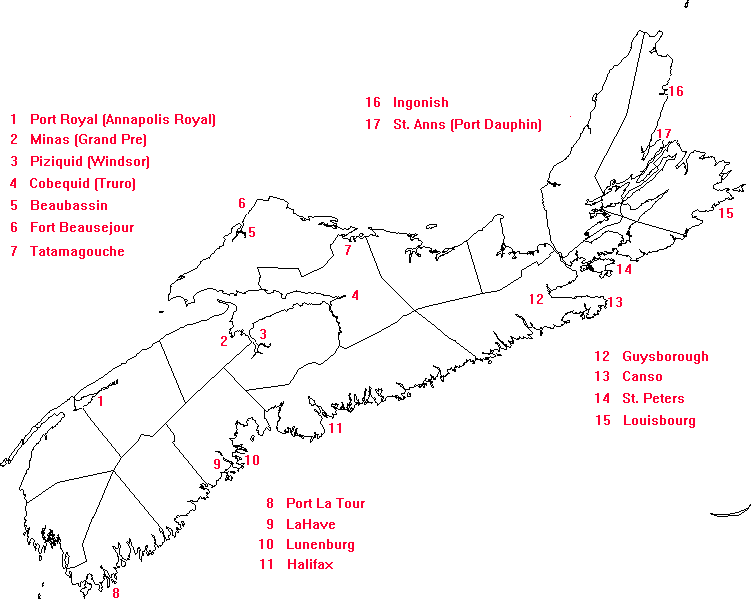
§The authorities are giving thought to "rebuilding the small barracks and the command officers quarters at Port Toulouse." A number of Acadians have settled at Port Toulouse, though they were to experience difficulties with the local commander (he is transferred out). It is thought that in time of war the enemy would not "bother about Port-Toulouse [St Peters] and Port Dauphine [St Anns], as this would be of little advantage to them." It is not thought, however, that these communities (see map) should be left altogether defenceless. "The only advantage the enemy could secure in capturing these posts, would be to cut off the help of the Indians and to hinder are comunication with Ile St. Jean and Canada (Quebec).
§It was during this year, 1731, Robert Jenkins, an English merchant captain, trading in the West Indies, was stopped by a Spanish ship and boarded. Jenkins was to appear before the bar of the British house of commons with his tale of being tortured by the Spanish and how they cut off his ear, which he presented to the gentry on the benches in a little box which he carried with him. This event, as between Britain and Spain, led to the outbreak, in 1739, to "The War of Jenkin's Ear."- -1732-
§Louisbourg: King's coat of arms cut in white stone to be placed at the Dauphine gate. By 1732 this cut stone is delivered together with "a painting representing St. John's baptism for the chapel of the Royal battery." As of the fall of 1732 the platforms of the King's bastion are in place. "... the barracks were roofed with slate and the chimney flues were erected [and] the covered way of the Dauphin bastion was made as well as the bridge at the gate." The authorities back in France, incidently, are annoyed that a slate quarry cannot be worked up somewhere handy Louisbourg rather than shipping slate all the way from France.
§Louisbourg: There are complaints about the high beach rents.
§Speculating ship captains are coming into the port of Louisbourg and are buying up scarce supplies. Fear of famine causes St. Ovide to send a ship to New York in order to buy grain.
§August 9th, 1732: "... the king's vessel Le Rubis sailed into Louisbourg with smallpox on board." In the result great numbers of men, women, and children died of smallpox during the winter of 1732/33. No one is spared and the Indians are particularly susceptible, many die. The Indians have little difficulty figuring out that this pestilence is associated with the white men and will often refuse to meet with them (French or English) even when presents are promised.
§Roads to Miré and Baleine are built.
§Louisbourg: Sixteen ships built at Ile Royale; however, as many were bought that year from New Englanders, a practice which the French authorities consider undesirable.
§September, 1732: George Mitchell comes to Nova Scotia, having been appointed a deputy surveyor of his majesty's woods in America. Mitchell, through to 1737, at which time he left the province, surveyed lands for stands of pine and "mapped the River Annapolis basin." (The results of this survey are set forth in a appendix of Knox's journal.]
§October 11th, 1732: The annual day set for the election of new deputies "in Commemoration of the Reduction of this place [Annapolis Royal] ..."
§December 23rd (Saturday), 1732: Annapolis Royal: Governor Lawrence writes out in one his despatches in the dim light of a candle: "... the Inhabitants, by mutual Consent, are contriving all the ways and means possible to distress his Majestys garrison by raising the price of all eatables, fire-wood, etc. And whereas they daily act with so much contempt, and behave themselves in most respects as independent of any Government, and show'd so little respect to His Majestys sovereignty, through a spirit of disobedience and obstinacy."
§Beaubassin, the younger, who had been the commandant off and on at Port Toulouse (St Peters) and at Ile St Jean is brought into Louisbourg and there to have broader responsibilities. He is given assurances that his sons will be promoted in the king's service at the right moment. Actually, in was in this year, 1732, that his sons, Louis and Philippe, are sent off, to live with the Indians at the mission at Malgawatch (on the West Bay of Bras D'or Lake). - -1731-