Significant Historical Happenings By Year: 1727-29.
- -1727-
§Written permits are required if English traders are to do business with the Acadians. August, 1727: Two sloops, the Hopewell and Endeavour are given "permission to Go up the Bay to take in a load of coal to carry to Boston."
§From the official despatches we see that one, Monsr. Le Fondt, was prosecuted for "Clandestine Trade being carried on by himself & Others from Mines & Checanectou." Brebner writes: "The summer of 1727 was a troubled one, being marked by considerable friction with the Annapolis merchants over their trade up the Bay and the quality of the provisions for the garrison. Acadians everywhere were uneasy. Moreover, the Council had fallen below a quorum and Armstrong filled it up with four officers. This resulted in a squabble between the military and the civilians over seniority. Altogether Armstrong had succeeded in creating an ominous atmosphere in his province." (New England's Outpost, p. 90.)
§A priest by the name of Antoine Gauline, in 1727, carries out a census of Acadians in Nova Scotia. It is reported that "the Acadian families in Acadia number 927, exclusive of those of La Hêve."
§September 26, 1727 (Tuesday): It is announced at a Council meeting that Captain Edward How, a resident of Canso but who, at this time, just happened to be in the harbour at Annapolis Royal with his schooner, Adventure, was willing to sail up the Bay and proclaim the accession of George II; he was paid 100£ and received on board a number of officers and troops. The Acadians are asked to sign an oath of allegiance to George II. They refused to give an absolute oath. The deputies [Abraham Bourg (1662-?) Francis Edwards, Charles Landry (b.1686; of Annapolis River), and Guillaume Bourgeois] are summoned to appear before the Council. It being determined that the wrong message had been given to the Acadian population in telling them of the permanency of such an oath, the deputies were sent off to spend some time in jail.
§June 11th, 1727: George the First, on a journey to Hanover, dies. "The temper of George the First was that of a gentleman usher; and his one care was to get money for his favorites and himself. The temper of George the Second was that of a drill-sergeant, who believed himself master of his realm." As parliament by this age was all powerful, it could nonetheless be bought by "places, pensions, and other bribes" -- sound familiar?
§November, 1727: Word is received by "Schooner Express" that there have been "Sevl Hostilitys committed by the Indians of this Province in Murdering Severals of his Majestys Subjects at Lescombs Harbour & Jadore ..." And that "the French of Cape Breton [are] ... Harbouring & Receiving the said Indians ...
§Louisbourg: During May, 1727, Sister de la Conception comes to Louisbourg to open a convent, by December she has 22 boarding pupils.
§50,000 slates to be "taken from Anjou to Nantes to be there put on ship-board, taken to Ile Royale, and handed over to Sieur Ganet, contractor for the King on that Island."
§A "fresh fund of 150,000 livres created by the king" for the works' at Louisbourg. Special mention is made of the "Battery of Ile de l'Entrée."
§The French consider that it "is well to maintain a garrison of 30 men at Port-Toulouse [St. Peters], considering the proximity of Canso and to free the inhabitants and neighbouring Indians from anxiety."
§St. Ovide is told that there is to be "no separate government of Ile Royal from that of New France."
§Defects in the construction of the barracks and Verrier is to make inquiries to see if money due on the building contract should be held back from Isabeau's heirs.
§Trading at Louisbourg: "The trading which the English are allowed to carry on at Louisbourg should be confined to live stock, sheep, pigs, fowls, fodder and building materials. No other commodities must be allowed to enter.
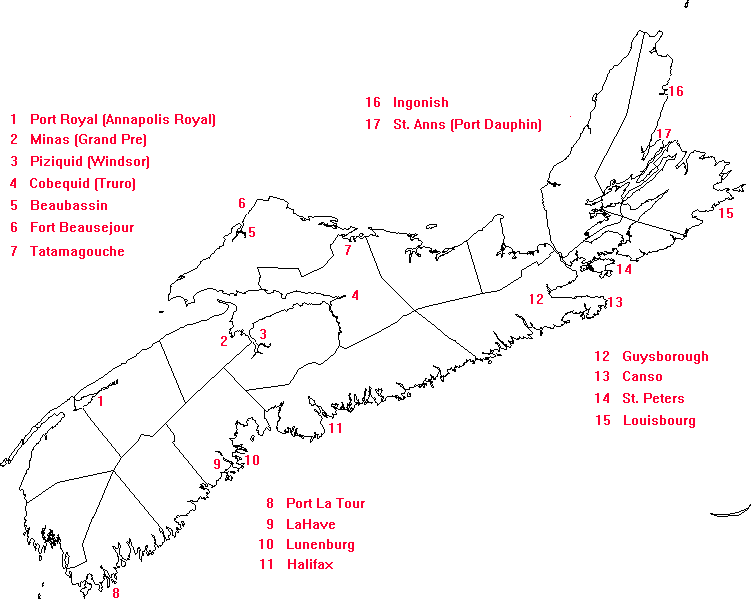
§Fishing at Niganiche: St. Ovide reports that "Niganiche as one of the best established ports of Ile Royale; that there are more fishing smacks there than all the rest of the island." (See map.)
§A French Despatch, June 10th, 1727: "Interest in populating Ile St. Jean. Encouragement to be extended to the Acadians. Let them choose their own lots and "treat them with consideration and mildness."
§Ile St. Jean: From the 1728 despatches we learn: there is an increase of six Acadian families over the previous year; the French are having some success with obtaining mast-timber, cultivation, and fishing. The navy Board is for extending further encouragement to the Acadians to settle at St. Jean, but not those of Port-Toulouse [St. Peters]. There is approval to spend 1,500 livres to provide for a 20 ton vessel and basing it at Port Lajoie and so to provide transportation between Port Lajoie and Louisbourg and to keep in communication with the inhabitants to the north on Ile St. Jean.
§July, 1727: A conference at Casco is concluded with a treaty: whereby, "for the more effectual preservation of the peace" a joint, peace keeping force was to be brought into being, "the forces to be paid and subsisted by the English and under the conduct of such a general officer as the English governor may judge proper to pursue ... refractory Indians ..."
§Sir Isaac Newton, the first man of science of the seventeenth century, dies in 1727.- -1728-
§Louisbourg: A despatch to Verrier, the Resident Chief Engineer at Louisbourg, from the President of the Navy Board, dated February 24th, 1728: While generally satisfied with progress, the President is "impatient to hear that the Royal Battery and that of l'Islet" have not come along as was expected and this because the workmen were employed at the "half bastion Dauphin." This dissatisfaction likely due because the local administrators were not following the policy that construction should proceed on the defense works first, residence building to come second. Also the board has examined "the plan of the beacon to be set up on a hill where the fishermen had formerly planted a cross; but as the place cannot be reached by the scows carrying the coal required to keep up the fire, is of the opinion that it would be better, for that purpose, to raise the clock tower on the main building of the barracks, so as to set the beacon thereon, if the foundations are sufficiently solid to support that additional weight."- -1729-
§Louisbourg: In a despatch to France reference is made to work being carried on the wharf at the careening-dock cove. Also hopes are expressed that the Battery at Ile de l'Entrée will be finished this year. Approval is granted to call the town gate "Porte Dauphine." The Royal Battery is now fit to accommodate soldiers, however it is intended to extend it another 30 to 40 feet. The clock tower has been completed. Louisbourg is now "well protected on the side of the sea, but it must be equally so on the land side."
§St Ovide is directed not to increase the number of soldiers in the outlying areas [for example, Ile St. Jean (Prince Edward Isalnd) and Niganiche (Ingonish)] without permission, this on account of the expense.
§Boularderie permitted to occupy the necessary ground and beach at Niganiche, provided they have 100 fishers there." (See map.)
§June, 1729: Governor Philipps arrives at Canso from England: "At Canso in June, 1729, he [Philipps] found 250 vessels and between 1500 and 2000 men employed in catching and curing fish ..."
§November 20th, 1729: The fishing for the season being about over at Canso, Philipps (Armstrong's boss) "after a difficult voyage," reaches Annapolis Royal. Armstrong, not wanting to have much to do with Philipps may have taken his leave to return to England at this time.
§Fall of 1729: Philipps approves of Abbé Bréslay taking up his position as the parish priest, and, in the resulting enthusiasm he is successful in securing an "unconditional" oath of allegiance. So, it was, that in this year, 1729, that the Acadians had first given their "unconditional" oath; however, as the years unfolded and up to that fateful year of 1755 when most all of the Acadians were deported, it was argued by the leaders of the Acadian community that Phillips did not receive an "unconditional" oath in that they were induced to sign such an oath on the oral representation that they would never be called on to bear arms against the French nation.
§23rd December, 1729: Oath Petition. About 400 Acadians signed up, of which 170 were from Annapolis Royal and 220 from along the Annapolis River. - -1728-