A Blupete Biography Page

David Hume
(1711-76):
"The Untroubled Sceptic."

"I found that the moral philosophy transmitted to us by Antiquity, laboured under the same inconvenience that has been found in their natural philosophy, of being entirely hypothetical, and depending upon more invention than experience. Every one consulted his fancy in erecting schemes of virtue and of happiness, without regarding human nature, upon which every moral conclusion must depend."1

GO TO TABLE OF CONTENTS.

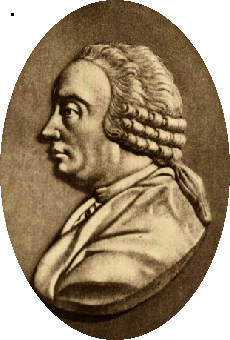
Portrait of Hume

TABLE OF CONTENTS.
  • Introduction:
  • Hume's Life:
  • Hume's Philosophy:
  • Quotes.
  • Dates.
  • Notes.
  • Introduction:-

    By this work I touch upon Hume: his life, his works and his thoughts.2 David Hume was but one of a number of men of eighteenth century Scotland who brought philosophy into a new age.3 These philosophers shunned the superstitions and speculations of the past as is represented by the Cartesian view, a view that envisioned man as a "human demigod, who derives his origin from heaven, and retains evident marks of his lineage and descent." These Scottish philosophers did not, however, go to the other extreme, insisting: that man was blind and awash in the forces of nature. The forces of nature, while unchangeable, are, in a number of instances, discoverable through scientific investigation; and, once discovered, to be reined and ridden like the wind. These Scottish philosophers, led by Hume, were of the view that "there is a great uniformity among the actions of men, in all nations and ages, and that human nature remains still the same, in its principles and operations. The same motives always produce the same actions: The same events follow from the same causes. Ambition, avarice, self-love, vanity, friendship, generosity, public spirit: these passions, mixed in various degrees, and distributed through society, have been, from the beginning of the world, and still are, the source of all the actions and enterprises, which have ever been observed among mankind."4


    [TOC]
    Hume's Life:-

    David Hume was born in Edinburgh, Scotland, 1711; he died there in 1776. Hume's widowed mother5 devoted herself to the education of "several young children." She came from an influential family, her father being Sir David Falconer, President of the College of Justice. The family, if not David, had thoughts that David should choose the law as a profession. I am not sure what concrete steps Hume took in this direction; but, at some point, he gave it up and moved in with his brother. At the age of 23, in March of 1734, Hume left Scotland for Bristol visiting London on the way. He had determined to attach himself to a merchant located at Bristol and to learn something of the business world. This venture, for whatever reason, did not work out; for, within a matter of months we see where Hume left Bristol and traveled to France.6 "There," Hume writes, "I laid that plan of life which I have steadily and successfully pursued. I resolved to make a very rigid frugality to supply my deficiency of fortune, to maintain unimpaired my independency, and to regard every object as contemptible except the improvement of my talents in literature."

    Hume was to stay three years in France during which time he was to work on his first book, A Treatise of Human Nature. During September of 1737, Hume returned from France and passed 16 months at London polishing and publishing his work;7 after which, he went home, "Ninewells, near Berwick," there, to languish at his family's "fair domain."8 He sought employment at the university at Edinburgh (Professorship of Moral Philosophy) and though he had powerful support, he did not get the job "on account of his well-known sentiments on religious subjects."9

    In 1752, after a failed attempt (once again) to gain a university position (a chair in logic at Glasgow) Hume was appointed the Keeper of the Advocates' Library in Edinburgh. Hume's connections included General Sinclair to whom, for a period of time, during the 1740s, he was secretary at the military embassies at Vienna and Turin (northern Italy).10 In 1763 he went to the embassy at Paris as Lord Hertford's secretary, a place at which Hume as Chargé d'affaires stayed after Hertford went off to govern Ireland in 1765. Though "entirely unmoved by the raptures of Paris," Hume moved in the highest of circles. "In the gay and fashionable circles of Paris his fame, station, and agreeable bearing, secured him so hearty a welcome that ladies and princes, wits and philosophers, vied in their attentions." On his return to England, in 1766, Hume was appointed by Lord Hertford's brother, General Conway, as an Under-Secretary of State, a position in the Home Office. However, on account of failing health, Hume was obliged to give up his Home Office position after about a year. After a short stay at Bath, in order to take of its healing waters, he returned to Edinburgh to spend his last few years; he died there on the 25th of August, 1776; and, was buried in the Calton Hill cemetery.

    Hume never married and as a bachelor led a peripatetic life. At Scotland with his family he enjoyed a "sophisticated, gregarious and bucolic intellectual life ... Hume valued friendship as one of the highest virtues, and conversation and claret as two of the major props of civilized living."11 Hume described himself as "a man of mild dispositions, of command of temper, of an open, social, and cheerful humour, capable of attachment, but little susceptible of enmity, and of great moderation in all my passions."12

    Though, in his day, Hume was better known as a historian, he is, today, remembered as a philosopher. Hume's philosophical work, An Enquiry Concerning Human Understanding, was written in 1748. It was a follow up to an earlier work, a more esoteric effort, a less popular work, A Treatise of Human Nature.13 In addition, in 1752, Hume wrote Political Discourses. In 1755, he wrote The Natural History of Religion; and, then, between the years 1754-62, he set forth his six volume, History of England; which, though despite its errors of fact,14 was the standard work for many years.15


    [TOC]
    Hume's Philosophy:-

    David Hume was an empiricist from the school of Locke. For empiricists, knowledge comes to a person exclusively through experience. What is true is what is experienced by the senses, and which, at the same time, is consistent and coherent with past experiences. (It was upon this basis that natural physical laws, such as Newtonian laws, were developed.16) We all take our cue from the customary or habitual succession of events. We judge that there is a causal relationship, and that the probabilities are that in the future a similar sequence of events will take place. Things, however, do not take place as a matter of necessity; things are not predetermined. Because of this, it is possible that some things, which we hold dear and near to our hearts, do not in fact exist, nonetheless, we proceed in life and make decisions, best we can, based on experience; and, regularly and subconsciously, bet that things will turn out for the best.

    Hume questioned the process of inductive thinking, which had been the hallmark of science. Hume was of the view that no matter how many individual observations an investigator may come up with (empiricism), he would never be in a position to make an unrestricted general statement. "When on innumerable occasions we observe certain experiences succeeding others, we naturally feel under similar circumstances in the future like events or causes will be followed by like effects. ... only custom or habit may validly be said to serve as the foundation for this causal idea."17 There is no guarantee, no matter how accustomed we may have become to certain sequential events of the past that the sequence will necessarily repeat itself. He concluded that the "whole of our science assumes the regularity of nature - assumes the future will be like the past ..."18 This is referred to in the texts as Hume's problem, the problem of induction.

    _______________________________

    A featured sketch in a book

    NOW AVAILABLE

    Biographical Sketches: The Thinkers


    _______________________________

    Found this material Helpful?

    _______________________________
    [TOC]
    Quotes:-

    Anger:-
    § "Anger, which is said to be the whetstone of courage." (Political Discourses.)
    Avarice:-
    § "Avarice, the spur of industry."
    Beauty:-
    § "Beauty in things exists in the mind which contemplates them."
    Criticism:-
    § "No criticism can be instructive which is not full of examples and illustrations." (Essays and Treatises.)
    Custom:-
    § "Men are not impelled by any reasoning or process of the understanding, but rather from Custom or Habit. ... Custom, then, is the great guide of human life." (Enquiry.)
    § "Men do not normally reason with one another, men impact on one another as billiard balls do; it is custom that leads men to do things as they do; it is custom, often concealed from the actor, which drives him to do things of which he is naturally ignorant as to why and for what purpose he does them." (Enquiry.)
    Human Nature:-
    § "Some exalt our species to the skies, and represent man as a kind of human demigod, who derives his origin from heaven, and retains evident marks of his lineage and descent. Others insist upon the blind sides of human nature, and can discover nothing, except vanity, in which man surpasses the other animals, whom he affects so much to despise. If an author posses the talent of rhetoric and declamation, he commonly takes part with the former: if his turn lie towards irony and ridicule, he naturally throws himself into the other extreme." ("Of the Dignity or Meanness of Human Nature," Essays.)
    Indecision:-
    § "He would stand, like the Schoolman's Ass, irresolute and undetermined, betwixt equal Motives." (An Enquiry concerning the Principles of Morals.)
    Labour:-
    § "Everything in the world is purchased by labour, and our passions are the only causes of labour." (Political Discourses.)
    Law:-
    § "Excessive severity in the laws is apt to beget great relaxation in their execution." (Political Discourses.)
    Love:-
    § "In general, it may be affirmed that there is no such passion in human minds, as the love of mankind, merely as such, independent of personal qualities, or services, or of relation to ourselves."
    Moral Sentiment Theory and Self Love:-
    § "That species of self-love, which displays itself in kindness to others, you must allow to have great influence over human actions, and even greater, on many occasions, than that which remains in its original shape and form. For how few are there, who, having a family, children, and relations, do not spend more on the maintenance and education of these than on their own pleasures? This, indeed, you justly observe, may proceed from their self-love, since the prosperity of their family and friends is one, or the chief of their pleasures, as well as their chief honour. Be you also one of these men, and you are sure of everyone's good opinion and good will; or not to shock your ears with these expressions, the self-love of everyone, and mine among the rest, will then incline us to serve you, and speak well of you." ("Of the Dignity or Meanness of Human Nature," Essays.)
    Patriotism:-
    § "There is one certain means by which I can be sure never to see my country's ruin: I will die in the last ditch."
    19
    § "A regard for liberty, though a laudable passion, ought commonly to be subordinate to a reverence for established government."
    Politics:-
    § "Politics consider men as united in society, and dependent on each other." (As found in the introduction of A Treatise of Human Nature.)
    § "The balance of power is a secret in politics." (Essays and Treatises.)
    Reason:-
    § "Reason is and ought to be the slave of the passions and can never pretend to any other office than to serve and obey them."
    § "Necessity calls, fear urges, reason exhorts." (Political Discourses)
    Superstition:-
    § "Opposing one species of superstition to another, set them a quarreling; while we ourselves, during their fury and contention, happily make our escape into the calm, though obscure, regions of philosophy."
    Taxes:-
    § "The best taxes are such as are levied upon Consumptions, especially those of luxury." (Essays and Treatises.)
    § "National debts cause a mighty confluence of people and riches to the capital. ("Of Public Credit," Political Discourses.) § "Taxes when carried too far, destroy industry, by engendering despair." (Political Discourses.)
    Whiners:-
    § "There is a certain Delicacy of Passion, to which some People are subject, that makes them extremely sensible to all the Accidents of Life. And when a Person, that has this Sensibility of Temper, meets with any Misfortune, his Sorrow or Resentment takes entire Possession of him." (Essays.)
    _______________________________

    Found this material Helpful?

    _______________________________
    [TOC]
    Dates:-

    1688:
    § The Glorious Revolution.
    1707:
    § By the Union Act of 1706, Scotland and England were formed into one country, Great Britain. (See background contained in blupete's accounting of Culloden.)
    1711:
    § April 26th, 1711, David Hume is born at Edinburgh.
    1723:
    § Hume attends Edinburgh University.
    1727:
    § Isaac Newton dies.
    1734:
    § During March, 1734, Hume starts for Bristol visiting London on the way.
    § Alexander Pope's Essay on Man makes its appearance.
    1734-7:
    § Leaving Bristol, Hume goes to France there to live at La Flèche, in Anjou. During this time he works on his book, A Treatise of Human Nature.
    1735:
    § The Copyright Act of 1735, due much to the efforts of Hogarth, is passed by the British parliament.
    1736:
    § The English law calling for the death sentence for witchcraft is repealed. Nonetheless, the average person was yet full of superstitious; "the mental food of children" was that of fairies and spirits.
    20
    § Samuel Johnson -- lexicographer, critic and poet -- comes up to London; and, contra to what any other writer (without independent riches) had ever done before, was resolved to make a living with his pen: this was now possible, due to the increasing literacy of the ordinary man and his increasing awareness of what a collective political effort might bring.
    1737:
    § In September of 1737, Hume returns from France and passes 16 months at London polishing his work, A Treatise of Human Nature.
    1738:
    § Westminster bridge is built adding a second road over the Thames. Up to this time the only way was the London Bridge beyond which shipping could not go; below it, "a forest of masts covered the pool of London, with which no scene in the world save Amsterdam could compare."
    21
    1739:
    § Hume publishes Books I and II of A Treatise of Human Nature, "Of the Understanding" and Of the Passions," London.
    1740:
    § Hume publishes Books III of A Treatise of Human Nature, "Of the Morals," London.
    1741:
    § Hume publishes Essays Moral and Political, Edinburgh.
    22
    1742:
    § Now living with his brother, Hume Essays comes out in a second edition, and, volume II of his Essays is published, Edinburgh.
    1742-48:
    § For a period during this time, Hume is at the military embassies at Vienna and Turin.
    1745:
    § Jonathan Swift dies.
    § On September 17th, 1745: Edinburgh surrenders to the forces of "Bonny Prince Charlie."
    1746:
    § April, 1746: Battle of Culloden.
    § Adam Smith as a seventeen year old goes down to Oxford.
    1748:
    § Essays' Moral and Political comes out in a third edition, Edinburgh and London.
    § The War of the Austrian Succession ends with the Treaty of Aix-la-Chapelle.
    § Hume publishes Philosophical Essays concerning Human Understanding, London.
    1749:
    § Henry Fielding is writing
    Tom Jones.
    § Travelers of the day carried pistols to be used, if necessary, against highwaymen; Dick Turpin and Jack Sheppard were popular heroes. "Beau Nash reigned king over the gaming-tables of Bath; the ostrich plumes of great ladies ... [and] the peacock feathers of the courtesans ... [mingled with the] young lords in velvet suit and embroidered ruffles ..." In dress the two sexes were never more alike. Men dressed with great flair whether going to a dance or going into battle in their "three-cornered hats, powdered perukes, embroidered coats, and lace ruffles"; their valets would serve them ices in the battle field.23
    1750:
    § Dr. Johnson is busy writing his dictionary.
    1751:
    § Philosophical Essays concerning Human Understanding, 2nd ed., London.
    § Hume publishes An Enquiry concerning the Principles of Morals, London.
    § Adam Smith takes the Chair of Logic at the University of Glasgow.
    § Thomas Gray writes, in 1751, the meditative "Elegy Written in a Country Churchyard."
    1752:
    § Hume becomes the Keeper of the Advocates' Library in Edinburgh.
    § Political Discourses is published at Edinburgh; before the year passes, a second ed. comes out.
    24
    § At this time, England was not, in comparison to France, Spain or Germany, a big European power. She was "a small state, which had obtained abnormal influence only by commercial and mercantile alertness, by a well-ordered financial system, and by means of a well-equipped fleet."25
    1754:
    § Start of the The Seven Years War.
    § Hume see to the publishing of The History of Great Britain, vol. I, Reigns of James I and Charles I, Edinburgh.
    1755:
    § Hume writes The Natural History of Religion.
    1756:
    § William Pitt, First Earl of Chatham becomes "nominally secretary of state, but virtually, premier."
    § Edmund Burke published A Vindication of Natural Society.
    § Adam Smith writes Theory of Moral Sentiments.
    § Hume sees to the publication of The History of Great Britain, vol. II, Reigns of James II and Charles II, London.
    1757:
    § Ferguson Adam (1723-1816) succeeds Hume as the Keeper of the Advocates' Library in Edinburgh.
    § Hume brings out Four Dissertations, London.
    §
    Jedediah Strutt and his brother-in-law, William Woollatt are seeking a patent in London for their "Derby-rib stocking frame."26
    1758:
    § Hume brings out Essays and Treatises on Several Subjects, London.
    1759:
    § The British Conquest and the death of James Wolfe.
    § The History of England under the House of Tudor, in two volumes, London.
    1760:
    § George III becomes the king.
    1762:
    § After twenty years of research and writing, Hume finishes his six volume History of England and brings out The History of England from the Invasion of Julius Caesar to the Accession of Henry VII, London. Hume's history was, generally, a great success and it made his reputation.
    § Rousseau sees to the publishing of two of his great works: Social Contract and Émile. Social Contract: starts with the opening sentence, "Man is born free; and everywhere he is in chains": it proceeds to elaborate Rousseau's life's theme: that man's natural goodness is corrupted by the influence of institutional life. Émile was a novel which sparked educational reform.
    1763:
    § The Treaty Of Paris ends the Seven Years War.
    1763-66:
    § During this time Hume is with Lord Hertford working at embassies which led him to spend time at Paris.
    1765:
    § The Stamp Act is passed by the British parliament.
    1766:
    § Lord Hertford's brother appoints Hume to a position at the Home Office.
    § Hume returns from France and brings with him, a visitor, Jean-Jacques Rousseau.
    1768:
    § The Encyclopaedia Britannica comes into being.
    § Essays and Treatises on Several Subjects, another ed., London and Edinburgh.
    1769:
    § A mathematical-instrument maker by the name of James Watt, in 1769, filed a patent for an engine which called for strange things such as condensers and steam jackets.
    § At around this time, Blackstone brings out his Commentaries on the Law of England.
    § Now, not well, Hume, "at last a prosperous and wealthy man," retires to Edinburgh.
    1770:
    § The members of the "Long Parliament" take their seats, it sat for 15 years.
    § Essays and Treatises on Several Subjects, another ed., London and Edinburgh.
    § A new authority was trenching upon the old. It went hand and hand with the growth of literacy and the ease by which political writers could get their pamphlets abroad. Though the old political guard were slow to recognize it: public opinion, right or wrong, was what was to rule: the plutocratic could rule but only through the shaping of public opinion. As Pitt observed, "Five hundred gentlemen, my Lords, are not ten millions; and if we must have a contention, let us take care to have the English nation on our side."
    27
    1773:
    § The Boston Tea Party.
    1776:
    § David Hume dies at Edinburgh and was buried in a cemetery on the Calton Hill.
    § This is the year, 1776, that: Edward Gibbon gives forth with his first volume of The Decline and Fall of the Roman Empire; Adam Smith, The Wealth of Nations; Jeremy Bentham, Fragments on Government; and Thomas Paine, Common Sense.
    1777:
    § Hume's Autobiography is published posthumously at London.
    1779:
    § Hume's Dialogues concerning Natural Religion is published posthumously at London.
    _______________________________
    [TOC]
    NOTES:

    1 From the letters of David Hume, as quoted by John B. Stewart in his work, The Moral and Political Philosophy of David Hume (New York: Columbia University Press, 1963) at fn 16, p. 343.

    2 I should think there have been a vast number of works written on Hume including those done by Greig (1931) and Mossner (1943 & 1954). There is a "short and witty" autobiography. The exclusive works on Hume that I have on my shelf are The Moral and Political Philosophy of David Hume by John B. Stewart (New York: Columbia University Press, 1963) and Hume by Nicholas Phillipson (New York: St. Martin's Press, 1988). I see from Chambers that T. H. Huxley made a study of Hume's life.

    3 I here speak of the men of the Scottish Enlightenment, a period that lasted from 1750 to 1830 and boasts of such luminaries, as: David Hume (1711-76), Adam Smith (1723-1790), Henry Home (Lord Kames, 1696-1782, the jurist), Francis Hutcheson (1694-1746, who asserted, as a philosopher, that our morals are instinctive), Dugald Stewart (1753-1828, mathematician, philosopher and biographer of Adam Smith) and Adam Ferguson (1723-1816, philosopher and historian): all being from the Scottish School, or the Common-Sense School of Philosophy.

    4 Hume, An Enquiry Concerning Human Understanding.

    5 Hume's father "died suddenly in 1713." Phillipson, op. cit., p. 5.

    6 Hume spent time in Paris and Rheims; but, apparently, most of his time was spent at La Flèche, in Anjou.

    7 To use Hume's words, A Treatise of Human Nature fell "dead born from the press." Phillipson writes that Hume "was bitterly disappointed to find that it was little read outside the sophisticated circle of his Scottish friends ..." (op. cit., p. 9.)

    8 The family property, as was invariably the case in those days, was left to his oldest brother.

    9 Phillipson writes in his prologue: "[Hume] was that most remarkable of eighteenth-century oddities, an untroubled sceptic who declared war on Christianity by showing that an unbeliever who reflected carefully and systematically on human behaviour as it was evidenced in human life could produce a far more closely textured and coherent account of the principles of human nature than theologians or Christian philosophers. He did so in the belief that it was better to teach human beings to gear their lives to the pursuit of happiness in the world of common life rather than pursue the uncertain and imaginary joys of happiness in a life hereafter."

    10 In his double capacity of secretary and aid-de-camp Hume would have worn the uniform of an officer. It should be pointed out, that, unlike Hobbes and Locke, Hume led a comparatively peaceful and quiet life, only slightly disturbed "by the Jacobite rising of 1745, by fairly remote foreign wars, and by the squabbling of the political parties at Westminster." (Stewart, op. cit., p. 7.) He was not drawn into public affairs and was to lead his life pretty much as a solitary writer, up, at least, to his involvement in 1763 with Lord Hertford, when, he went off to Paris to work at the British embassy. After this, in 1766, he accepted a position at the Home Office.

    11 Phillipson, op. cit., pp. 12-3.

    12 "My Own Life," Essays, vol. I.

    13 An Enquiry Concerning Human Understanding was Hume's simplified version of his first work which, as we have seen was written by Hume when he was a young man. Phillipson (op. cit., p. 9.) writes that the Treatise "was and remains long, dense and difficult." Strachey [Portraits in Miniature and Other Essays (Chatto & Windus), p. 143] writes that the Treatise was a "masterpiece which contains all that is most important in his thought." And Stewart (op. cit., p. 17) thinks it to be Hume's greatest of his works, though incomplete, some parts unpolished and others not fully developed; it is "a kind of Carcassonne of thought in which the builder had lost his joy, but not before the keep had been completed and the main towers and walls had been erected. ... his later writings are not radically different new undertakings; instead, they can best be understood as applications and extrapolations of the principles set forth in the Treatise."

    14 See Strachey, op. cit., at page 147 where that author points out that the virtues of a philosopher are the vices of a historian.

    15 Hume's works are readily available, full text, on line: see blupete's links .

    16 No matter what the process is, in the search for knowledge, one must start at some point. We start with a guess and try to fit it in with what we know and what we know was likely built up with guess-work; thus, it is argued that all we know is but "a woven web of guesses." But not to despair, for while empirical generalizations, for the most part, are not verifiable, they are, at least, falsifiable. (See Sir Karl Popper.) It was through this process (test, not to prove, but to falsify) that Einstein turned Newtonian physics on its ear.

    17 Henry Alphern, An Outline History of Philosophy (Forum House, 1969) at p. 117.

    18 Bryan Magee, Popper (London: Fontana/Collins, 1973) at p. 20.

    19 Reported by Hume in his History of England, ch. 65, to have been said by William III, Prince of Orange (1650-1702.)

    20 Trevelyan's England Under Queen Anne (London: Longmans, Green; 1948), vol. 1, p. 60 & vol. 2, p. 211.

    21 Ibid., vol. 1, p. 81.

    22 Stewart, op. cit., sets out a chronological list and breaks down their content of most all of Hume's publish works, at pp. 405-8.

    23 Parkman, Montcalm and Wolfe (vol. 1), pp. 9,14.

    24 Political Discourses dealt with the political management of a state which was being transformed by scientific discovery and increased wealth through commerce. This work, Phillipson writes in his prologue, "had established itself at home and abroad as one of the foundation stones of the new and increasingly influential science of political economy, a status it has enjoyed from that to this (1989)."

    25 Von Ruville's biography on Pitt (London: Heinemann, 1907) p. 10. The population levels of France and Britain (including Scotland and Ireland) stood out in stark contrast: Britain, nine million; France, 21 million. Each year with her climate and soil, France renewed her riches; England had to do with what she had, and agriculturally it was much, much less. Louis XIV proved to be England's greatest ally as he went about draining France of her resources in order to support his corrupt court.

    26 Ashton's An Economic History of England: The 18th Century (London: Methuen, 1969), p. 28.

    27 Von Ruville's biography on Pitt, op. cit., vol. 3, p. 258.

    _______________________________

    Found this material Helpful?

    _______________________________

    Google
     
    Web www.blupete.com
    [UP]
    [THE PHILOSOPHERS]
    [BIOGRAPHIES JUMP PAGE]
    [HOME]

    1999-2006

    Peter Landry