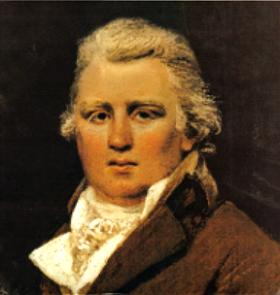
A Blupete Biography Page


William Cobbett (1763-1835):
The Poor Man's Friend.1


"I defy the Attorney General,
and even the Devil himself,
to produce from my writings
any one essay, which is not
written in the spirit of peace."
  • Introduction:-
  • Cobbett's Early Life:-
  • The Army:-
  • First Flight To America, 1792-1800:-
  • Cobbett's Return To England, 1800:-
  • Imprisoned, 1810-12:-
  • Second Flight To America, 1817-19:-
  • Cobbett's Return & New Charges, 1819-35:-
  • Conclusions.
  • Dates & Events During Cobbett's Life:-
  • Cobbettian Quotes & Views:-
  • Notes.
  • [TOC]
    Introduction:-

    William Cobbett disliked Methodists and middlemen; he thought that the eating of potatoes was unhealthy, and, that the people of London were parasitic, living at the expense of the impoverished country people. Strange were some of Cobbett's thoughts; but his principle purpose in life, the "digging and rooting up of all corruptions," especially in public affairs, laid the ground work for the political reform that unfolded in England during the 19th century. The paper he started in 1802, and which he published with little interruption throughout the balance of his life, the Weekly Political Register, was widely read during its time by people of all stripes. As for government: it was, for Cobbett, but an agent of the "loyal club-mongers" who communicate their schemes to it. These loyal club-mongers then lived like fighting-cocks upon the labour of the rest of the community. That, fundamentally, government was a tyranny which saw to the "enriching and pampering of those who render no public service." A tyranny, which has "no enemy so formidable as the pen." Cobbett, at one point, for his troubles, got two years in Newgate (1810-12): he was not much deterred, he wrote on.2

    [TOC]
    Cobbett's Early Life:-
    Born at Farnham, 35 miles southeast of London, halfway between London and Portsmouth; "bred," as Cobbett wrote, "at the plough-tail."3 William came from no fancy line of people; his grandfather was a laborer and worked for the same farmer all his life as "a road wagoner"; his father ran a public house in Farnham, the "Jolly Farmer," a place in which William and his three brothers were born. William received little in formal schooling, learning, as he accounts, from his father how to read and write. When but sixteen years of age, William was sent along to work for a Rev. James Barclay who resided in the nearby community of Guildford. Rev. Barclay had a reasonably well stocked library and William was thus introduced to what we might suppose to be good reading material, and, not only was William encouraged to read but also to write; his first project written when he was but a teenager was pretty ambitious, "he made a small manuscript book containing a history in epitome of all the kings and queens of England."4 In 1783, our young adventurer struck out for London and there he found employment in a barrister's office: "Holland ... did me the honour to take me into his service, and the next day saw me perched on a great high stool, in an obscure chamber in Gray's Inn, endeavouring to decypher the crabbed drafts of my employer." This work did not much appeal to Cobbett and he took his leave of Mr. Holland within the year.5

    [TOC]
    The Army:-

    Next, Cobbett joined the army. It was thought that such an adventure would be preferable to drudging for long days in an ill lit barrister's office. After receiving the King's shilling, Cobbett was sent to Chatham to learn how to become a soldier. At Chatham, Cobbett was spotted as a man who could write with a fair hand; an officer, Colonel (later General) Hugh Debbieg took him on as a secretary. Debbieg became Cobbett's mentor and while encouraging Cobbett in his writing abilities suggested that he had a long way to go. Cobbett, presumably at Debbieg's suggestion, went out and bought a grammar book.6 This grammar book was not to be treated as only a reference work: Cobbett made a study of the book; he was to write it out word by word on more than one occasion and while on lonely sentry duty bawled memorized parts of it out into the night air. Such an approach to the matter, of course, was to improve Cobbett's ability to deal with the English language, and, incidently, was to impress his superiors. Cobbett in short order was promoted to corporal. In March of 1785, he was sent off to join his regiment, the 54th, which was just then stationed at Halifax, Nova Scotia.7

    George Spater, one of Cobbett's biographers, writes:

    "Cobbett learned the full value of his knowledge of grammar after he joined his regiment. He was first made clerk of the regiment, then the whole business of the regiment fell into his hands. At the end of about a year, 'neither adjutant, paymaster, or quarter-master could move an inch without my assistance.' He drew up the returns, reports, and other official papers."8
    It was during this time while soldiering in Canada that Cobbett taught himself French; and, further, he "found time for skaiting, fishing, shooting, and all the other sports of the country." It was during this time, too, that Cobbett met his future wife, Anne or Nancy Reid. She was the daughter of a fellow soldier; and when he first met her she was but thirteen years old, he twenty-four. I am sure not too much transpired between the couple, but plainly Cobbett had his eye on her and was sorry to see her family go back to England, he to continue on in lonely duty at Fort Howe.

    We saw where, because of his abilities, that "the whole business of the regiment fell into his hands"; this was to turn into a serious problem for our hero; he came to see that the officers of the regiment were dishonest in that a portion of the army provisions were being siphoned off for the benefit of those in control. Most of the soldiers were content to let the matter slide, as, most, it seems, were to one degree or another, to take benefit from this well established system of corruption: Cobbett resolved to blow the whistle. He went about collecting evidence and when he returned to England brought it with him. Cobbett returned to England with his regiment in 1791; Cobbett, himself, was to receive his discharge shortly after his return.

    One of the first things that Cobbett was to do on his return to England was to look up Miss Reid. The couple, Nancy and Billy, were married at Woolwich on February 5th, 1792. It was also, at the first of this year, that Cobbett was to set in motion a train of events, the culmination of which was to badly backfire on Cobbett and haunt him for a number of years thereafter. Turning over his evidence to the authorities, he prepared a petition addressed to the Secretary of War accusing four officers of his old regiment of various acts of misconduct. A court-martial was summoned and a hearing was to take place in March of that year; however, no one showed up to prosecute the case and the charges were dismissed and the defendants acquitted. Just before the court convened, Cobbett and his new wife fled to France ("the six happiest months of my life"). It seems, that in getting the case ready, Cobbett formed the opinion that the evidence had been tampered with; further, it would appear that some of Cobbett's friends were going to be implicated. He advised the officers who were to prosecute the case that he would not give evidence unless certain guarantees could be given to keep his friends clear of all the trouble: no such guarantees were given: and thus the reason that Cobbett fled the country.

    [TOC]
    First Flight To America & The Start of Cobbett's Writing Career:-

    It would seem that Cobbett would have been quite content to spend time in France until things cooled down for him in England, but the French Revolution got in the way. He and Nancy found passage at Le Havre, mid-August, 1792, on a sloop bound for America, the Mary. The couple settled down at Wilmington, Delaware. Cobbett determined to make a living best he could by turning his hand to a number of things, including the practicing of his skills which he had honed up in the army: teaching and writing. He taught English to the newly arrived French and wrote a book on English grammar intended for these new immigrants. So too, he took up gardening and hunting; and, as his biographer, George Spater explains, "borrowing money against future prospects."9

    At this time, in the new country of the United States -- one formed by revolution but fifteen years before Cobbett's arrival -- there were people sympathetic to those, in France, who were crushing the old regime and bringing about revolutionary changes. The French, was it not so, had helped the new country in its time of need; now it was time, a great number of Americans felt, to give support to the French republicans, no matter that it, the French Revolution, caused death, property loss and great misery. The sympathetic Americans either did not know of the extreme violence caused by the French Revolution; or, were simply possessed of the philosophy that an omelette cannot be made without breaking eggs. William Cobbett was all for reform -- he was throughout all of his life -- but he was, as was his fellow countryman, Edmund Burke, against the way the French were going about it.10 Cobbett then started in on what was to become his life's work as a political commentator. His first written piece was against the supporters of the French Revolution or more particularly the hardheadedness of those in America that supported the movement. This first piece of published work came out in pamphlet form. Cobbett's pamphlet was published in August of 1794. A great many Americans bought his little work. Five editions of it came out in Philadelphia; an edition came out in New York; and, indeed, an edition came out in England. With this work, Cobbett's writing became a sellable commodity.

    With the success of his first bit of published writing, Cobbett was encouraged to get busy and to write others. He wrote under the pen name, "Peter Porcupine." In his writings he advocated moderation and emphasized the importance of a good relationship between Great Britain and the United States; it was a position, that, throughout Cobbett's stay in the United States, was one that supported George Washington's administration. (I should say, incidently, that while there were no organized parties in the early constitutional life of the United States, there were competing views on how the country should be run. Washington's opposite was Thomas Jefferson, the pro-French democrat, who, when running for the presidency, Cobbett was to describe as "a man as much fit to be president as I am to be an Archbishop! A man who is a deist by profession, a philosopher by trade, and a Frenchman in politics and morality.") With Washington's retirement and the election of John Adams in 1797, Cobbett removed his sights and went off Sten-gunning everybody, including the new president. I turn to George Spater:

    "Peter Porcupine no longer limited his scope to top-level governmental decisions, but became the arbiter of both public and private virtue. As such, he periodically pointed out American shortcomings, including the 'great depravity and corruption' of their morals, the low level of their literacy, and poor quality of their officials. He ridiculed the Pennsylvania legislature's description of a new highway as an 'artificial road,' declaring that more sensible people would have called it a 'turnpike.' He criticized the composition of the Philadelphia board of health on the ground that the doctors composed nearly half of its members ... These gratuitous observations on his neighbors were used as amusing fillers to flesh out Cobbett's daily criticism of the president, his cabinet, and various members of congress."11
    Cobbett's approach made him many more enemies than friends. His readership fell off. To complicate matters, Cobbett was sued in defamation. The Pennsylvanian judge who heard the case, at an earlier point in time, had been made the butt of one of Cobbett's commentaries. It will not be surprising, therefore, to hear that Cobbett lost the case and a large award was made against him. After the case Cobbett fled to New York, where, in short order, he determined to leave America altogether. Thus, it was, that in 1800, sailing on the Lady Arabella, Cobbett with his small family left America.12

    [TOC]
    Cobbett's Return To England, 1800:-

    The Cobbett family arrived at London on July 15th, 1800. They first took up accommodations in London; but Cobbett favoured the countryside13, so that, in July of 1805, he moved his family14 to Botley, Hampshire, a place about five miles east of Southampton. Here, at Botley, Cobbett was to pursue one of his principal passions in life, viz. his insatiable love of growing things. Cobbett, of course, did not take up the life of a farmer to the exclusion of his passion for writing. He kept his pen busy and sent his articles with instructions up to London.

    Before his move to Botley, Cobbett had solidified his connections with the printers and booksellers of London, a number of which he had first established during his time in America. As we have seen, Cobbett first published in America and these works found their way to Britain where he was to develop a steady increase in readership. Immediately with his return to London, in 1800, Cobbett set out to set up his own paper. His first attempts were not successful; then there came Cobbett's Weekly Political Register. The first issue went to the streets in January, 1802, thereafter, until 1835, the year of Cobbett's death, every Saturday in London, one could put two pennies down15 and get his fix of the Political Register. Lord Lytton, a writer of the 19th century, was to observe:

    "Whatever a man's talents, whatever a man's opinions, he sought the Register on the day of its appearance with eagerness, and read it with amusement, partly, perhaps, if De la Rochefoucauld is right, because, whatever his party, he was sure to see his friends abused. But partly also because he was certain to find, amidst a great many lies and abundance of impudence, some felicitous nickname, some excellent piece of practical-looking argument, some capital expressions, and very often some marvelously-fine writing, all the finer for being carelessly fine, and exhibiting whatever figure or sentiment it set forth in the simplest as well as the most striking dress."16
    Cobbett's writing was, in the main, political; he made it his business to criticize government. Though he had a great deal of difficulty with the way things were run in England, Cobbett was satisfied that the structure of government in England, was, "near perfect." For Cobbett, it was the person or persons that were running things that were at fault; then he came around to thinking that the structure, as sound as he thought it was, was bound to become infected or defiled by that which causes it to run: profit-seeking electees running after profit-seeking electors, or to put it more plainly -- the political system was overrun, overwhelmed with graft. This was not Cobbett's imagination working overtime: the political system, certainly up to 1832, was, indeed, corrupt: all, it seems was bribery, blackmail, and the general abuse of power. "By 1806," as his biographer George Spater was to observe, "Cobbett had definitely made a break with the past. From thenceforth his principal work has to promote those changes in the laws which he thought necessary to create a decent government devoted to the interests of the people."17

    Cobbett's goal, in his political commentary, was to change the common man's lot by seeing to improvements in how he was collectively governed; but Cobbett was just as keen, again through his writing, to change the common man's lot by inspiring the individual to better himself. Cobbett was a voluminous writer. Much of it, of course, appeared in his own newspaper, the Political Register. In addition, he published a great number of books, as Spater was to write: "all for the purpose of instruction, and nearly all the instruction related to four subjects: language, gardening or farming, personal behavior, and government affairs, with a goodly amount of overlap among categories."18 Rural Rides -- a work which I read a number of years back and which, given my interest in rural England, I much enjoyed -- was the work for which Cobbett is best remembered and a must read "for those who want to come to the true history of England, an unequaled picture of the early nineteenth century, written by a man well qualified to observe and to comment."19

    Trevelyan thought that Cobbett possessed a "rare literary power."20 Hazlitt thought Cobbett to be a most powerful writer. "He is not only unquestionably the most powerful political writer of the present day, but one of the best writers in the language. He speaks and thinks plain, broad, downright English. He might be said to have the clearness of Swift, the naturalness of Defoe ..."21 Cobbett has been likened to Thomas Paine, the writer of Common Sense (1776), a work which fed the American revolutionaries. But Cobbett was no Paine:

    "Cobbett with vast industry, vast information and the utmost power of making what he says intelligible, never seems to get at the beginning or come to the end of any question: Paine in a few short sentences seems by his peremptory manner 'to clear it from all controversy, past, present, and to come. ... Cobbett is a pleasanter writer for those to read who do not agree with him; for he is less dogmatical, goes more into the common grounds of fact and argument to which all appeal, is more desultory and various, and appears less to be driving at a previous conclusion that urged on by the force of present conviction. He is therefore tolerated by all parties, though he has made himself by turns obnoxious to all; and even those he abuses read him. ...
    If he is less metaphysical and poetical than his celebrated prototype [Paine], he is more picturesque and dramatic. His episodes, which are numerous as they are pertinent, are striking, interesting, full of life and naïveté, minute, double measure running over, but never tedious--nunquam sufflaminandus erat. He is one of those writers who can never tire us, not even of himself; and the reason is, he is always 'full of matter.' He never runs to lees, never gives us the vapid leavings of himself, is never 'weary, stale, and unprofitable,' but always setting out afresh on his journey, clearing away some old nuisance, and turning up new mould. His egotism is delightful, for there is no affectation in it. ...
    As a political partisan, no one can stand against him ... he knocks out their brains ... [with] his powerful and repeated attacks. But with the same weapon swung round like a flail, with which he levels his antagonists, he lays his friends low. ... If his blows were straightforward and steadily directed to the same object, no unpopular minister could live before him ...
    In short, wherever power is, there is he against it: he naturally butts at all obstacles, as unicorns are attracted to oak-trees, and feels his own strength only by resistance to the opinions and wishes of the rest of the world. To sail with the stream, to agree with the company, is not his humour. ...
    When he is in England, he does nothing but abuse the Borough-mongers, and laugh at the whole system: when he is in America, he grows impatient of freedom and a republic. If he had stayed there a little longer, he would have become a loyal and a loving subject of his Majesty King George IV. He lampooned the French Revolution when it was hailed as the dawn of liberty by millions; by the time it was brought into almost universal ill-odour by some means or other (partly no doubt by himself) he had turned, with one or two or three others, staunch Bonapartist. ... He changes his opinions as he does his friends, and much on the same account. He has no comfort in fixed principles: as soon as any thing is settled in his own mind, he quarrels with it. He has no satisfaction but in the chase after truth, runs a question down, worries and kills it, then quits it like vermin ..."22
    [TOC]
    Imprisoned, 1810-12:-

    In 1809, there was to appear, in the Political Register, an article by Cobbett which was to get him into great trouble. Cobbett knew something of the army and the abuses within. In the officer corps, things got done because of favours that were extended back and forth: for the common soldier things got done, all to often, through the use of the whip. It seems that at Ely there was an incident where a certain German cavalry unit (the British were never adverse to hiring German mercenaries) were called in to put down a perceived mutiny; the local militiamen at Ely had demanded their back pay. The ringleaders, according to one report in the paper23 "were tried by a Court Martial, and sentenced to receive five hundred lashes each ..." Cobbett flew into the administration, opening his article with the observation that finally the administration had found a "useful employment" for German troops, viz. "the means of compelling Englishmen to submit to that sort of discipline which is so conducive to producing in them the disposition to defend the country, at the risk of their lives." A charge of criminal or seditious libel followed; and, after a period of time, a trial was brought on in the Court of King's bench with Chief Justice Ellenborough and one of government's special juries24. Cobbett made the mistake of trying to defend himself without legal counsel. For Cobbett the result was that he was imprisoned in Newgate for two years and given a £1,000 fine, and at the end of two years he would be released if he bound himself over on a £3,000 bond with two sureties in the amount £1,000, each, so, "to keep the peace" for seven years -- and thus the authorities effectively gagged Cobbett. He had been to them, a festering thorn in their sides. George Spater:

    "Not Perceval [the Prime Minister] alone, but the government at all levels had scores to settle with Cobbett. He had condemned the celebration of the king's jubilee on October 25, 1809, a day set aside to commemorate the fiftieth year of the reign of George III. What reason was there to rejoice? asked Cobbett. During that period the national debt had been increased from £90 million to £700 million; the number of paupers had increased from 200,000 to 1,200,000; America had been lost following the capture of a whole British army at Saratoga and another at Yorktown. At the moment of celebration thousands of British soldiers were sick and dying at Walcheren; thousands more wounded had been left behind a retreating British army in Spain; and the French, who dominated the European continent, threatened to invade the country. The junior members of the royal family had also come under attack by Cobbett: He opposed increases in their handsome allowances and inveighed against the public display of their mistresses. He thought the royal family should pay taxes like everyone else. The influential leaders of the opposition, as well as the members of the cabinet, were constantly under Cobbett's flail. And the letter addressed 'To the Right Honourable Lord Ellenborough' published by the Political Register in September 1808, how he should interpret the law of libel."25
    So off went Cobbett to prison.26 At the time he had dependant on him a pregnant wife and six children from three to fifteen years old. He had no liquid assets. He had but his farm at Botley (since his return from America, over the succeeding nine year period, Cobbett had collected up tracts of land at Botley amounting to about 600 acres) and his publishing business in London.

    While in prison, Cobbett continued to write and his articles got published. They were usually ended with, "State Prison, Newgate." On June 18th, 1812, Cobbett was released from Newgate. To celebrate his reentry into society, a grand dinner was given at the Crown and Anchor attended by 600 admirers with Sir Francis Burnett27 in the chair. The next day, Cobbett, in "a carriage full of gentlemen" left London for Cobbett's home at Botley. The family, I should say, noticed that there was to be a marked changed in Cobbett after his release from prison: he was more severe and less good humoured.

    [TOC]
    Second Flight To America, 1817-19:-

    On December 16th, 1816, there unfolded an event known to history as the Spa Fields Riot. Certain agitators for reform had called a meeting to take place in Spa Fields located in the north of London. Six to eight thousand people had gathered to hear the stirring speeches. The meeting was peaceful enough but that evening a bunch of rowdies broke into "some bakers' and butchers' shops." This event was by itself not enough to get the authorities too nervous but it came in the wake of "two years of sporadic riots and violence, at a time when the excesses of the French Revolution were hardly ancient history." The nervous legislators established "secret committees" and to these committees there reported a small army of spies and spies-turned-provocateurs whose job was to track down Luddites and attend meetings of the suspected reform clubs. On February 18, this secret meeting of the House of Lords, based on reports that it had received, found that the Spa Fields meetings were part of a traitorous conspiracy formed for "the purpose of overthrowing, by means of a general insurrection, the established government ... and of effecting a general plunder and division of property." There then came about the suspension of the Habeas Corpus Act and a determination by the authorities to round up the "chief incendiary writers" so that they might be put in "safe custody." Cobbett was to find out he was on the government's list, so, he once again, this time with two of his sons, fled to America. He arrived there on May 5th 1817.

    While choosing to live in America28, Cobbett still kept up his connections in England and promised his readership that he would, after a short interval, keep the Political Register going by sending his written pieces from America. Cobbett, who was always on the edge of financial disaster, with his move to America, was to lose most everything that he owned in England. The family he left behind found quarters in London, as they were put out of possession of their home at Botley; the farm, stock and equipment were seized together with the furniture and other effects including Cobbett's books: all of it to be sold to satisfy Cobbett's many creditors.29

    Cobbett situated himself on Long Island there to live the simple life: "rising before the sun, eating mainly the vegetables he grew, drinking nothing but water and milk."30 Nancy and the five younger children followed Cobbett out, arriving around the end of the year. However, by the following summer, 1818, Mrs Cobbett and most of the children returned to England; Cobbett, himself, was to return a year after that, in 1819. On his return to England, Cobbett was to have as part of his luggage a bag of bones; he had disinterred Thomas Paine who had been laid in American ground ten years earlier.31

    During his stay in America, Cobbett was to write two books: Journal of a Year's Residence in the United States of America and Cobbett's English Grammar. His Grammar was much more then a little book of grammar: "it contained some excellent advice on both substance and style, warning the reader against writing about any matter which he does not well understand and against the use of figures of speech, superlatives, and the type of affection which from the beginning of the written word has characterized official communications."

    [TOC]
    Cobbett's Return & New Charges, 1819-35:-

    Cobbett's return to England may simply be put down to the fact that that was the place where he could be with his family. The reason for his flight to America no longer existed as the Habeas Corpus Act, an act which has been in place since 1679 and by which the liberty of every Englishman was made as certain as law could make it, was back in place; so, Cobbett had nothing to fear if he kept his nose clean.32 However, while Cobbett had less to worry about, viz. that he shouldn't be pulled out of bed some night on account of a government roundup, how to make a living was more of a problem then ever. Again, I turn to George Spater:

    "Cobbett's ability to make money out of the Political Register was abruptly curtailed by the new laws Lord Liverpool's government rushed through parliament. One of these -- directly aimed at Cobbett and his imitators -- put an end to cheap unstamped pamphlets commenting on affairs of the day. ... Thus the price of the Political Register to the reader would be tripled, rising from twopence to sixpence."33
    It was at this time that Cobbett tried to supplement things by bringing out another paper, the Cobbett's Evening Post, a daily which first came out on January 29th, 1820; it lasted but fifty-five issues. It was too, at about this time, that Cobbett, with the help and encouragement of his friends, ran for parliament; he ran in Coventry. The election was held in March of 1820. At the end of it, not having been able to overcome the government competition, Cobbett lost, as he put it: "At Coventry, my opponents took 'loyalty and religion' to themselves, and allotted to me 'sedition and blasphemy.'" After the election, Cobbett was forced into bankruptcy and during the process he was reduced to meager circumstances. After his discharge, however, it seems that things went better for Cobbett. There was a greater demand then ever for news commentary, as, there was much news. In 1820, George III died and his son George IV took the throne. In June, the estranged wife of the king, Caroline returned to England demanding her right to sit along side George IV as his Queen. The new king would not agree, and thus, the Caroline Crisis ensued; it "swallowed up every other topic from June to November." All of this spilled over into 1821 when the Queen was put on trial; and, during the coronation ceremony she was prevented from entering Westminster Abbey. These tasty domestic stories were to be supplemented by other international happenings such as the second expedition of Parry to the Polar regions, and, the insurrections in Greece. People who could write these stories up, and in a manner such as Cobbett did, were bound to make a living.

    Cobbett was not content to let the stories come to him, he went out like a good reporter and dug them up, especially the story that he returned to time and time again in the course of his writings: the plight of the rural Englishman. He began riding around the country on horseback making observations of what was happening in the towns and villages. Rural Rides, a work which Cobbett is best known for today, first appeared in serial form in the Political Register running from 1822 to 1826; it was published in book form in 1830.

    It was in 1830 that Cobbett once again ran afoul the law. In his Political Register, on December 11th, 1830, Cobbett published his article, "Rural War." Cobbett effectively supported those in the country who at this time were smashing farm machinery and burning stacks (ricks or rucks) of hay in the fields. Cobbett asserted that "one thrashing machine takes wages from ten men; and they [the tenant farmers] also know that they should have none of this food; and that salt and potatoes do not burn." On February 17th, 1831, Cobbett was indicted for seditious libel.34 The process that Cobbett was then put through was all too familiar to him; but this time he won. The main reason being, is that the court was headed up by a very different judge. Lord Tenderten who heard the 1831 case was quite a different person than Chief Justice Ellenborough who heard the case back in 1809. Ellenborough, as Spater observed, was the son of a Bishop and Tenderten the son of a hairdresser: Ellenborough was overbearing, Tenderten was mild-mannered. This court business came late in Cobbett's career and given his sad experience in 1809 and the resultant two years in prison, Cobbett had to be quite anxious about the process. The acquittal was to be one of the highlights of Cobbett's life.

    Seemingly to top off his victory in the court room, Cobbett, within a couple of years of that was to finally35 win a seat (Oldham) in parliament, a place which was to come under Cobbett's direct eye, a place of "insensible roarings and scoffings" where there is created "the noise of a parcel of dogs howling at the moon."36 Cobbett, by the time he took his seat in parliament, had lost his bloom and was in the twilight of his years. The great Macaulay, who had sat in parliament with Cobbett in 1833 was to observe that Cobbett's "faculties were impaired by age" and that "his egotism and his suspicion that everybody was in a plot against him increased and at last attained such a height that he was really" quite mad.

    The nocturnal schedule and endless routine of parliament ill-suited Cobbett and it was to take its toll. In June of 1835 he complained of felling ill; influenza it is said. He was soon put to bed and it was very much downhill thereafter. It seems he was alone with his servants but the word went out and each of his family came to see him, being separately ushered into the room. It seems that he had instructed the servants that he was only too happy to have a visit from them but none were to stay over night under his roof. At the last of it, Nancy, Cobbett's long suffering wife, did stay over and sat by the bedside bathing the temples of her unconscious Billy.

    He had written his last article for the Political Register on 13th June 1835; five days after that William Cobbett was dead.37

    [TOC]
    Conclusions.

    As Cobbett put it, "I have pleaded the cause of the working people." But he was never a clever or careful pleader. In both public and in private matters, Cobbett "was headstrong, often impetuously plunging ahead on an implied impulse without much deliberation, and nearly unstoppable once under way."38

    His son was to write well after Cobbett's death:

    "He had great influence over every body about him; & inspired inferiors with awe ... he inspired confidence in circumstances of difficulty, & had a way of speaking of undertakings that made others fancy him capable of every thing he resolved to on. -- Equally attached (or won) by affection, and subdued by fear. -- His manner, when about to set to at any active pursuit, was full of resolution: stamping his feet as he got up, and calling out "Now, then!"39
    George Spater in his introduction:
    "[Cobbett] consistently stood in opposition to the establishment. He was for wider suffrage and the ballot; for the selection of civil servants on the basis of merit rather than rank or family; for the correction of such church abuses as nonresidency and plural livings; for the elimination of sinecures and the public workhouse; for the abolition of the Bank of England as a privately owned establishment profiting from its dealings with the government; for stricter child labour laws; for the termination of the unfair game laws; for the cessation of flogging in the army; for the freedom of Ireland from Protestant domination. ... [it is necessary to disregard] the calumnious charges of his enemies which have been thoughtlessly repeated so many times as almost to become gospel. This is not to claim he was a saint, Far from it. He was often wrong; he was a supreme egotist; he was harder on both his friends and his enemies than he should have been ... his attainment frequently fell short of his goals. Yet there were elements of greatness in the man."40
    Spater, in his conclusion of his two volume work, recapped the life of Cobbett:
    "[Cobbett] quickly proved his superiority as a soldier, rising from private to sergeant major in three years and establishing himself, in the process, as a dominant force in the regiment, even among the officers. He just as rapidly proved superiority as a writer, first in America and then in England. But he was not content to be a superior soldier, or a superior writer; he insisted on his superiority as a husband, as a father, as an employer, as a farmer, as an economist, as a teacher, as a ... whatever role he was playing at the moment. The introduction of a better fireplace or domestic straw plait, or a demonstration of how the laws should be enforced against wrongdoers, were means of proving his superiority in the same way as were the introduction of a better tree or a better apple or a better method of cultivating turnips, or a sounder system of currency. ..."
    His effort to expose the corruption that existed in the army forced him to flee from England in 1792. His attacks on Rush's [Benjamin Rush, the American physician and politician] false cure for the yellow fever stripped him of his earnings and drove him back to England in 1800. His condemnation of flogging put him in prison from 1817 to 1819. Not only were good deeds met with punishment, but the punishment was accompanied by vilification from the press and from the establishment to which the press pandered. The vilification did not stop with known facts; outright falsehoods were circulated."41
    Throughout his life, Cobbett had fixed notions of what was right and what was wrong. This fixation, as we have seen, got him into difficulty with society at large. If he could not bring people around to thinking his way, then, especially in later life, and especially subsequent to his imprisonment, not thinking for a moment that he should make any compromise, he would become bitter and unforgiving. As hard as this was on him in his public activities, it might well be concluded, it was harder on him in his personal relationships. Between his duties in the House of Commons and the making of his constant rounds he was not to see much of his family, this estrangement was to become more complete in the last years of Cobbett's life. His biographer was to write:
    "... his great egotism, his suspicious nature, his readiness to see conspiracies against him, his extreme aggressiveness, his desire for revenge, his lack of emotional attachment to others, and his strong sense of unrivalled power and superiority ... these characteristics, observable in some degree from Cobbett's youth, grew steadily with the years, and reached a new level in 1833, when -- as we have seen -- he began to find conspiracies against him among member of his own family."42
    In the final analysis, Englishmen and those throughout the world who inherited their unique form of government, own much to William Cobbett. Cobbett, always the farmer, in his digging and rooting up of the political corruption of his day, especially in public affairs, laid the ground work for the political reform that unfolded in England during the 19th century, reform which only first started to take hold as Cobbett's life ended. The Great Reform Bill of 1832 saw to the elimination of the small boroughs, but much was to be done after that, and much, for that matter needs yet to be done. William Cobbett showed the way; he showed how political agitation and the spread of discussion, would ultimately drive parliament to reckon with the sentiments of the people at large.

    _______________________________

    Found this material Helpful?

    _______________________________
    [TOC]
    Dates & Events During Cobbett's Life:-

    1763:
    §Cobbett is born.
    §End of The Seven Years War and the signing of The Treaty Of Paris.
    1765:
    §The Stamp Act is passed by the British parliament.
    1767:
    §Voltaire dies.
    1769:
    §At around this time, Blackstone brings out his Commentaries on the Law of England.
    1770:
    §The members of the "Long Parliament" take their seats, it sat for 15 years, until 1785.
    1775:
    §Burke brings out, On Conciliation with the American Colonies.
    1776:
    §July 2nd, 1776, the Continental Congress carries a motion for the independence of the 13 states on the East coast of America. Two days later the Declaration of Independence is adopted.
    §Edward Gibbon gives forth with his first volume of The Decline and Fall of the Roman Empire.
    §Adam Smith's The Wealth of Nations is published.
    §Bentham brings out his, A Fragment on Government.
    1779:
    §Young Cobbett takes up a two year residency with Rev. James Barclay of Guildford where he learns the value of a good library.
    1781:
    §British troops under Cornwallis surrender at Yorktown.
    1783:
    §December 13th, penal laws against Roman Catholics repealed.
    §British evacuate New York.
    §Cobbett is now in London transcribing for a barrister of Gray's Inn: he did not last a year in this employment.
    1784:
    §Cobbett joins the army just as the American war ended and spends a year at Chatham.
    1785:
    §March: Cobbett is sent to Nova Scotia to join his regiment, the 54th.
    §The Big Bang of the Industrial Revolution occurs in England, when, for the first time, steam engines are used to power spinning machinery.
    1789:
    §Bentham brings out his, Introduction to the Principles of Morals and Legislation.
    1790:
    §Burke writes Reflections on the French Revolution.
    1791:
    §September: Cobbett returns to England.
    1792:
    §February 5th: William Cobbett marries Nancy Reid.
    §Cobbett flees England for France.
    §Paine's reply, The Rights of Man.
    §September massacres in Paris.
    §Cobbett flees France for America.
    1793:
    §In January Louis XVI is beheaded.
    §Godwin's Political Justice appears.
    §The trials of the "Reform-martyrs," Muir and Palmer who were subsequently transported to Botany Bay; this was part of the larger government effort to prosecute editors, nonconformists and radicals who were arguing for Parliamentary reform.
    §August: In America, Cobbett publishes Observations on the Emigration of Dr. Joseph Priestley and becomes an instant success as a political writer, indeed his popularity spreads back to Great Britain.
    1797:
    §In January, with Bonaparte having successfully invaded Italy, and Spain coming in on the side of France, Britain withdrew her ships from the Mediterranean, which was to become a "French Lake" from January 1797 to May 1798.
    §Cobbett is now a great success as a political commentator in America; his Porcupine's Gazette was the most widely read paper in the country.
    1798:
    §Malthus brings out his Essay on the "Principle of Population."
    §Coleridge and Wordsworth bring out Lyrical Ballads.
    §Nelson re-enters the Mediterranean in May, 1798, and destroys Napoleon's fleet.
    1800:
    §June: Cobbett and his family leave America to return to England.
    1802:
    §The Treaty of Amiens is signed and the war between France and England is ended leaving France supreme in Western Europe and England supreme on the oceans of the world.
    §Cobbett begins his Weekly Political Register.
    1803:
    §Malthus brings out the second edition of his Essay on the "Principle of Population."
    §Cobbett begins unofficial publication of Parliamentary reports (taken over by Hansard in 1811).
    1804:
    §War between Britain and Bonaparte-dominated Spain breaks out on December 12th, 1804.
    §Napoleon becomes emperor of France.
    1805:
    §In 1805, Trevithick adapts the Watt engine to a vehicle, and the locomotive comes into being. By the middle of the century a network of railways had spread all over Europe.
    §Nelson's victory at Trafalgar.
    1806:
    §In 1806 England abolishes the slave-trade (in 1833 slavery itself).
    1807:
    §Fulton's first steam boat.
    1808:
    §In support of a Spanish rising, in July, Arthur Wellesley (later to become known as the Duke of Wellington) leads the first small British force of 9000 men into the Peninsula of Spain; a gate into the hostile fortress of Napoleonic Europe.
    1809:
    §Cobbett publishes an article critical of the whipping of soldiers at Ely; he is prosecuted for seditious libel and gets two years in Newgate.
    1811:
    §Austen's Sense and Sensibility.
    1812:
    §June 18th: President Madison and the American Congress declares war on Britain.
    §July 19th: Cobbett's two year term in Newgate ends.
    1813:
    §It was during the winter that the news came of Napoleon's retreat from Moscow and his struggle to retain hold of central Europe.
    §In England, 13 "Luddites" are hung at the York Assizes.
    1815:
    §June 18th, 1815, the Battle of Waterloo.
    1816:
    §December 16th, 1816: Spa Fields Riot.
    1817:
    §Ricardo's, Principles of Political Economy & Taxation.
    §Habeas Corpus is suspended as the war against the Radical Press in England heats up.
    §Cobbett flees to America with his two sons, arriving there on May 5th, 1817.
    1819:
    §August 16th: Peterloo: it was "an orderly and unarmed crowed of about 60,000 men, women and children" assembled in support of universal suffrage, in St. Peter's Fields, Manchester. They were there to hear the speaker, Radical Hunt. The magistrates, in a move to arrest the speaker, order the cavalry in: "eleven persons, including two women, were killed or died of their injuries; over a hundred were wounded by sabres and several hundred more injured by horse-hoofs or crushed in the stampede."
    §A Factory Bill prohibiting children under the age of nine to work in cotton mills is passed in 1819; this is the first of a series of parliamentary bills which were to be passed over the next forty years in a process of law reform which was first prompted by the writings of Jeremy Bentham.
    §November: Cobbett returns to England from America.
    1821:
    §Cobbett's Rural Rides begin to appear in his Political Register (to 1830).
    §Faraday discovers electromagnetic induction.
    1825:
    §The first railway opens in the northern part of England, between Stockton and Darlinton; Stephenson's "Rocket," with a thirteen ton train, gets up a speed of 44 miles per hour.
    1827:
    §On 27th March, 1827, Darwin gives a short talk to the Plinian Society, and communicates two discoveries which he has made: First, "that the ova of the Flustra posses organs of motion; and the second, that the small black globular body hitherto mistaken for the young Fucus Lorius [a seaweed], is in reality the ovum of the pontobdella muricata [a leech that infests skates]. At the request of the society he promised to draw up an account of the facts and to lay it, together with specimens, before the Society next evening."
    1831:
    §Cobbett tried for seditious libel: he is acquitted.
    1832:
    §Darwin sails on the Beagle.
    §The Great Reform Bill.
    §Cobbett is elected to a parliamentary seat (Oldham).
    1835:
    §Cobbett dies.

    _______________________________

    Found this material Helpful?

    _______________________________
    [TOC]
    Cobbettian Quotes & Views:-

    Agriculture:-
    §"Cranberries, the finest fruit for tarts that ever grew, are bought for about a dollar a bushel, and they will keep for five months." (Resid. U.S.)
    Class:-
    §"The foul, the stinking, the carrion baseness, of the fellows that call themselves country gentlemen." (Rur. Rides.)
    Credit:-
    §"The man therefore who purchases on trust [credit] not only pays for the trust, but he also pays his due share of what the tradesman loses by trust." (Adv. Yng. Man.)
    Education:-
    §Cobbett's view, back then, was that children would be better off learning from their parents. The main thing that children learn when cooped up in a school is laziness. He was also against a general tax on all to support those who were headed in any profession that required book learning. Why, I suppose, should the poor be made to pay so the children of the rich might be educated. Cobbett was of the general view that what the poor family needed was more bread, bacon and beer. (See Spater, vol.2, pp.540-1.)
    Government:-
    §"Faction and favouritism are the high roads to power." (Pol. Reg. XIV.)
    §"The out party proposed to pass a law [etc.]. The in party said that such a law was unnecessary." (Pol. Reg. XXXII.)
    §"Public property is never so well taken care of as private property; and this, too, on the maxim, that that which is every body's business is nobody's business." (Advice to Young Men.)
    Health:-
    §"[Health will be secured] by early-rising, exercise, sobriety, and abstemiousness as to food." (See Spater, vol.1, p.94.) Cobbett, it should be noted, "never used sugar, coffee, or rum because they were the produce of slavery." (See Spater, vol.1, p.205.)
    Laws:-
    §"What of Excise Laws and Custom Laws and Combination Laws and Libel Laws, a human being scarcely knows what he dares do or say." (Cott. Econ.)
    Love:-
    §"Love is a great leveller; a perfect Radical." (Weekly Reg. 30 Mar. 779.)
    Moneyless:-
    §"Every insolvent blames a solvent, that will not lend him money." (Rur. Rides.)
    Money, Paper:-
    §A sizable portion of government expenditure was attributable to maintaining the debt that was particularly high coming out of the Napoleonic wars, circa 1815. That a third of the collected taxes was used to serve the national debt was a situation which Cobbett abhorred.
    §"Industrious and care-taking creatures reduced to beggary by bank-paper." (Rur. Rides.)
    §"The desolating and damnable system of paper-money." (Rur. Rides.)
    §"To put an end to the gains of the paper-money people." (Rur. Rides.)
    §"It is boundless joy to me, to contemplate this infernal system [of paper-money] in its hour of wreck: swag here; crack there: scroop this way: souse that way." (Rur. Rides.)
    Nova Scotia:-
    §"When in New Brunswick I saw the great wild grey cat, which is there called a Lucifee." (Rur. Rides.)
    §"A rascally heap of sand and rock, and swamp, called Prince Edward's Island." (Rur. Rides.)
    Reformers:-
    §"Reformers, not so well able to express as to think, would have had an answer to all questions relating to their views." (Pol. Reg. XXXIII.)
    Shakespeare:-
    §"It was fashion alone that cause people to applaud "under the name of Shakespeare, what they would hoot off the stage in a moment, if it came forth under any other name." (See Spater, vol.2, p.538.)
    Taxes:-
    §"The immense sums, thus pinched from the millions, and put into the hands of thousands." (Weekly Reg. 13 Apr. 69.)
    Universities:-
    §"Dens of Dunces." Cobbett claimed that such institutions were the mortal enemies of youth, destroyers of time and talent and detrimental to the independence of mind in political matters. (See Spater, vol.2, p.539.)
    Writing:-
    §"I defy the Attorney General, and even the Devil himself, to produce from my writings any one essay, which is not written in the spirit of peace." (Wks. XXXII.)
    _______________________________
    [TOC]
    NOTES:

    1 In addition to be known as, "The Poor Man's Friend"; William Cobbett was also popularly referred to as "John Bull, incarnate." See Hazlitt's essays in The Spirit of the Age and in Table Talk; P. P. Howe's New Writings by William Hazlitt, "Mr. Cobbett and the Quakers"; and see C. H. Herford's work, The Age of Wordsworth (London: Bell, 1916) at p.9 and Spater's work, William Cobbett: The Poor Man's Friend (Cambridge University Press, 1982) at vol.1, p.5. This last work, extensively referred to herein, I simply refer to as, "Spater."

    2 "Loyal club-mongers communicate their schemes to the government." (1817, Wks. XXXII. 72.) "[They] live like fighting-cocks upon the labour of the rest of the community." (1826, Rural Rides)] "The enriching and pampering of those who render no public service." (1812, As written in The Examiner, 19 Oct., 671/2.) "Tyranny has no enemy so formidable as the pen." (1820, Gram. Eng. Lang.)

    3 Cobbett left us with autobiographical material; see, in particular, Life and Adventures of Peter Porcupine (London: The Nonesuch Press, 1927) and The Progress of a Plough-Boy (London: Faber & Faber, 1933).

    4 Spater, vol.1, p.12.

    5 Hazlitt figured that Cobbett's experience in a Barrister's office was the reason that Cobbett generally saw "things through the medium of heat and passion, not with reference to any general principles..." A statement which is equally harsh on both Cobbett and lawyers, alike. (See Hazlitt's essay, "Mr. Cobbett."

    6 It was Robert Lowth's, A Short Introduction to English Grammar (1762), a classic.

    7 Cobbett was to write: "Nova Scotia had no other charm for me than that of novelty. Every thing I saw was new; bogs, rocks and stumps, musquitoes and bull frogs." (As quoted by Spater, vol.1, p.20.) Of the six years that Cobbett spent in Canada as a soldier he spent most of those years in an area which we now know as New Brunswick (for a while at Saint John then at Fredericton, Fort Howe).

    8 Spater, vol.1, p.21. Cobbett also turned teacher and gave lectures on such diverse subjects as proper army drill and mathematics, open to all including the highest ranking officers.

    9 Spater, vol.1, p.47.

    10 Cobbett was a great admirer of Burke's; "this great man ... the profoundest of statesmen; the ornament of his country."

    11 Spater, vol.1, p.85.

    12 By this time there were two Cobbett children; Anne nearly five years old and William not yet two. I note, for my Nova Scotian friends, that on route to England, Cobbett and his family was to have a short stay over at Halifax. (Murdoch, History of Nova Scotia, vol. 3, pp.193-4.)

    13 For Cobbett, London was a "scene of noise & nonsense."

    14 His family in 1805 included four children, the eldest ten years old and the youngest two. Cobbett was eventually to have seven children: four sons and three daughters. All of his children were educated at home; all the boys were to become lawyers. Incidently, Nancy Cobbett was contemporaneously described as being "a quiet, good sort of woman," "a sweet motherly woman," one who was totally devoted to her husband and her children. In later years, however, Nancy was to become very frustrated with her increasingly estranged husband, and, at one point, attempted suicide. (See Spater, vol.1, p.162, vol.2, pp.518 & 532-5.)

    15 To its critics, the Political Register and the papers like it, were referred to as "two-penny trash." G. M. Trevelyan wrote, "In his Register and other publications he had devised and conducted, single-handed, a system of political education for the masses, at a time when they had no serious political writings within their reach." (Lord Grey of the Reform Bill (London: Longmans, Green and Co., 1929, 2nd ed. at pp. 216-7.)

    16 As quoted by Spater, vol.2, p.447. Spater writes (vol.1, p.122) "Cobbett was responsible for -- if not the invention, at least the development, of -- what is known in America as the editorial and in England as the lead article. His views were expressed in the Political Register in the form of open letters addressed to named individuals or groups of individuals and through a weekly column, often entitled 'Summary of Politics,' in which he reviewed and commented on the news reported in the daily papers."

    17 Spater, vol.1, p.156.

    18 Spater, vol. 2, p.433.

    19 Spater, vol. 2, p.440.

    20 I quote G. M. Trevelyan, from his work, British History in the Nineteenth Century, p.186. It would appear, though, that, Trevelyan, for the most part, was no admirer of Cobbett. To Trevelyan, Cobbett's writing reflected a "gross unfairness and inaccuracy"; that Cobbett did a "good deal of posing"; and, "whose economics were as wild as his history." (Ibid.) George Spater, in his work on Cobbett's life, was to write that despite "the repeated attacks on him [Cobbett] for inconsistency, it seems probable that he changed his mind no more often than anyone else in public life who expressed himself over an extended period." (vol.1, p.5.)

    21 See Hazlitt's essay, "Mr. Cobbett." Though his brain incessantly teemed with new projects; he was always ready with a fresh argument. "An argument does not stop to stagnate and muddle in his brain, but passes at once to his paper. His ideas are served up, like pancakes, hot and hot. Fresh theories give him fresh courage. He is like a young and lusty bridegroom, that divorces a favourite speculation every morning, and marries a new one every night. He is not wedded to his notions, not he. He has not one Mrs. Cobbett among all his opinions." (Ibid.)

    22 Hazlitt's essay, "Mr. Cobbett."

    23 Courier, see Spater, vol.1, p.234.

    24 Cobbett was not the only defendant. Richard Bagshaw, John Budd and T. C. Handsard were also named; the first two as publishers and Handsard as the printer. These others did not contest the matter, and in spite of Cobbett's declaration in the open court that they had nothing to do with the impugned article, they were also sent off to prison: the publishers two months each and the printer, three months.

    25 Spater, vol.1, pp.241-2.

    26 We should not form the image of Cobbett being held in a dank and furnitureless cell without company for two years. In fact Cobbett was moved to a house adjacent to the prison belonging to one of the keepers; he occupied the upstairs flat; rent was paid to the keeper by Cobbett or his friends. "At length," Spater reports (vol.1, p.246) Cobbett was to be "comfortably housed in a sitting room and two bedrooms ..." Cobbett was permitted to conduct his business from these accommodations and his family was permitted to come and go without any problems, indeed, throughout the two year period, one of Cobbett's older children could be found occupying the spare bedroom.

    27 I write of Sir Francis Burnett (1770-1844). Burnett had received an aristocratic education (Westminster then Oxford) and married Sophia Coutts, she of the banking family. Burnett was therefore very well connected. He entered parliament and was decidedly on the side of reform. He more than once got himself in trouble with the House and things became that serious that at one point he was carried off to the Tower under a Speaker's warrant (it would not appear that he was kept under arrest for very long). Burnett for many years was a supporter of Cobbett's; but, in 1817, the pair were to have a falling out.

    28 It will be remembered that Cobbett left America in 1800, quite critical of the place, when, as "Peter Porcupine," he pointed out American shortcomings, including the "great depravity and corruption" of their morals, the low level of their literacy, and poor quality of their officials. This time around, however, circa 1818, he saw a "free country where every labourer with plenty to eat and drink." Where never there was to be observed "the hang-dog face of a tax gatherer. ... No Judges escorted from town to town and sitting under the guard of dragoons. No packed juries of tenants." (Cobbett, as quoted by Spater, vol.2, p.370.)

    29 Spater, vol.2, p.359. It would not seem that Cobbett lost all his rights to the Botley farm, as, in 1819, after returning from his sojourn in America, the family did move back to Botley for a period of time; but, a bankruptcy proceeding in 1820, permanently ended, for Cobbett and his family, their residency at Botley. From 1821 to 1833, the Cobbett family resided in London in the Kensington area.

    30 Spater, vol.2, p.375.

    31 According to Hazlitt, this was the only time that Cobbett became romantic; but no sooner "had he landed in Liverpool, when he left the bones of the great man to shift for themselves; and no sooner did he arrive in London, than he made a speech to disclaim all participation in the political and theological sentiments of his idol ..." Though there has been speculation, no one seems to know what became of the bones of Thomas Paine. (See Spater, vol.2, p.532.)

    32 The suspension of the Habeas Corpus Act, which was put in to effect because of the Spa Fields Riot of December, 1816, and which drove Cobbett to flee the country, was lifted in January of 1818.

    33 Spater, vol.2, p.390.

    34 As Cobbett put it, it was the "old charge, that we are seeking to produce riot and confusion, and to destroy Social Order!"

    35 Cobbett ran for parliament on two previous occasions and was defeated both times; he ran in Preston in 1826, and, at a later point, Manchester.

    36 Cobbett's words are as quoted by Spater, vol.2, p.513. Spater, at the same place, describes parliament, a description which, in many respects, still fits: "The average whig or tory member of the House spoke to an audience of brothers, brothers-in-law, cousins, ex-schoolmates, boozing pals, hunting companions, fellow club members, and political allies, and was cheered when he said something his friends liked to hear. When something was said that they did not like to hear, the gentlemen of the House utilized the yawn, the cough, the sneeze, the ironical cheer, and other marks of disrespect to make it almost impossible for the speaker to proceed."

    37 Spater writes that there are "no living descendants of William Cobbett," a conclusion, before which, he outlines what had become of Cobbett's family. Nancy Cobbett died thirteen years after her husband. None of the three daughters married. The four sons, all lawyers, with the exception of one had no children. The youngest Richard, Spater reports, did carry on the line a few additional generations. (See Spater, vol.1, p.162, vol.2, pp.518 & 532-5.)

    38 Spater, vol.1, p.172.

    39 As quoted by Spater, vol.1, p.174. Spater quotes another contemporary, at p.213: "You could see the sergeant blended with the farmer in every motion of his body."

    40 Vol.1, p.6.

    41 Spater, vol.2, pp.448-9.

    42 Spater, vol.2, pp.522-3.

    _______________________________

    Found this material Helpful?

    _______________________________

    Google
     
    Web www.blupete.com
    [UP]
    [A LIST OF POLITICAL THEORISTS AND ACTIVISTS]
    [THE PHILOSOPHERS]
    [PROPRIETORS AND PATENTEES OF REFORM]
    [BIOGRAPHIES JUMP PAGE]
    [HOME]

    2003-5

    Peter Landry