A Blupete Biography Page


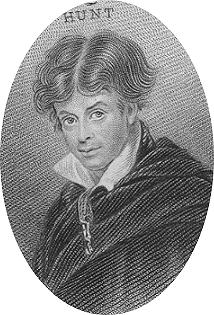
Leigh Hunt
(1784-1859):
"No Praise for Policy's Sake,
Nor, Blame for Malignity's --."
Portrait of Leigh Hunt
[Table Of Contents] [See Further Portrait]

TABLE OF CONTENTS.
No. 1 Introduction:
No. 2 Early Life (1784-1808):
No. 3 Seditious Liable (1808-15):
No. 4 The Poets: And A Sojourn In Italy (1816-25):
No. 5 Later Years (1826-59):
No. 6 Some Concluding Remarks:
No. 7 Dates:
No. 8 Notes:

[TOP]
[TOC]
No. 1 -- Introduction:-

William Michael Rossetti:

"Leigh Hunt is known to us all a fresh and airy essayist, a fresh and airy poet, a liberal thinker in the morals both of society and of politics (hardly a politician in the stricter sense of the term), a charming, companion, a too-constant cracker of genial jacosities and of puns."1
Together with his elder brother, John, Leigh Hunt established one of the most famous newspapers of the time, the Examiner. The Examiner, a Sunday paper, was one in which Leigh Hunt was given to express his liberal views. Such expressions of liberalism were to get the Hunts into trouble with the government of the day, which was more interested in prosecuting the war against Napoleon than with civil liberties at home. The Hunts were tried and found guilty "for a libel on the prince regent"; both of the Hunt brothers were imprisoned for two year terms, 1813-15. Thus, the Hunts were martyrs to the new age of reform; but, as for Leigh Hunt, he is more to be remembered as a literary figure -- if not for his own writing, then for his connections. It was through the Examiner that he introduced to the world: Keats and Shelley. In 1822, Hunt left England to be with his literary friends: Shelley and Byron who were then in Italy. No sooner did he arrive, when, then, Shelley was to tragically die in a boating accident. In 1825 -- the government having taken the pressure off of those who expressed views contrary to it -- Hunt returned to England to carry on for the balance of his life with his literary pursuits.


[TOP]
[TOC]
No. 2 -- Early Life (1784-1808):-

His father, Isaac Hunt (1752-1809), descended from an English family that had, many years back, established themselves in the English colony at Barbados. Isaac was sent to Philadelphia for his education, after which, he was called to the Pennsylvania bar. There, at Philadelphia, Isaac met and married, in 1767, Mary Shewell, the daughter of a merchant. Isaac Hunt came out full square against those who fought with the British for the independence of the American colonies. As Leigh Hunt was to write, in his Autobiography: "he [his father] entered with so much zeal into the cause of the British Government, that, besides pleading for loyalists with great fervour at the bar, he wrote pamphlets equally full of party warmth, which drew on him the popular odium."2 Once the outcome of the American War became obvious, Isaac Hunt took his family to England, where he intended to build a new life.3

In England, Issac Hunt was not able to practise law, a profession -- as undoubtedly it was -- reserved for the well connected. His education and oratory skills, however, gave Issac good standing as a candidate for the church; he became a preacher, an understandable course, as his father and his grandfather had been men of the cloth in the Barbados. It was the Duke of Chandos, James Henry Leigh, who having heard him preach, employed Isaac Hunt as a tutor to his nephew. Thus, we will better understand, that, upon the birth of his fifth son on October 19th, 1784, at Southgate, a community near London, the infant was to be named, James Henry Leigh Hunt.

Leigh's father earned little from preaching and tutoring and it was only ever to be but a minor supplement to a small loyalist pension. The father, too, was one of those souls, forever possessed with plans but not the gumption to put any of them into effect. Of his father, Leigh Hunt was to write, "he was always scheming, never performing; always looking forward with some romantic plan which was sure to succeed, and never put into practice."4 The Hunt family, therefore, not surprisingly, was to have money problems; indeed, the first room of which Leigh Hunt had any recollection was the one his father occupied in debtor's prison.

Leigh received his schooling at London; he attended Christ Hospital5, thus to become a "Blue coat boy."6 Attending first in 1792, Hunt spent eight years at Christ Hospital. Hunt writes in his Autobiography that at age fifteen he traded in his school uniform for "a coat and neckcloth." "I was then first deputy Grecian,7 and I had the honour of going out of the school in the same rank, at the same age, and for the same reason, as my friend Charles Lamb.8 ... For some time after I left school, I did nothing but visit my shoolfellows, haunt the book-stalls, and write verses." Eventually, due to a good connection, Hunt was to get a job as a clerk in the war office,9 though at the same time Leigh took an increasing interest in the business which his older brother had established. John Hunt, eight years older than Leigh, had become a printer. The brothers decided in 1805, while Leigh was yet with the war office, to establish, as a joint venture, a newspaper, The News. I know nothing of this publication, but, for whatever reason it did not seem to be published beyond 1808, for, in 1808, the brothers established a political weekly, which made their reputation, the Examiner.10 "The main objects of the Examiner newspaper," as Hunt describes, "were to assist in producing Reform in Parliament, liberality of opinion in general (especially freedom from superstition), and a fusion of literary taste into all subjects whatsoever."11 The Examiner had not been established for more than a year before it drew the attention of those who ran the government; and, soon thereafter, prosecutions were instituted against the Hunt brothers as the proprietors of the Examiner.


[TOP]
[TOC]
No. 3 -- Seditious Liable (1808-15):-

During the last part of the 18th century, between the opening years of the American Revolution and the beginning of the French Revolution, journalism, or rather the power of journalism, came of age. As literacy spread and the population grew, reading was becoming an increasingly popular pastime; publishing was becoming a big business. With the turning of the century there were to be found on the streets of London, papers, such as: the The Morning Chronicle, The Morning Post, The Morning Herald, and The Times. Public opinion from this point was to be moulded by what was written in the public press.12 And because of the better established periodicals, such as has been just mentioned, there came "a new tone of responsibility and intelligence."13 In the beginning years of the 19th century, however, the state of journalism was to shift with the coming of the "radical press"; and, against which, the aristocratic institutions in England, having been thoroughly shaken by the American and French revolutions, took action.

"The differences and animosities were fully reflected in the radical press, which included Henry White's Independent Whig, T.J. Wooler's Black Dwarf, the Hunt Brothers' (Leigh and John) the Examiner, Cobbett's Political Register, and the many scurrilous sheets with names like The Cap of Liberty and Medusa. Such publications abused each other as often as they did the government. The government and its friends studied them nervously, from time to time, and occasionally prosecuted, though doing so had become much more difficult since Charles James Fox's 1792 amendment to the law of libel, which allowed the jury (as opposed to the judge) to decide whether the words complained of were libelous. Juries, especially those in the London area, were usually unpredictable, notably in cases involving freedom of the press. In the years 1808-21 the authorities embarked on 101 prosecutions for seditious liable, and as often as not failed to get a conviction."14
From its very first edition, those who made up the aristocratic institutions perceived the Examiner to be a threat. As Hunt set out in his Autobiography: "In the course of its warfare with the Tories, the Examiner was charged with Bonapartism, with republicanism, with disaffection to Church and State, with conspiracy at the tables of Burdett, and Cobbett, and Henry Hunt."15 The first prosecution against the Hunts came about in consequence of some remarks in respect to a British army officer in that he showed favouritism and was guilty of corruption. The prosecution against the paper prompted an internal investigation in the services, which, in turn, brought on a move by the prosecution to drop the charges. Within the year, yet another prosecution was brought against the Hunts because of a less than complimentary set of words about the old king; also, at the same time, charges were brought against a Mr. Perry of the Morning Chronicle. Perry's case came up first and he obtained an acquittal, which led to the dropping of the charges against the Hunts.16

During 1812, the Hunts were once again brought into a court of law. In that year, on March 22nd, there appeared in the Examiner a ferocious attack on the Prince Regent, viz. that he "was a violator of his word, a libertine over head and ears in disgrace, a despiser of domestic ties, the companion of gamblers and demireps, a man who has just closed half a century without one single claim on the gratitude of his country, or the respect of posterity!" They could not escape this one. The government attempted to negotiate a settlement but the Hunts were uncompromising. The prosecution proceeded, and, in the result, both brothers were convicted. The sentence was pronounced on February 3rd, 1813. Because of my interest in things legal, I set out the pronouncement of the sentencing judge, Mr Justice Le Blanc, who addressed the defendants in the following terms:

"-- 'John Hunt and Leigh Hunt, you have been tried and convicted by a jury of your country, of printing and publishing a scandalous and defamatory libel upon his royal highness the prince regent. The libel is contained in the information, and ... is expressed, in the newspaper of which you, John Hunt, were the printer, and you, Leigh Hunt, the editor ... What were the motives which induced you either to compose, or to adopt the composition of others, and which in your minds appeared honourable, and not with any design to slander from personal malice, it is impossible for me to conceive; but this one may venture to pronounce, that no man filling the character of a good subject could, with any motive but a bad one, print a libel of this description, attacking and vilifying the head of the government of the country; because the individual occupying that station, standing at the head of the government of a nation, is not to be held up in public newspaper, in the manner you have held up the prince regent, as an object of detestation and abhorrence, which you endeavour to persuade your readers that he is. Whether your motive was to gratify the mischievous curiosity of the public -- to satisfy the diseased taste of the people, greedy to catch at anything which, by destroying the respect due to the constituted authorities, pulls down those at the head of affairs to the lowest possible level -- if such were the motive which you call not malicious or dishonourable, the court cannot pronounce. But when they have before them men who have been convicted of offences like the present, it behoves those who are entrusted with the administration of criminal justice to protect that government under which we all live, and to support the head of that government, without which the present state of society could not exist. In passing, therefore, the sentence of the court, it is necessary to keep in view that which is ever an object of criminal justice -- to hold forth to the world, that those who are found in your situation, must answer to the country for the mischief which their publication must necessarily occasion, since the effect of it is to destroy the bonds of society, by holding up the government to disgrace and contempt. We must point out wholesome examples to others, to deter them from being guilty of offences similar to that of which you have been convicted.
The sentence of the court upon you, therefore, is, that you severally pay to the king a fine of £500 each; that you be severally imprisoned for the space of two years; you, John Hunt, in the prison in Coldbath-fields, and you, Leigh Hunt, in the New Jail for the county of Surrey in Horsemonger-lane; that at the expiration of that time, you each of you give security in £500 and two sufficient sureties in £250 for your good behaviour during five years, and that you be further severally imprisoned until such fine be paid, and such security given.'
The defendants bowed, and withdrew from the court in custody."
Hunt's prison term was not as one might imagine it; he was not confined to one small dingy room to live on water and bread and to stare continuously at a brick wall with a small barred window. No, Hunt was not uncomfortable17 in prison; he was able to have his friends and family with him.18 He was able to continue to carry out his journalistic work. His experience in prison, however, was to permanently change Leigh Hunt.
"At night-time the door was locked; then another on the top of the staircase, then another on the middle of the staircase, then a fourth at the bottom, a fifth that shut up the little yard belonging to that quarter, and how many more, before you got out of the gates, I forget: but I do not exaggerate when I say there were ten or eleven. The first night I slept there, I listened to them, one after another, till the weaker part of my heart died within me. Every fresh turning of the key seemed a malignant insult to my love of liberty. I was alone, and away from my family."19
Imprisonment, viz. the condition of being kept in captivity and forcibly deprived of personal liberty, is an experience -- thankfully, I can only but imagine -- which impacts greatly on the life of the imprisoned person. There is no question, notwithstanding that he made the most of it, Leigh Hunt was indelibly marked by the experience: as he himself declared many years later in his Autobiography, "I have never thoroughly recovered the shock given my constitution." Upon his release from prison, in 1815, Hunt turned from things political to things literary.


[TOP]
[TOC]
No. 4 -- The Poets: And A Sojourn In Italy (1816-25):-

Ann Blainey writes of Hunt's immediate post-prison life:

"At the end of 1816 he moved to the favorite of all his homes: Hampstead, the site of his mother's grave and the place to which, above all others, he felt strongly attached. The place -- near enough to London for visiting friends, bookshops, and theaters but sufficiently rural to provide peace and quiet -- soothed his jangled nerves and he entered into a happy and fruitful period. The focus of his life was changing. Previously it had centered on his brother John and the Examiner to the detriment of his wife and babies. In prison he became a different person, his priorities committed less to John and the paper and more to his wife and three children, and to those literary friends who had so faithfully supported him through his sentence."20
Among his literary friends were two young men, who, it can be claimed, were first introduced by Hunt to the literary world. "I first saw Shelley," Hunt explains in his Autobiography, "during the early period of the Examiner, before its indictment on account of the Regent; but it was only for a few short visits, which did not produce intimacy. ... He was then a youth, not come to his full growth; very gentlemanly, earnestly gazing at every object that interested him, and quoting the Greek dramatists." It appears that the two did not hit it off until 1816, after Hunt had come out of prison and after his, "The Story of Rimini" was published in 1816. It was shortly after that, that Shelley, from an aristocratic family of means, sent "a large sum of money" to Hunt at his home address, known as the "Vale of Health" at Hampstead: thereafter, "an affectionate correspondence began."21 On December 6th, Shelley arrived at Hunt's home at Hampstead and was ushered in as a member of the family. Also at about the same time, and quite independent of Shelley the young John Keats, a medical student at the time, also arrived at Hunt's home, and, he was to get the same sort of warm reception. To both Keats and Shelley, Hunt dispensed enthusiasm and encouragement; and most importantly he gave them access to the columns of the Examiner. Thus, it is to Leigh Hunt that we might give thanks, likely, for our current day knowledge of Shelley and Keats. Though it was indeed fortunate for them to have taken the trouble to meet Hunt, their friendship with this writer and newspaper editor came with a built in set of enemies. As we shall see on our biographical sketch on Keats, the association he had with Hunt made him a particular target of critics.

In 1816, Hunt had his long narrative poem, "The Story of Rimini" published. It had a mixed reception. His friends liked it well enough, but Hunt's enemies (he had many due to his writings in the Examiner) criticized the poem's "idiosyncratic, colloquial style and the sympathetic treatment of incestuous adultery." The Quarterly Review and Blackwood's Edinburgh Magazine, Tory magazines, seemed to have led the attack.22 Hunt's style was a matter of taste, but the reference to his acceptance of sexual liberty was a matter of fact. Hunt himself, it seems, was faithful to Marianne, a simple woman and by whom he had numerous children; but his young poetic friend, Percy Bysshe Shelley was ready to get it on with any attractive woman who happened to be in his company and had a little time on her hands. Paul Johnson:

"Shelley was soon renting a big house in Great Marlow, for an extended family consisting of himself; the pregnant Mary [Mary Wollstonecraft/Godwin, Shelley's second wife]; her stepsister Claire Clairmont with the baby, Allegra, whom she had just had by Byron; as well as Leigh Hunt and his wife Marianne, also pregnant; and Marianne's sister Bess. They built an alter to Pan in the woods, and the atmosphere was heavy with sexual innuendo. Mary was correcting the proofs of Frankenstein and Shelley was writing Laon and Cynthia, whose theme was incest."23
The worshippers at Great Marlow were not to stay together for long, for, in February of 1818, the Shelleys with Claire and the children left for Italy, so to join Lord Byron. Hunt was probably encouraged to come along; but he, with no money and a growing family, could hardly go off to Italy as much as he might like to do so.24 By September of 1821, however, Hunt was summing up the reasons why he too should go off to Italy: his health, Marianne's tuberculosis, his declining interest in the Examiner, the cheapness of living and education in Italy, the sunshine, and the classical culture. An additional incentive was offered: the three (Shelley, Byron and Hunt) could get up a new literary/political journal which they could all do from Italy. Hunt was without money, but that problem too was surmounted; Shelley and Byron (with independent aristocratic means, the both of them) would provide money sufficient, and a house. Mary Shelley was to write directly to Marianne Hunt: "Italy will not strike you as so divine at first; but each day it becomes dearer and more delightful; the sun, the flowers, the air, all is more sweet and more balmy than in Ultima Thule that you inhabit."25

In January of 1822, Shelley, writing from Italy, sent to Hunt by "return of post" £150. In his letter Shelley writes:

"Lord Byron has assigned you a portion of his palace, and Mary and I had occupied ourselves in furnishing it ... We had hired a woman cook of the country for you, who is still with us. Lord B. had kindly insisted upon paying the upholsterer's bill, with that sort of unsuspecting goodness which makes it infinitely difficult to ask him for more ..."26
On May 13th, 1822, the Hunt family27 went aboard a sailing vessel, the David Walter, which set sail for Italy; the vessel arrived at Genoa on June 15th, it then sailed down to Leghorn arriving there on the first of July. Within days of Hunt's arrival in Italy, Shelley was to die in a boating accident. The death of Shelley left Leigh Hunt without his chief ally in respect to the forthcoming publication of the planned periodical, The Liberal. Byron was to soon lose interest in The Liberal.28 Its first number did appear in September of 1822. It was a work doomed to failure, mainly, I suppose to Shelley's death: it was criticized as "a miscellany of disconnected writings without the momentum of a controlling mind." Shelley's contribution to the publication was key to its success; it might have still had a bit of a run, but Byron had lost interest, it seems, even before Shelley's tragic and unexpected death. With Shelley having died, and with Byron's whims and Hunt's penniless state; it will be no surprise to read that The Liberal came onto the streets a sickly child. It was blasted by certain editors, such as those at the Quarterly, as just being more drivel from "The Cockney School of Poetry."29

It is of course history, and a matter to be taken up in connection with my biographical sketch of the man; but Lord Byron, leaving Italy, went off to Greece in 1823, there to die, at the age of 36, in pursuit of his final romantic dream. So, there it is: Hunt's reasons for being in Italy, to be with Shelley and Byron, went up and disappeared, like thick-flaming shots from a funeral pyre. Hunt would then have gladly returned to England but he lacked passage money; further, he could not face the prospect of being arrested for debt, or of trying to resolve the growing argument with his brother, John (from whom he had borrowed heavily) over the proprietorship of the Examiner.

In September of 1825, having received "a literary advance" from England, Hunt and his family (there was by this time seven children) departed overland for Calais; on October 12th, the family took a "steamboat" at Calais. For Hunt, with the death of Shelley and Byron, an era had come to an end; in any event, Leigh Hunt was glad to take his leave of Italy.

"To, me. Italy had a certain hard taste in the mouth. Its mountains were too bare, its outlines too sharp, its lanes too stony, its voices too loud, its long summer too dusty. I longed to bathe myself in the grassy balm of my native fields."30

[TOP]
[TOC]
No. 5 -- Later Years (1826-59):-

Leigh Hunt, with a large family and little money coming in from his writing31, suffered from poverty most all of his days; though in his later days matters improved. There were, of course, authors of the time who did not suffer from the miseries of poverty; I am thinking particularly here of: Southey, Wordsworth and Scott. Because they accepted government positions, they were subject to being in a state of dependance, and thought to be quite ready to please and humour their Patrons. That could not be said of Hunt, or, by way of further example, of Hazlitt or of Keats.32 That certain of his contemporaries, who started out as reformers, sold themselves to officialdom, so to live a more comfortable life, must have galled Hunt.

"'Mr Southey', he [Hunt] had said, 'and even Mr Wordsworth, have both accepted offices under government, of such a nature as absolutely ties up their independence. Mr Coleridge, in pamphlets and newspapers, has done his best to serve likewise; and yet they shall all tell you that they have not diminished their free spirit a jot. In like manner they are as violent and intolerant against their old opinions, as ever they were against their new ones, and without seeing how far the argument carries, shall insist that no man can possess a decent head or respectable heart who does not agree with them. ...The persons of whom we have been speaking have been always in extremes, and perhaps the good they are destined to perform in their generation, is to afford a striking lesson of the inconsistencies naturally produced by so being. Nothing remains the same but their vanity'."33
In later years Hunt's fortunes improved. A new generation of young writers saw him as the survivor of the glamorous poetic world of Keats, Shelley, and Byron. Budding writers, one of whom was Charles Dickens, organized a private pension and agitated for a government pension which was first paid to Hunt in 1847.

In the meantime, in 1835, Hunt moved to Chelsea -- it having that combination of town and country which he loved. It was on his suggestion that Thomas Carlyle became Hunt's neighbor in Cheyne Row; and Carlyle was to become one of Hunt's closest friends. Hunt's door was always open to his friends; at the right moment he may be caught at his supper and the recommendation by Hunt would be immediately made to partake of his fare, "dried fruit, bread, and water." Most visitors came away appalled by the thriftless gypsiness of the Hunts' chaotic household. Hunt floated above it all in his flowered "wrapping gown," reading the classics and discoursing on the beauty of nature, and always through his words and acts expressing the philosophy of positive enjoyment. He wrote ceaselessly: essays, articles, poems, literary guide books to London, reworkings and recyclings of former works, and a number of anthologies which he rounded out with essays often on literary criticism. Hunt published his Autobiography in 1850. Carlyle was to observe34 that it was "by far the best of autobiographic kind I can remember to have seen in the English language."

In the mid-1840s his eldest daughter and his second son (a delinquent child who had grown into a delinquent adult) had died, however, their deaths did not hurt him as much as that of Vincent, his youngest son and favorite child. The last illness of tubercular Vincent was in the autumn of 1852, it was a time when Hunt and his beloved son became closer than ever. Hunt's grief at Vincent's death was extreme.

The publication of Charles Dickens' novel, Bleak House, was to cause quite a stir in the Leigh Hunt circle. In the work, there was a character, "airy, improvident and objectionable"; his name was Harold Skimpole. The character of Skimpole was, without doubt, based on Leigh Hunt. This characterization of Hunt by Dickens was to greatly effect Hunt and his friends; Dickens' denials and apologies only partly fixed up the rift that Bleak House had caused between Dickens and a number of his literary contemporaries.35

In his later years, as his Autobiography will show, Hunt allowed that he was "ratherish unwell." Though he occasionally got out to go to the theatre or to dinner he became increasingly more sedentary. In January, 1857, Marianne died. "She [Marianne Hunt] was a limited, consumptive girl beset by chronic poverty, illness, and a family of ten children; and he was an impractical, insecure, and intensely demanding man whose intellect and friends were beyond her."36 Thorton Hunt, Leigh Hunt's eldest son, who was to go on to become an accomplished man of letters in his own right, was to write of his parents: "Fate joined him with one who shared his taste for plastic art, with a greater natural aptitude, but without culture or the power of acquiring it; with childlike sense of verse, never matured; with an almost equally childlike sense of economy which the bookworm long believe to be nearly perfect. ... they were actuated by motives so different, that lengthening years only made them, in the longer portion of their faithful and unsevered union, strangers."37


[TOP]
[TOC]
No. 6 -- Some Concluding Remarks:-

The artist, Benjamin Robert Haydon, a contemporary of and an early friend of Leigh Hunt's:

"He [Hunt] had been educated at Christ Hospital, and was not deficient in classical knowledge, but yet not a scholar. Then we were nearly of an age; he being only three years older than myself, and he had an open affectionate manner which was most engaging, and a literary, lounging laziness of poetical gossip which to an artist's mind was very improving. At the time of our acquaintance, he really was, whether in private conversation or surrounded by his friends, in honesty of principle and unfailing love of truth, in wit and fun, quotation and impromptu, one of the most delightful beings I ever knew."38
William Hazlitt was of the view, what our thoughts of Leigh Hunt, as came to us through his writings, were but improved through personal acquaintance:
"This is a charge that none of his friends will bring against Mr. Leigh Hunt. He improves upon acquaintance. The author translates admirably, into the man. Indeed, the very faults of his style are virtues in the individual. His natural gaiety and sprightliness of manner, his high animal spirits, and the vinous quality of his mind, produce an immediate fascination and intoxication in those who come in contact with him, and carry off in society whatever in his writings may to some seem flat and impertinent. From great sanguineness of temper, from great quickness and unsuspecting simplicity, he runs on to the public as he does at his own fire-side, and talks about himself, forgetting that he is not always among friends. His look, his tone are required to point many things that he says: his frank, cordial manner reconciles you instantly to a little over-bearing, over-weening selfcomplacency. 'To be admired, he needs but to be seen': but perhaps he ought to be seen to be fully appreciated. No one ever sought his society who did not come away with a more favourable opinion of him: no one was ever disappointed, except those who had entertained idle prejudices against him. He sometimes trifles with his readers, or tires of a subject (from not being urged on by the stimulus of immediate sympathy); but in conversation he is all life and animation, combining the vivacity of the school-boy with the resources of the wit and the taste of the scholar. The personal character, the spontaneous impulses, do not appear to excuse the author, unless you are acquainted with his situation and habits: like some great beauty who gives herself what we think strange airs and graces under a mask, but who is instantly forgiven when she shews her face."39
And finally, Leigh Hunt, of himself, was to write:
"I am not conscious of having given praise for policy's sake, or blame for malignity's; and I never will. A strict adherence to truth, and a recurrence to first principles, are the only things calculated to bring back happier times of our literature and constitution; and however humble as an individual, I have found myself formidable as a lover of truth, and shall never cease to exert myself in its cause, as long as the sensible will endure my writings, and the honest appreciate my intentions."40
Leigh Hunt died on August 28th, 1859 in his 75 year; he was buried in the place of his choice, Kensall Green Cemetery.
_______________________________

One of the biographies in a book

NOW AVAILABLE

The English Romantics


(For More)(Index In .pdf)
_______________________________
[TOP]
[TOC]
No. 7 -- Dates & Events During Leigh Hunt's Life:-

1784:
  • October 19th: Leigh Hunt is born.
    1789:
  • The outbreak of the French Revolution.
    1792:
  • Leigh Hunt's first year at Christ Hospital.
    1793:
  • January: Louis XVI is beheaded.
  • February 1st: War breaks out between France and England; it runs pretty much continually (the Napoleonic Wars) for the next 23 years.
  • Habeas Corpus suspended, and the Traitorous Correspondence Act was passed.
  • Godwin's Political Justice appears.
    1797:
  • With Bonaparte having successfully invaded Italy, Spain coming in on the side of France, and Austria retiring from the war -- France was left without an enemy on the continent and England without an ally. England, fearing an invasion, withdrew her ships from the Mediterranean.
    1798:
  • Coleridge with Wordsworth bring out Lyrical Ballads.
  • August: Nelson destroyed Napoleon's fleet at the Battle of the Nile.
    1799:
  • Leigh Hunt, at age 15, takes his leave of Christ Hospital.
    1802:
  • In 1802, the Treaty of Amiens is signed.
  • Brougham, Smith, Jeffrey and Horner establish the Edinburgh Review.
    1803:
  • The peace between France and Great Britain lasted but a mere thirteen months. During those months, in seems, Britain went about the business thinking they had something more permanent reducing its armed forces: France on the other hand used the period to retrench.
    1804:
  • Napoleon becomes emperor of France.
  • The Code Napoleon, that "Draconian work and leveller of all class distinctions" is promulgated in 1804.
    1805:
  • The "Third Coalition" against France is formed: Russia and Austria throw in with Britain.
  • October 21st: Nelson's victory at Trafalgar. By this event, both the French and Spanish navies were annihilated, and, the danger of any invasion which all of England had anticipated, passed.
  • In December of 1805, the Battle of Austerlitz took place (Austerlitz is a place located in modern day Czechoslovakia). Napoleon decisively defeated the armies of Russia and Austria, each with its emperor at its head.
  • London, Morning Post, June 15th, 1805: "The shop of Lardner and Co., the corner of the Albany, Piccadilly, is illuminated every evening with Carbonated Hydrogen Gas, obtained from the decomposition of Coals. It produces a much more brilliant light than either oil or tallow, and proves, in a striking manner, the advantages to be derived from so valuable an application."
  • Byron enters Trinity College, Cambridge.
  • Leigh Hunt joined his brother in editing a newspaper called The News.
    1806:
  • By a proclamation, dated Berlin, November 21st, 1806, Napoleon declares that the British Isles are in a state of blockade; further, that all letters going to, or coming from England, are not to be forwarded, and all those written in English are to be suppressed; and further, that trade in English goods is to be rigorously prohibited.
  • Great Britain abolishes the Slave Trade.
    1807:
  • Robert Fulton's Clermont proves the practicality of steam power for river craft.
    1808:
  • The Hunt brothers involved themselves in a new journalistic effort, a political weekly, the Examiner, the first number of which appeared January 3rd.
  • In support of a Spanish rising, in July, Arthur Wellesley (later to become known as the Duke of Wellington) leads the first small British force of 9000 men into the Peninsula of Spain; a gate into the hostile fortress of Napoleonic Europe.
    1809:
  • John Murray founds the Quarterly Review, with William Gifford as its editor.
  • Leigh's father, Isaac Hunt, dies at age 57.
  • July 3rd: Leigh Hunt marries Marianne: she was 21 and he was 25.
    1810:
  • George III ill; his son, the Duke of Wales (1762-1830) takes over as the Prince Regent; in 1820, on his father's death, he becomes George IV.
  • September, 10th: Thornton, Hunt's oldest son, was born.
    1811:
  • January: The Hunt brothers were acquitted of seditious libel.
    1812:
  • William Hazlitt lists the Questions of the Day: "Our colonial policy, prison discipline, the state of the Hulks, agricultural distress, commerce and manufactures, the Bullion question, the Catholic question, the Bourbons or the Inquisition, 'domestic treason, [and] foreign levy'" ("Mr. Brougham -- Sir F. Burdett.")
  • May: Prime Minister Perceval, assassinated.
  • Liverpool becomes the English Prime Minister.
  • On 18 June, 1812: President Madison and the American Congress declares war on Britain.
  • General election in Britain.
  • Byron Donkin builds (tin plate having been invented in 1810) the first canning factory in England, his principal orders come from the Royal Navy.
    1813:
  • In England 13 "Luddites" are hung at the York Assizes.
  • February 3rd: The Hunt brothers are convicted of libeling the Prince Regent and are sent off to prison for two years.
  • News comes to England of Napoleon's retreat from Moscow; and, his struggle to retain hold of central Europe.
  • During forty days in May and June, the British troops drive the French armies over the Pyrenees and out of Spain; Napoleon's back is broken by the military and diplomatic actions of Wellington and Castlereagh.
  • Southey becomes Poet Laureate and is so until 1843.
    1814:
  • April: Paris is captured and Bonaparte abdicates.
    1815:
  • February 3rd: The prison terms of both Hunt brothers end.
  • March 1st, Napoleon returns from Elba and the "Hundred Days" begin.
  • June 18th, The Battle of Waterloo.
  • Unemployed ex-servicemen walk the streets.
    1816:
  • Hunt's narrative poem, "The Story of Rimini," is published.
  • December 1st: Hunt writes in his Examiner on "Young Poets," including those now in his circle, Shelley and Keats.
  • The war against the Radical Press in England heats up; Habeas Corpus Act is suspended for a whole year as a result of the Spa Fields Riot on December 16th, 1816.
    1817:
  • Cobbett flees to America.
  • Coleridge publishes Biographia Literaria.
  • Hunt publishes The Round Table, a collection of essays that he and William Hazlitt had written.
  • October: John Gibson Lockhart, then, but age 23, at Edinburgh, with his platform being Blackwood's Magazine, a Tory magazine, fulminates against "The Cockney School of Poetry."
    1818:
  • Unrest in England, with the Northern and Midland radicals causing sporadic violence and attacks on mills.
  • March 10th: Shelley leaves for Italy.
    1819:
  • "Peterloo": On August 16th, 1819, "an orderly and unarmed crowed of about 60,000 men, women and children" assemble in support of universal suffrage, in St. Peter's Fields, Manchester. They were there to hear the speaker, Radical Hunt (not, I think, related). The magistrates, in a move to arrest the speaker, order the cavalry in: "eleven persons, including two women, were killed or died of their injuries; over a hundred were wounded by sabres and several hundred more injured by horse-hoofs or crushed in the stampede."
  • September 28th: Marianne Hunt give birth to a sixth child, a boy
  • A Factory Bill prohibiting children under the age of nine to work in cotton mills is passed in 1819; this is the first of a series of parliamentary bills which were to be passed over the next forty years in a process of law reform which was first prompted by the writings of the legal philosopher, Jeremy Bentham.
    1820:
  • January 29: George III dies, George IV (1762-1830) takes the throne, due to his father's derangement he had been the Prince Regent since 1810.
  • Thistlewood's planned insurrection in February of 1820; hung May 1st.
  • In June Caroline, George IV estranged wife, returns to England and the Caroline Crisis ensues; it "swallowed up every other topic from June to November."
  • September 30th: Keats, seriously ill, with his friend, the painter, Joseph Severn, sail from England arriving at Naples on the 21st October.
  • Benjamin West (1738-1820), the Neoclassical Painter, historical painter to the English court, died.
    1821:
  • February: Keats dies in Italy.
  • The coronation of George IV takes place on July 19th.
  • Caroline dies on August 7th, 1821.
  • De Quincey published in the London Magazine his essay, Confessions of an English Opium Eater.
  • The trial of the Queen; the coronation; the death of Queen Caroline; the second expedition of Parry to the Polar discoveries; and the insurrections in Greece -- cover the columns of the periodicals.
  • November: The Hunt family make their first attempt to sail to Italy; but, due to stormy weather in the English Channel, the family is forced to go back ashore in England.
    1822:
  • January: Shelley and Byron send money from Italy to Hunt, so, he and his family might be able to follow through on their plans to go to Italy.
  • May 13th: The Hunt family boards another sailing vessel; they finally touch at Genoa on June 15th; staying with the vessel, on the first of July the family arrives at Leghorn.
  • July 8th: Shelley dies in Italy as a result of a sailing accident.
    1824:
  • July 17th: Byron, with Trelawny and others, depart for Greece.
  • April 19th: At the age of 36, Byron dies at Missolonghi, Greece.
    1825:
  • September: Hunt and his family depart overland for Calais; on October 12th, the family in order to cross the Channel took a "steamboat" at Calais.
    1827:
  • Hunt's young son, Swinburne, dies.
    1828:
  • In London a exhibition specifically devoted to machinery is held.
    1829:
  • Sir Robert Peel's police make their appearance in London; before this time public tranquillity was maintained by the military forces. With "Peelers" there now existed "an efficient civilian force, of non-partisan character, and armed only with staves.
    1830:
  • June 22, George IV dies and William IV, the popular sailor king takes the throne.
  • Hazlitt dies.
    1832:
  • The Reform Bill.
  • Bentham dies.
  • Scott dies.
  • Darwin sails on the Beagle.
    1834:
  • Coleridge dies.
  • Lamb dies.
    1838:
  • Hunt's The Book of Gems is published; in this work first appeared "Abou Ben Adhem."
    1843:
  • Southey dies.
  • Wordsworth is appointed the poet laureate.
    1844:
  • Hunt's Imagination and Fancy is published and which has been reprinted many times since. Its object was to present the public with some of the finest passages in English poetry, marked and commented upon. In this work Hunt sets out passages from Spenser, Marlowe, Shakespeare, Jonson, Milton, Coleridge, Shelley and Keats: for these last two he saved his most sweet tributes.
    1847:
  • The crown grants a yearly pension to Hunt of £200.
  • September 7th: Leigh Hunt's brother, John, dies.
    1850:
  • Hunt comes out with his Autobiography.
    1852:
  • Hunt's youngest son, Vincent, who lived with his father and who was Hunt's best companion in his later years, and of so much help, died.
    1857:
  • Marianne Hunt, at age 69, dies.
    1859:
  • August 28th: Leigh Hunt, at age 75, dies.
  • _______________________________
    [TOP]
    No. 8 -- Notes:

    1 William Michael Rossetti (1829-1919), brother to Christina and Gabriel. I quote from Rossetti's Work, Life of John Keats (London: Walter Scott, 1887) at p. 21.

    2 First published in 1850; my copy of Leigh Hunt's Autobiography is that published by Smith, Elder, 1870 (London); the quote I use is found at p. 7.

    3 Moving to London, the American artist Benjamin West also fled Philadelphia. West was to later marry Elizabeth Shewell, the sister of Isaac Hunt's father-in-law. Mary Shewell, who had married Isaac Hunt, was Elizabeth's niece. Mary and Elizabeth were not too far apart in age; and friends they were; there was a period of time during which Isaac and Mary lived with the Benjamin Wests in London. [Leigh Hunt's "New World Forebears" by Desmond Leigh-Hunt, Iowa 40 (April 1984) The University of Iowa, URL: http://www.lib.uiowa.edu/spec-coll/Bai/leigh-hunt.htm (April, 2003).]

    4 Autobiography, op. cit., at p. 15.

    5 Hunt wrote in his Autobiography: "Christ Hospital is a nursery of tradesmen, of merchants, of navel officers, of scholars; it has produced some of the greatest ornaments of their time; and the feeling among the boys themselves is, that it is a medium between the patrician pretension of such schools such as Eton and Westminster, and the plebeian submission of the charity schools. ... Christ Hospital, I believe, towards the close of the last century [1700], and the beginning of the present [1800], sent out more living writers, in its proportion, than any other school." (Op. cit., p. 50.)

    6 The well recognized uniform of the boys from Christ Hospital was a long blue habit and yellow stockings. As set out in my biographical note on Coleridge: "The discipline at Christ Hospital in those days was ultra-Spartan, the mood monastic. All domestic ties were to be put aside." In Blunden's work, Leigh Hunt and his Circle (London: Harper Brs., 1930) we see this at p. 14: "The system of education was simpler than what has been attempted in later days without more convincing results. A Blue either spent his school life in the Writing School, where he would normally become a master of counting-house rules and fearsomely fine longhand; or in the Mathematical School, there to vanquish the ogres of latitude, azimuth, parallax; or in the Grammar School, with 'insolent Greece and haughty Rome.'" Hunt was to spend his time at Christ Hospital in the Grammar School, there, under a very well remembered Reverend James Bowyer (see Hunt's Autobiography). In the truly great poets, Bowyer would say, there is a reason assignable, not only for every word, but for the position of every word ..."

    7 Hunt explains: "The Upper Grammar School was divided into four classes or forms. The two under ones were called Little and Great Erasmus; the upper were occupied by the Grecians and Deputy Grecians. ... When a boy entered the Upper School, he was understood to be in the road to the University, provided he had inclination and talents for it; but, as only one Grecian a year went to College, the drafts out of Great and Little Erasmus into the writing-school were numerous. A few also became Deputy Grecians without going farther, and entered the world from that form. Those who became Grecians always went to University ..." (Autobiography, op. cit., at p. 66.)

    8 Lamb and Coleridge, it is to be remembered, were also "Blue coat boys," though at earlier points in time; Lamb being eight years older than Hunt, and Coleridge, twelve.

    9 Hunt, though working with his brother in the newspaper business kept his job at the war office but left it in but a year or so, it seems, in order to fully put his time and energies into the paper.

    10 The Examiner "was a weekly, published on Sunday, of 16 pages and only two columns a page, which made it more legible than most dailies (though the type was poor). Its circulation gradually rose to 7,000 -- 3,000 -- 5,000 was the usual break-even range -- and, as Jeremy Bentham testified, was the most highly regarded weekly among 'political men.'(Johnson, The Birth of the Modern (New York: HarperCollins, 1991) at p. 368.)

    11 Autobiography, op. cit., at p. 156.

    12 "Great is Journalism. Is not every Able Editor a Ruler of the World, being a persuader of it?" (Carlyle, The French Revolution.)

    13 Green, History of the English People, vol. X, p. 77.

    14 Johnson, The Birth of the Modern, op. cit., p. 367.

    15 Op. cit., at p. 156. Burdett, of course, is Sir Francis Burdett, and, as a parliamentarian, campaigned for parliamentary reform; Hunt is Henry Hunt (1773-1835) (no relation to Leigh Hunt) who was considered to be, at the time, a dangerous radical who advocated annual parliaments, universal suffrage, the secret ballot and the repeal of the Corn Laws; I have written extensively on William Cobbett.

    16 Ibid., at p. 181.

    17 The authorities -- maybe thinking the sentence severe -- passed the message down to the prison authorities that they should try to make Hunt's stay as comfortable as possible. An unused ward of the prison infirmary, consisting of two rooms was assigned to him. The rooms were painted and decorated to his taste; the walls were papered with rose trellising and the ceiling was "colored with clouds and sky." Hunt's family was allowed to stay with him, though it would not appear that his wife stayed with him for the entire two year period. He had his library books with him and on top of the bookshelves was a bust of Homer; in the corner he had a piano; "there was no other such room," Charles Lamb was to declare, "except in a fairy-tale." A small part of the prison yard was fenced off just for him where he established a garden.

    18 "In his library Hunt conducted his extensive journalistic practice and received visitors. Barnes, then Hunt's assistant, wrote: 'It became fashionable in progressive circles to be seen in his prison' (and to send hampers of delicacies). Brougham popped in. Hazlitt stayed to talk. Haydon was allowed to bring along his 12-foot Judgment of Solomon to show Hunt. Thomas Moore called and (like others) wrote a poem about the prisoner. Byron paid a visit and christened Hunt 'the wit of in the dungeon.'" (Johnson, The Birth of the Modern, op. cit., at p. 369.) Hunt writes that the "Lambs came to comfort me in all weathers, hail or sunshine, in daylight and in darkness ..." (Autobiography, op. cit., at p. 220.) Bentham came too, who Hunt described as one who united "the wisdom of a sage with the simplicity of a child."

    19 Autobiography, op. cit., at p. 215.

    20 "A Portrait of Leigh Hunt," The University of Iowa, http://www.lib.uiowa.edu/spec-coll/bai/portrait.htm (April, 2003).

    21 Blunden, op. cit., at p. 107.

    22 It was in October of 1817 that John Gibson Lockhart, then, but age 23, at Edinburgh, with his platform being Blackwood's Magazine, began to fulminate against "The Cockney School of Poetry"; and, in particular attacked John Keat's Endymion, and Coleridge's Biographia Literaria.

    23 Johnson, The Birth of the Modern, op. cit., p. 505. Though Hunt wrote little in his Autobiography about his Marianne, he did write, at least this much: "My wife was a woman of great generosity, great freedom from every kind of jealousy ... she was uncomplaining."

    24 Italy was represented, by a mutual friend of Shelley's and Hunt's, as a place where one "will find no nuisance but the litter of the rose-leaves and the noise of the nightingales." (As quoted by Blunden, op. cit., at p. 170.)

    25 As quoted by Blunden, op. cit., at p. 168.

    26 As quoted by Blunden, op. cit., at p. 166. In addition to the £150 sent by Shelley, Byron made a loan to Hunt in the amount of £220. (Ibid.)

    27 Actually the family, together with a goat for fresh milk, had set out to sail to Italy during November of the previous year (1821), but, due to stormy weather, the vessel did not get beyond the English Channel. The Hunts, after having been tossed about for weeks, came ashore to seek some comfort, and, in seems, in the process, forfeited their passage money.

    28 Byron's loss of interest in the publication of The Liberal can be laid to the fact that Shelley, its chief proponent, had died. But also, it is to be noted that Byron took a dislike to Hunt, or more particularly to Hunt's family. The Hunt family had initially lodged itself in the downstairs area of Byron's palace at Pisa. Byron greeted the Hunt family at his place as like he would the arrival of the plague. In a contemporary letter from E. E. Williams to his wife, we read (Williams died in the boating accident with Shelley on the Bay of Spezzia but days later): "Lord B.'s reception of Mrs H. was, as S. tells me, most shameful. She came into his house sick and exhausted, and he scarcely deigned to notice her; was silent, and scarcely bowed. This conduct cut H. to the soul ..." [Trelawny, Recollections of the Last Days of Shelley and Byron (Boston: Ticknor & Fields, 2nd ed., 1859) p. 114.] Byron himself was to write of the Hunt children that they "are dirtier and more mischievous than Yahoos. What they can't destroy with their filth they will with their fingers ... six little blackguards." (As quoted by Blunden in his work, op. cit., at p. 187.) Of Hunt himself, Byron, at least in the earlier years, liked him well enough: In December of 1813, Byron was to make this note in his diary: "An extraordinary character, and not exactly of the present age. He reminds me more of Pym and Hampden times -- much talent, great independence of spirit, and an austere yet not repulsive aspect. If he goes on qualis ab incepto, I know few men who will deserve more praise or obtain it. I must go see him again ..." (As quoted by Blunden in his work, op. cit., at p.78.)

    29 The Liberal, it appears, consisted of but four numbers, with the last coming out in 1823. (See Appendix I, Blunden, op. cit., at p. 356.)

    30 Autobiography, op. cit., at p. 335.

    31 The actual ownership of the Examiner was obscure, the older brother, John Hunt thought he certainly had a better right to it. While Leigh was in Italy, and while he did submit the occasional piece; John did all the work of getting it to the streets. Further Leigh continued to expect that his brother John should continue to make remittances to his "co-owner" in Italy. Blunden observes "that a difference between these two brothers began, and widened into a coldness." (Op. cit., at p. 203.)

    32 To round out this romantic group of early 19th century English literature we mention Shelley and Byron, who did not accept government patronage; but, they did not have to, since, they were supported to one degree or another by their aristocratic families.

    33 Howe, The Life of William Hazlitt (Penguin, 1949) at pp. 198-9.)

    34 As quoted by Blunden, op. cit., at p. 303.

    35 Dickens, however, twenty-six years junior to Hunt, proved to be of considerable support to Hunt. It was Dickens and others friends that agitated for the payment of a government pension which, finally, in 1847, was granted to Hunt. On Hunt's death in 1859, Dickens was to sing the praises of Leigh Hunt and his regret that so many of Hunt's critics took up and echoed his description of Hunt in the fictional character, Skimpole; Hunt, as Dickens pointed out, showed his "graces and charms" by his continued forbearance in saying anything about Skimpole. Further Dickens was to declare: that the imprisonment of Leigh Hunt because of remarks about the king's son, in 1813, was, a national disgrace. (See Blunden, op. cit., at pp. 318-20.) In 1902, Swinburne was to write (July, Quarterly Review: "The simple and final reply should have been that indolence was the essential quality of the character and philosophy of Skimpole, and that Leigh Hunt was one of the hardest and steadiest workers on record, throughout a long and checkered life, at the toilsome trade of letters: and therefore to represent him as a heartless and shameless idler would have been as rational an enterprise, as lifelike a design after the life, as it would be to represent Shelley as a gluttonous, canting hypocrite, or Byron as a loyal and unselfish friend."

    36 Ann Blainey, "A Portrait of Leigh Hunt."

    37 See Appendex 2, Blunden, op. cit., at pp. 358-9.

    38 Haydon's Autobiography (Oxford University Press, nd) at pp. 160-1. Haydon and Hunt, in the earlier years, were the best of friends, but at some point had a falling out over Mrs Hunt. Keats explained (Keats died, tragically young, in 1821): "The quarrel with Hunt I understand thus far. Mrs H. was in the habit of borrowing silver of Haydon -- the last time she did so, Haydon asked her to return it at a certain time -- she did not -- Haydon sent for it -- Hunt went to expostulate on the indelicacy, etc. -- they got to words and parted for ever. All I hope is at some time to bring them all together again." [in a letter to his brothers dated 13th of January, 1818, Letters of John Keats (Nelson, 1938) p. 87.] In later years, the Hunts were friends of the Carlyles. Mrs Carlyle was to write: "She [Marianne Hunt] is every other day reduced to borrow my tumblers, my teacups; even a cupful of porridge, a few spoonfuls of tea, are begged of me ... She actually borrowed one of the brass fenders the other day, and I had difficulty in getting it out of her hands; irons, glasses, teacups, silver spoons are in constant requisition; and when one sends for them the whole number can never be found." (Again as quoted by Blunden, at p. 254.)

    39 "Mr. T. Moore -- Mr. Leigh Hunt"; also, see Hazlitt's comments in "On the Conversation of Authors," viz. Leigh Hunt has "a fine vinous spirit about him, and tropical blood in his veins: but he is better at his own table."

    40 Hunt's Autobiography.

    _______________________________

    Found this material Helpful?

    _______________________________

    Google
     
    Web www.blupete.com
    [UP]
    [BIOGRAPHIES JUMP PAGE]
    [HOME]

    2003-7

    Peter Landry