
A Blupete Biography Page

Lord Byron
(1788-1824).
A Peer, a Poet of Revolt ...
An Aristocrat in Sentiment, a Democrat in Opinion ...

For the Ladies ....
"Mad, Bad, and Dangerous To Know."1
[Table Of Contents]


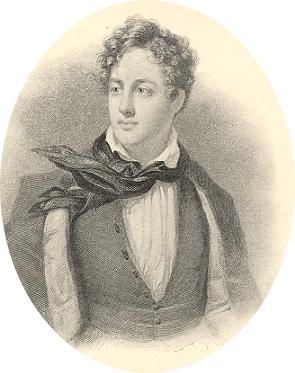
Portrait of Byron
2

TABLE OF CONTENTS.
No. 1 Introduction: No. 2 Byron's Early Life:
No. 3 Cambridge and The Lord's Rejection: No. 4 Hobnobbing with Ali Pasha:
No. 5 English Love Affairs:
1. Caroline2. Jane3. Annabella4. Augusta:
No. 6 Italy (1816-20):
1. Claire2. Countess Guiccioli
No. 7 The Last Years of Byron (1821-24): No. 8 Final words:
No. 9 Lines From Byron: No. 10 Dates & Events During Byron's Life:
No. 11 Notes:

[TOP]
[TOC]
No. 1 -- Introduction:-

Lord Byron's whole biography is a moral tale. While Byron was born an aristocrat, he led the life of a vagabond. He was a genius subject only to his own ruling passions. He was born with a malformation of one foot, which left him with a life long limp. Notwithstanding, he grew up to be a dark and handsome man; the women liked Byron and he liked the women; his sexual exploits are legend. Byron spent a significant part of his adult life on the continent, making his first trip in 1809 with his school chum, John Hobhouse. Hobhouse returned to England leaving Byron to go on to Greece by himself. During this eastern trip Byron wrote the first two cantos of Childe Harold, which tells the story of his tour. On his return to England, he arranged for its publication and it "took the town by storm; seven editions were sold in a month." Byron then tried to settle down into a regular aristocratic life, even to the point of getting himself married (it lasted but a few months); but, for Byron, none of it worked very well. By 1821, Byron was permanently living in Italy where he became part of a romantic literary circle, one of whom was Shelley. Byron was to get himself caught up with the war between the Greeks and the Turks, and, in 1824, Byron embarked for Greece. Shortly, thereafter, at the age of 36, he died.

Byron became an idol of the romantic movement, a symbol of the heady times that extended from the 1790s to the 1830s. He represented one extreme of these highly political times.3 A model has been made of him, "The Byronic Hero": brave, proud, masterful with a general contempt for his fellows.4


[TOP]
[TOC]
No. 2 -- Byron's Early Life:-

Our hero's grandfather was a well respected navy man, Admiral John Byron (1723-86). The admiral had two sons and three daughters. It was the eldest son, John Byron (1751-91) who was the poet's father. Young John received a commission in the army and became a captain in the guards. His military career likely matched his dismal life. "Mad Jack"5 was an unprincipled man and had the respect of no one including the members of his family. In 1779, "Mad Jack" married his first wife.6 Of that union came two daughters; the first died in infancy; the second, Augusta, lived on (we will take up Augusta and her relationship with her famous step brother, presently). "Mad Jack's" first wife died in the same year (1784) that she gave birth to her daughter, Augusta.

Byron's mother, Catherine Gordon of Gight (b.1765), was John Byron's second wife. She was one of the Gordons of Scotland, however, at the time Catherine first met John Byron, she was residing at Bath. The two married on May 13th, 1785. I am not sure when or the reasons for the move7 but eventually "Mad Jack" took Catherine off to live on the continent (shades of the first marriage). The trouble that the Byrons had with one another mounted up, such that, apparently while still on the continent, Catherine left "Mad Jack" to go to live with her family in Scotland. While laying over at London, on her way to Scotland, Catherine gave birth to her only child, George Gordon, on the 22nd January, 1788. Thereafter, Catherine took her son to Scotland. At Aberdeen, doubtlessly with the help of her family, Catherine took a small house. "Mad Jack," not long after, was at the doorstep of Catherine's place in Aberdeen. For a short period of time the three -- Catherine, John, and their baby, George Gordon -- lived together, but not for long.8 Being pressed by his creditors, abandoning his wife and young son, John Byron fled to Valenciennes, France, where he died in August of 1791.

Byron attended Aberdeen Grammar School. Due to a pronounced limp from a congenital malformation of at least one of his lower limbs9, Byron likely had problems with the socialization process involved with his early schooling. Difficulties in the school yard surely had an effect on his developing personality. But likely that which had more of an effect on the young Byron and the string of difficulties that he was to have in his adult life, especially with his female acquaintances, was Byron's relationship with his mother. Catherine, was pathetic, generous and affectionate, but with a violent and uncontrollable temper; as a boy, she alternately petted and abused Byron.10 The temper, which Byron preserved throughout the balance of his life was "passionate, sullen, defiant of authority, but significantly amenable to kindness."11

More generally, as to his early schooling, John Nichol in his biography on Byron writes:

"... he was backward in technical scholarship, and low in his class, in which he seems to have had no ambition to stand high; but that he eagerly took to history and romance, especially luxuriating in the Arabian Nights. He was an indifferent penman, and always disliked mathematics; but was noted by masters and mates as of quick temper, eager for adventures, prone to sports, always more ready to give a blow than to take one, affectionate, though resentful."12
Now, what is to be told, is how this young lame boy in Scotland was to become a peer of the realm and to take all the privileges that flow from the added appelation of "Lord". Though he personally could in no way be described as such, Byron's father, as previously noted, came from a noble English family. Byron's grand-uncle was the Fifth Baron Byron of Rochdale, a hereditary title. The Fifth Baron died in 1798 leaving no direct descendants, such that, through the laws that govern succession, this hereditary peerage fell to our poet making him the Sixth Baron Byron of Rochdale.13 As fine a gift as a baronetcy was to the young Byron, what hope, title or no tile, did such an honour hold out, where the inherited estate was all but bankrupt and where the only income to the promoter of the young lord, his mother, was a yearly income of £122, being from a small capital sum that she had managed to rescue from "Mad Jack's" spendthrift ways. What was necessary was for somebody with money and connections to take the young Lord in tow. By whatever manner, the case came to the attention of Frederick Howard, fifth Earl of Carlisle (1748-1825), a distant relative to the ten year old Lord Byron. Friends had encouraged Lord Carlisle to take the young lord under his wing and see to his education. The first thing that Carlisle did was to use his influence to get Catherine Byron placed on the civil list which was to provide her an additional yearly income of £300. What was necessary, too, was to move the young peer to London. So it was, that Catherine and her young son moved away, as it turned out, permanently from Scotland.14

The reason, I suppose, that the move to London was necessary, was, because an application had to be made to Chancery Court. Being a minor and a lord and without a father, Byron was automatically a ward of the court. A solicitor was employed to handle matters in respect to the applications for approval of the guardianship, etc. The solicitor employed was John Hanson, who, thereafter, took a personal interest in the affairs of the young Byron, and, indeed, played a pivotal role in the balance of Lord Byron's life.

For the next number of years, Byron and his mother lived at London. The young Byron was sent to school at Dulwich.15 Soon, Byron's mother was complaining to Hanson that her son was meant to be educated at a better school then that of Dulwich. Catherine was to make such a nuisance of herself, that, in April of 1801, Byron was sent to Harrow. No doubt, Byron's time at Harrow, 1801-1805, was beneficial to his budding poetic mind. He learned Latin and Greek and dipped into the classics. Also, he came to the view, as generally all boys do who attend such schools as Harrow by measuring the esteem of each other, that he was made of special social wood.16

With Byron's advancement to a Baronetcy came title to the Newstead Abbey, the ancestral Byron estate in Nottinghamshire. No sooner after she settled legal matters at London, Catherine took her ten year old son to Newstead Abbey, only "to find it in almost complete decay."

"Hitherto the less ruinous portions of the abbey had been occupied by a tenant, Lord Grey de Ruthven. The banqueting hall, the grand drawing-room, and other parts of the monastic building were uninhabitable, but by incurring fresh debts, two sets of apartments were refurnished for Byron and for his mother. Dismantled and ruinous, it was still a splendid inheritance. In line with the front of the abbey is the west front of the priory church, with its hollow arch, once a "mighty window," its vacant niches, its delicate Gothic mouldings. The abbey buildings enclose a grassy quadrangle overlooked by two-storeyed cloisters. On the eastern side are the state apartments occupied by kings and queens not as guests, but by feudal right. In the park, which is part of Sherwood Forest, there is a chain of lakes -- the largest, the north-west, Byron's "lucid lake." A waterfall or "cascade" issues from the lake, in full view of the room where Byron slept. The possession of this lordly and historic domain was an inspiration in itself. It was an ideal home for one who was to be hailed as the spirit of genius of romance."17
On arrival at Newstead Abbey, Catherine determined to effect repairs and live there. It was soon realized, however, that fixing up Newstead Abbey was an impractical plan. They returned to London where Byron started school, as we have seen, at Dulwich. Catherine was a thorn in the side of the Chancery solicitor who was in charge, John Hanson, as it seems she was to everyone including her young son. She went on about more than just a better school for her son, there were other matters and Catherine was continually working her list. Finally Hanson decided to put his foot down. He limited Catherine's involvement in her young son's affairs. A compromise seemingly was worked out. Byron's enrolment at Harrow would be arranged; and -- given the quarrels and difficulties between Catherine and her young son -- the Hanson family would establish a second home for Byron. (The Hansons lived at Earl's Court.) Byron was to be given a choice as to, with whom he wished to spend the holidays. Therefore, after 1801, one would have seen Byron, when not boarding at Harrow, visiting with either his mother or at the Hansons. In July of 1803, when Byron was fifteen years of age, his mother moved to Burgage Manor in Southwell, a village about 12 miles from Nottingham, viz. near the ancestral Byron estate, Newstead Abbey. The young Lord Byron, in between times at Harrow, in addition to his place in London (the Hansons) and his mother's place, had a third place to which he might run. Byron's mother, not able to cope with the expenses and in need of money, had rented Newstead Abbey to Henry Edward, the nineteenth Baron Grey de Ruthyn, a lease which was to last during Byron's minority. Lord Grey extended, however, an open invitation for Byron to visit his ancestral estate anytime he pleased (Lord Grey had an eye for young boys). Determined to skip the fall term at Harrow in 1803, Byron rode to Newstead where he stayed at the gate-house with Owen Mealey, the steward. It was during this time that Byron was to first experience the pangs of love, when he met his cousin, Mary Chaworth of Annesley Hall, an event we will expand upon in due course.

[TOP]
[TOC]
No. 3 -- Cambridge and The Lord's Rejection:

Having finished up at Harrow (he apparently ran away from the place a couple of times), in October of 1805, at the age seventeen, Byron entered Cambridge (Trinity College). Byron was fast approaching the age of majority, when, without permission of the court, he could deal with his own affairs as he saw fit. Byron was particularly looking forward to taking title to Newstead Abby. Money lenders in London, now that he was approaching the age of majority, were fast becoming Byron's friends. Thus, Byron could easily raise the money to support a conventional life of extravagant dissipation. During his years at Cambridge, 1805-08, he divided his time between Cambridge, London and at his mother's house at Southwell. At times through these years he would leave Cambridge in the middle of term, or early, or late; Lord Byron was more interested in tasting life as might be had at London than keeping his nose in the books at Cambridge. Still, the allowances were coming through Hanson's hands and Byron was kept at the wheel of learning through threats from solicitor Hanson, that, should Byron leave Cambridge, he would be cut off. These threats usually had the effect of driving Byron back to his studies at Cambridge.18

Quarrels through these years continued with his mother over his extravagances at Cambridge and London, and his arrangements with the money-lenders. He passed his days not so much studying as much, with his friends, shooting pistols, playing cricket, and swimming.19 At London, Byron took fencing and boxing lessons. Notwithstanding all this activity, Byron found time to write. As early as 1806, Byron saw to the publication of his first poems, Fugitive Pieces. This first work was privately printed without Byron's name. Criticism of this work caused Byron to recall most of the distributed copies which he then proceeded to destroy. He then carried out "excisions and prunings" of the work and re-published it. In 1807, he brought out Poems on Various Occasions (January), again, privately printed (about 100 copies) and Hours of Idleness (June). In February of 1808, a scathing review of Hours of Idleness appeared in the Edinburgh Review, "imitative, sentimental, and mawkish." This criticism provoked Byron to reply with the publication, in 1808, of English Bards and Scotch Reviewers. This work, English Bards and Scotch Reviewers was an immediate success and a sell out.20

In 1808, Byron entered into a time that he could fully call his own. In June of that year, Lord Grey's lease on Newstead Abbey came to an end. That July, Cambridge granted Lord Byron a degree. By September, Byron took up residence at Newstead. His mother was likely quite prepared to join him there but he managed to keep her away on the basis that repairs must first be carried out.21 His friend, Hobhouse22, joined him at Newstead and stayed until November, after which Byron continued to write in the isolation of the Abbey.23

Upon coming of age, Byron went through the motions of establishing himself as a high class member of society. On January 22nd, 1809, Byron became twenty-one. He traveled to London and filed his papers giving evidence of his heredity right to become a member of the House of Lords. In March of that year, Byron took his rightful seat at the House of Lords, but he was "humiliated by the manner in which he is announced." The fact is that the young lord was spurned by his fellow lords; and, Byron felt it deeply. Why was he rejected? -- Was it because he was too young to join the old club. Was it because these men thought that Byron had no real power or money behind him? Was it because Byron was a man who fancied himself a poet? Was it because his father was a reprobate? Was it because he was a cripple? Byron, I am sure, turned over all of these reasons in his mind. Eventually, Byron decided that he did not need the approval of such men. He would make his way in the world on his own terms.24


[TOP]
[TOC]
No. 4 -- Hobnobbing with Ali Pasha:-

Trelawny recollects25 that in 1809 Byron first left England; rode on horseback through Spain and Portugal, four hundred miles; crossed the Mediterranean on board a frigate, and landed in Greece26, where he passed two years after which he returned to England.

Leaving London with John Hobhouse, in June of 1809, the pair departed Falmouth on July 2nd, on the Lisbon packet, Princess Elizabeth.27 By the 7th of July, Byron and Hobhouse were at Lisbon, and from there went by horseback to Seville and Cadiz. It is during this time that Byron swam the Tagus.28 In time, he went by sea to the British base of Gibraltar. On the 16th of August, Byron sailed for Malta where he makes love to Mrs. Spencer Smith (the "Fair Florence" of Childe Harold [canto II, stanzas xxix-xxxiii]). After three weeks in Malta the party landed at Preveza and after that, toured Albania. He met the bandit, Ali Pasha, and the two take a liking for one and other. The two in company travelled to Greece29 and Turkey (Byron swam the Hellespont). His travels with Ali Pasha included, to quote E. H. Coleridge: "a yachting tour along the shores of the Ambracian Gulf (November 8-23), a journey by land from Larnaki to Athens (December 15-25), and excursions in Attica, Sunium and Marathon (January 13-25, 1810)."30 Hobhouse was not so impressed with all of this as was Byron. On July 14th, 1810, Hobhouse took a passage to England, leaving Byron to go back to Greece. During this, Byron's first eastern trip, he writes the first two cantos of Childe Harold, which tells the story of his tour. At Greece he composes "Hints from Horace" and the "Curse of Minerva".

Not as much is known of Byron's travels after saying his goodbyes to Hobhouse, in July of 1810. I quote E. H. Coleridge's biography, once again: "... he was travelling in the Morea during August and September, that early in October he was at Patras, having just recovered from a severe attack of malarial fever, and that by the 14th of November he had returned to Athens and taken up his quarters at the Franciscan convent."31 Byron might have been in residence at a convent, the Capuchin convent; but Byron did not live the life of a monk. We see at this period of time, November, 1810 -- though in bad financial shape -- how Byron managed to partake of the high life in Athens. In a letter to a friend, Byron describes "a party with drunken, rowdy Turkish heads-of-state." It is thus that Byron continued on in Athens, until, April of 1811. It was in June that he was back in Gibraltar; in between April and June he spent a few weeks at Malta. (Ah! Yes. -- Mrs. Spencer Smith.) It was after leaving Malta that Byron wrote in his journal of his general unhappiness with mankind. By July 14th, he was back in England32 after an absence of a little more than two years. Before the month was out, Byron had met up with Hobhouse, now a captain in the Militia. The pair toured Canterbury and its vicinity. I believe that it was in August of 1811, that he heard the news that his mother was ill. Upon hearing this, Byron borrowed £40 from his Solicitor, John Hanson, so that he could travel home to see his sick mother. It was too late. Catherine died at Newstead on August 1st. "On arriving at Newstead, all their storms forgotten, the son was so affected that he did not trust himself to go to the funeral, but stood dreamily gazing at the cortége from the gate of the Abbey."33


[TOP]
[TOC]
No. 5 -- English Love Affairs:-

Very early in Byron's life, the little girls about him made his heart go pitter-patter. For instance there is, when he was but a boy of eight, the record of his first love affair. It amounted to a passionate attachment to Mary Duff, a distant cousin he met at dancing-school either in Aberdeen or Banff. The attachment that gets more attention, however, is the one that Byron had for his cousin, Mary Chaworth of Annesley Hall, to whom we have already made reference. In 1803, the 15 year old Byron, made his first visit to his ancestral home, Newstead Abby. He had determined to skip the fall term at Harrow, and lodged himself at the gate-house with Owen Mealey, the steward. His infatuation for Mary Chaworth ended when he overheard her mocking his lameness.34 We read, too, that during this time that Lord Grey -- remember Lord Grey, he was the one that held the lease on Newstead Abbey, but only to Byron's age of majority -- Lord Grey made "some sort of sexual advance" that shocked the young Byron and led to "an abrupt and decisive break between the two." Byron's discovery of the pleasures or displeasures of sex, however, come about at an earlier point of time. When Byron was but a boy of eleven, there was in his household, a housekeeper, May Gray. Ms. Gray, it was found out, used to slip into bed with the young lord. The Chancery Solicitor who had taken Lord Byron under his wing, John Hanson, came to learn of Ms. Gray's proclivities and promptly saw to her dismissal.

After the death of his mother that August, Byron stayed on at Newstead until December when he returned to London; though, before the month was out, he was back at Newstead with friends. In January of 1812, Byron again travelled to London. This time it was for the opening of Parliament (being a lord, he had a seat in the upper chamber). On March 10, 1812, Childe Harold, Cantos I and II, were offered for public sale by John Murray. "Within three days, the first edition of 500 copies sells out."35 Byron's prospects were looking up. He also was in for quite a sum of money, as Byron that year had entered into an agreement to sell Newstead.36 Thus it is, in 1812, that George Gordon Byron was widely known as a handsome lord with money. Enter, all in the month of March: Lady Caroline Lamb, Lady Jane Oxford and Annabella Milbanke.

Lady Caroline Lamb (1785-1828) was the wife of William Lamb who was to become known as Viscount William Melbourne (1779-1848).37 Lady Caroline was the daughter of the Earl of Bessborough and Henrietta Ponsonby, and the niece of the Duchess of Devonshire. "As a child she was a tomboy - and a spirit of recklessness and disdain for convention never left her."38 (The portrait to our left was done by Thomas Phillips, date unknown.) At the time of their first meeting, in March of 1812, Byron was 24 years old; Caroline was 27 years old, married and the mother of an autistic son. They met at a function in a grand room of one of those great homes of aristocratic England, Holland House.39 Byron used these words to describe Caroline: "She was tall and very thin, with short, curly blonde hair and hazel eyes."40 It was not long after this first meeting when the pair were alone with a little time on their hands: we might imagine Byron slowly unbuttoning one of Caroline's pageboy outfits.

"They became lovers and shocked London with their affair through much of April and May 1812. Byron had long believed women were truly incapable of understanding male thoughts and desires. With Caroline, he was forced to abandon this notion. They read together, discussed poetry - and argued fiercely. His supposed flirtations with other women and her open affection for her husband and other admirers caused most of the fighting. Some arguments ended 'without any verbal explanation', Byron told a friend. He was particularly jealous of her waltzing with other men. And since Byron could not dance with his club-foot, Caroline now sat with him, no longer the life of her parties. When she was not invited to a party he attended, she would wait out in the street for him. If he needed money, she told him, he could pawn her jewels. ..."41
Byron left a lifelong track record: he loved to pursue women but once he realized his goal of having them completely he then grew bored and became irritated with them. This familiar course defines the short affair he had with Caroline Lamb. To quote his biographer, Nichol: "... after the first excitement, he began to grow weary of her talk about herself, and could not praise her indifferent verses; 'he grew moody, and she fretful, when their mutual egotisms jarred.'"42 He, too, was getting pressure from his friends such as John Hobhouse. Shocked by the open affair of Byron and a married lady of high standing, they urged him to return to Newstead Abbey and forget Caroline. Leaving Caroline in the lurch, Byron took his friends' advice and rode up to Newstead. Caroline wrote him there, letter after letter which Byron systematically ignored. Needing to attend to business, by July, Byron was back at London. Finding out that he was back, Caroline arrived at Byron's rooms. Hobhouse was there at the time and wrote of the event in his diary:
"Wednesday July 29. Went to Byron's in expectation of going to Harrow, a scheme he had resolved on to avoid the threatened visit of a Lady - at 12 o'clock just as we were going, several thundering raps were heard at the door & we saw a crowd collected about the door & opposite to it - immediately a person in a most strange disguise walked up stairs - it turned out to be the Lady in question from Brocket43.... I did think that to leave my friend in such a situation, when.... every soul in the house servants & all knew of the person in disguise, and not to endeavor to prevent the catastrophe of an elopement which seemed inevitable, would be unjustifiable - accordingly I stayed in the sitting room whilst the Lady was in the bed room pulling off her disguise - under which she had a page's dress.... at last she was prevailed upon to put on a habit, bonnet & shoes - belonging to a servant of the house and, after much entreaty did come out into the sitting room. ..."44
In August, Caroline left her family. The call went out to Byron and he sought her out in Kensington from where he returned her to her family at Brocket Hall. Though now somewhat of a prisoner (I suppose) at Brocket Hall, Caroline continued to write letters threatening Byron with revenge; and at one point, in a yard at Brocket, Caroline Lamb burned effigies of Byron and copies of his letters, while neighborhood children danced around the bonfire. In January of 1813, Caroline managed to carry off a much valued painting of Byron and did so by forging Byron's writing in a letter directing his publisher, John Murray to give the painting to Lady Caroline. Caroline's theft of the portrait upset Byron which of course was Caroline's objective. Caroline kept up these antics for a considerable period of time. Later in the year, 1813, both Byron and Caroline were at Lady Heathcote's ...
"On 5 July, they met again at a waltzing party at Lady Heathcote's. Caroline remembered his earlier pleas for her to sit with him instead of dancing. She walked up to him and asked, 'I conclude I may waltz now.' Byron replied: 'With every body in turn - you always did it better than anyone. I shall have a pleasure in seeing you.' Later, he said to her sarcastically, 'I have been admiring your dexterity.' Caroline picked up a table knife, 'not intending anything', she later wrote. Byron was amused and contemptuous. 'Do, my dear. If you mean to act a Roman's part,' he told her, 'mind which way you strike with your knife - be it at your own heart, not mine - you have struck there already.' Caroline cried out, 'Byron!' and fled in distress. When some ladies tried to take the knife from her, she cut her hand."45
Byron continued to be the object of Caroline's scorn for a considerable period of time. It might have passed in a shorter time, except that Byron was bedding one of Caroline's friends, Lady Jane Oxford, an affair which Caroline came to know about, and which accounts -- together with her natural proclivities -- for Caroline's extreme reactions. At some point earlier, the Oxfords had befriended Byron. (His relationship with the Oxfords, I note parenthetically, drew Byron into the circle of the Princess of Wales, such that he was a regular visitor at Kensington Palace.) I am not sure of the exact circumstances; but it seems clear that Lady Oxford's affair46 with Byron started in October of 1812, a point in time after he had broken things off with Caroline Lamb. Lady Oxford did not help matters much and goaded Byron on in his dealings with Caroline. Caroline during this withdrawal period had written Byron asking for a lock of Byron's hair. The letter, as was the case with others were read jointly by Byron and Jane. A lock of hair was sent to Caroline, not of his but rather of Lady Oxford's; it being determined that there was little difference in the colour of Jane's hair when compared to that of Byron's. The affair between Byron and Lady Oxford lasted but a few months.

A closing note on Caroline Lamb: she continued, to one degree or another, to be a problem for Byron until about 1815, when Caroline's attention was finally diverted. It was then that she and her mother travelled over to Europe, as her brother, Frederick Ponsonby, had been wounded at Waterloo; Caroline and her mother planned to be at Brussels to nurse him. For Caroline, as it certainly was for Byron (he was to have hundreds), what was wanted was to have a number of love affairs. Her political husband (highly successful) was to receive appointments which included stays at Paris and Brussels where there were stationed a great number of young handsome military officers. Her most famous conquest was the Duke of Wellington. Caroline became more and more distraught as her last years sped by. She separated from Lord Melbourne in 1825, though he continued to remain close, indeed, he was at her bedside when she died in 1828 at the age of 43. Lord Melbourne survived Caroline for twenty years; never married again; and went on to be the prime minister of Great Britain.

It is now time to pass on to Anne Isabella Milbanke (1792-1860), she was most always referred to as Annabella. She has her place in history as the wife of Byron. She was an heiress and a cousin of Caroline's husband, William Lamb. Annabella is one of the mysteries of Byron's life; it is reported that he was not in love with her, and there was no money to be gained by Byron with the match. Annabella was not, it would appear swooped off her feet by Byron; but, like so many woman to come into his orbit, in time, succumbed to Byron's sexual charms.47 "In his endeavours to corrupt my mind he has sought to make me smile first at Vice, saying 'There is nothing to which a woman may not be reconciled by repetition or familiarity.' There is no Vice with which he has not endeavoured in this manner to familiarize me." This much we know: in 1813, Byron proposed to Annabella and she refused him. In September of 1814, however, a further marriage proposal was accepted by Annabella. In January of 1815, Byron married Annabella, and in December their daughter, Augusta Ada48, was born; a month later, in January of 1816, the pair parted for good.49

It was on the 25th of March, 1812, that Byron met Annabella Milbanke at Brocket Hall, a place that is central to our story of Byron during this part of his life; it is where the Melbournes live, near Hatfield in Hertfordshire. Lady Elizabeth Melbourne, was Annabella's father's sister. It just so happens -- there is some suggestion that Lady Elizabeth arranged it -- that Annabella was at Melbourne House when Byron came to visit. I am not sure how things progressed to the point, but on October 12th, Byron proposed marriage which Annabella rejected, a rejection which likely came more from Annabella's family than herself. The pair, however, kept up correspondence. Annabella's family gradually warmed up to Byron, such that in April of 1814, Byron received a formal invitation to visit Seaham Hall from Sir Ralph Milbanke, Annabella's father. Written correspondence between the two picked up through the summer. In August, Byron received a cryptic letter from Annabella in which she acknowledges an "imperfect" attachment to him. On September 9th, Byron posted a marriage proposal to Annabella. On the 19th he received Annabella's acceptance. The fiancés are then seen to be writing daily to one another. Though Annabella wished for a large wedding, Byron insisted on a private ceremony. When Byron learns that a potential agreement of purchase and sale for Newstead fell through, he proposed to Annabella that they postpone the wedding. Byron's insistence that they will be poor until Newstead is sold leaves her unconcerned. On January 2nd, 1815, the pair were bound over on their marital vows in a private ceremony in the first floor drawing room at Seaham Hall.50 Lord and Lady Byron spent their honeymoon at the Noel estate, Halnaby.

I do not know how long the wedded bliss lasted. By February, Byron's financial affairs were such that Byron thought it best to be in London. They eventually moved into residence at Piccadilly Terrace and were living mostly on Lady Byron's marriage settlement from her parents. That spring Annabella met Byron's half-sister, Augusta, for the first time. Augusta was Byron's -- I would say -- closest friend, we will come to her shortly. His finances were in a very precarious state. Creditors were stepping up the pressure. Legal writs and processes were coming at him with regularity; and he feared the next step was not far away -- distrains and arrests. Though Byron's properties were then worth over £100,000, he was unable to find buyers to pay his price. Things were that disparate that Byron sold his library. Byron was at this point drinking heavily.51 Byron's rages led Annabella to believe him temporarily insane. In September, Byron wrote Augusta telling her that he believes Annabella has been searching through his papers and had broken open his writing desk. In November, Augusta, in response to Annabella's alarming letters, arrived at Piccadilly Terrace to help manage Byron's moods. On December 10th, Annabella delivered a baby girl, Augusta Ada. In January of 1816, things were such between Byron and his wife that he proposed that they break up the expensive house in London, with Annabella and the baby moving, "temporarily" to her parents' house in Kirkby Mallory.52 Annabella and the baby made the move; and when Annabella's family heard about what was going on they obliged their daughter to consult their solicitors; soon after that formal separation papers were drawn and by March formal terms were agreed upon.

The question that now comes to be asked, is: What role did Byron's half-sister play in the breakdown of his marriage; or, more generally, what was the nature of the relationship that Byron had with his half-sister, Augusta Leigh (1783-1851). We first mentioned Augusta when dealing with Byron's early life. We saw where Byron was born in 1788, the son of John ("Mad Jack") Byron. Byron was the product of his father's second marriage. John's first wife died shortly after giving birth, in France, in 1784, to a daughter, Augusta. Now I do not know where Augusta was during the years that Byron grew into manhood; it seems Augusta was missing from the picture. With both her mother and father being dead, Augusta, it would appear, was brought up by her mother's family.53

We pick up on Augusta's life at her age 20. It was in October of 1804 that General Charles Leigh objected to his son's marriage to Augusta based on the smallness of her income, £350 a year left her by her grandmother Lady Holderness. During October and November of 1804 we see Byron and Augusta exchanging letters in which they commiserate over their respective troubles: for him the difficulties he is having with his mother; and her, the troubles with the Leighs.54 The Leigh family was to eventually get over their objections to this marriage of first cousins. On August 17th, 1807, Augusta married Colonel George Leigh, the son of General Charles Leigh and Frances Byron (sister of John Byron, Augusta's and Byron's father). Byron did not see much of Augusta after her marriage, for, maybe a five year period. There seems to be no correspondence between the two, even after his return from Greece in July of 1811. If is difficult to think that he did not see Augusta at Newstead just after his mother died on August 1st, 1811. In any event, only in 1813, do we see Byron and his half-sister coming together to commiserate as they did eight years previously. Byron had just passed a year full of problems, 1812. You will remember, this was the year that Byron was trying to extricate himself from the clutches of Caroline Lamb; the year, after dropping Caroline, that he took up with Lady Oxford; the year that he first met Annabella Milbanke.

In 1813, Augusta Leigh was living with her husband at Six Mile Bottom, north of London, very near Cambridge. It was in June of that year that Augusta arrived at London for a three week visit. She came again to London on August 5th and by the 20th she was back at Six Mile Bottom. In mid-December, Augusta was again in London and after a stay of a few days was brought back to Six Mile Bottom by Byron who returned to London on December 27th. On January 17th, 1814, Byron and Augusta had set out for Newstead. On January 22nd, Byron celebrated his 26th birthday. Augusta Leigh gave birth to a daughter on April 14th, 1814. The child was named Elizabeth Medora after Byron's famous heroine in The Corsair.55 In May, Byron sent Augusta £3000 to settle her husband's debts. In August of 1814, Byron, Augusta, and the Leigh children travelled to Newstead. Augusta tried to arrange a marriage for him with Lady Charlotte Leveson Gower. It will be remembered that Byron married Annabella on January 2nd, 1815.

Well what are we to make of this recitation of the times and events in respect to the relationship between Byron and his half-sister. I think it was but a matter of a sister moving close to her brother during a time he was having troubles; though there are those who would say that the two had an incestuous relationship; but, really, there is little proof of it. Ms Hellam, in her analysis writes:

"Byron began to woo his half-sister Augusta Leigh in August of 1813. On April 15, 1814 Augusta gave birth to Elizabeth Medora who is believed to be the child of Byron's and Augusta's incestuous relationship. To end rumors that circulated about the two of them, Augusta urged Byron to marry. Annabella, due to their correspondence for the past eight months and previous romantic history, seemed the likely candidate. In September of 1814 Byron proposes and Annabella surprisingly accepts."56
After the marriage, in February, the wedded pair visited Six Mile Bottom, where Annabella and Augusta meet for the first time.57 In July, 1815, Byron signs a new will stipulating that after the payment of Annabella's marriage settlement, the remainder of his estate would go to Augusta and her children.58 Augusta, it would appear, continued to help her brother as he went through the marriage breakup. She spent time with Byron that November in response to Annabella's alarming charges that Byron had gone mad. Augusta went to London to be with Byron. He was in a bad mood and lashing out at anyone, even Augusta.59

Byron took the separation from his wife with great difficulty. Leigh Hunt saw him at this time and observed that Byron became ill; "his face was jaundiced with bile; he felt the attacks of the public severely; and, to crown all, he had an execution in [on] his house. I [Hunt] was struck with the real trouble he manifested, compared with what the public thought of it. The adherence of his old friends was also touching."60 Trelawny recollects: "As to the oft-vexed question of the Poet's separation from his wife ... he treated women as things devoid of soul or sense; he would not eat, pray, walk, nor talk, with them. ... who would have marvelled that a lady tenderly reared and richly endowed, pious, learned, and prudent, deluded into marrying such a man, should have thought him mad or worse, and sought safety by flight? Within certain degrees of affinity marriages are forbidden; so they should be where there is no natural affinity of feelings, habits tastes, or sympathies."61

On April 8th, 1816, Byron, Augusta Leigh, and Hobhouse (who had by then moved in with Byron) attend a party at Lady Jersey's where they meet Benjamin Constant. Some of the fashionable set cut both Byron and Augusta ... On the 13th, Annabella snubs Augusta, by having her solicitor respond to a private note. Byron is furious; it is more than he can take. On the 23rd, he is on a carriage headed for Dover; on the 25th he sails for Ostend, Belgium.62 On May 4th, 1816, Byron stands on the field of Waterloo, so bloodied near a year ago. We can but only image, Byron turning west away from England and the bloody fields; and, then, he is off to Switzerland and Italy, there to take up a new life with a new circle of poetic friends.


[TOP]
[TOC]
No. 6 -- Italy (1816-20):-

As has been observed at another place (Shelley) There are many reasons why an Englishman, back in the early part of the 19th century, would want to settle down in Italy.63 Marital difficulties or financial difficulties (they so often go together) are good reasons to get thyself to Italy. The living was cheaper in Italy than in England, then there is the climate (wonderful), the fresh vegetables and fresh fruit, the women, the wine, -- well, you know all the usual enticements. However, I must not get too far into this part without telling of yet another woman in Byron's life: Jane Clairmont, better known as Claire. To put matters in larger perspective: Clair was the younger half-sister of Mary Godwin (father, William Godwin) who ran off with Shelley, a married man, in 1814, and who eventually became his wife. Claire and Mary, as they say, were joined at the hip.64 Anything the one did the other came along and did likewise. When Shelley first met Mary in the spring, he determined (if she, they, were willing) that he would abandon all and run off with her. It was in June of 1814, much before any of them made their acquaintance with Byron, that Shelley arranged for a carriage and the girls (Mary was seventeen, Claire was sixteen) slipped out of their parents' house and off they drove to Dover. They travelled through France and on to Switzerland. By September the 13th the three were back in London. (All of this can be read in my work on Shelley.)

What we know for sure, is that on January 13th, 1817, in England, Claire gave birth to a child (Allegra) who, the parents disclosed, was fathered by Byron.65 If the child went full term, then Claire and Byron were together during the month of April. Byron was off to Dover on the 23rd of April headed for Belgium, maybe after a wonderful night with Claire, who knows? That May, as it turned out, Shelley, Mary and Claire were visiting Byron at Lake Geneva. Thus it might have been that Allegra was born prematurely.

Running from his matrimonial and financial66 troubles, on April 25th, 1816, getting to Dover by way of Canterbury, Byron with his party67, crossed over on a sixteen hour voyage to Ostend, Belgium. On the 26th, they stayed the night at the Cour Imperiale, Bruges from where in the morning they take the carriage to Ghent. At Ghent they stayed at the Hotel des Pays Bays. On the evening of April 29th, they arrived at Antwerp where the next day the group visited the basins built for Napoleon's navy as well as the principal churches and museums. After lunch, the party travels to Mechlin (Malines); the carriage breaks and must be repaired at Brussels where they next stay. At Brussels, Byron met Major Pryse Lockhart Gordon, a friend of his mother. The party stayed over to May 4th, at which time Byron visits the field of Waterloo with Gordon as his guide. During that time from May 10th to the 16th, Byron and party travel the Rhine, visiting Bonn, Coblenz, the Castle of Drachenfels, and Mannheim. On the 18th Byron and party were at Basel, Switzerland. It was at this time that Shelley, needing a break from his particular set of matrimonial and financial troubles, together with Mary and Claire arrive at Geneva with the express purpose of meeting up with Byron. It was there, in May of 1816, that Shelley and Byron met for the first time. Shelley and Byron, though possessing quite different personalities hit it off.68 The four -- Shelley, Byron, Mary and Claire -- for the most part, had a wonderful time while together at Lake Geneva. These four months on Lake Geneva are very important months to the world of literature. Byron wrote Prisoner of Chillon; Shelley wrote Mont Blanc and the Hymn to Intellectual Beauty; Mary Godwin (Shelley) wrote Frankenstein; and Claire was busy writing out fair copies of Byron's third canto of Childe Harold. They played and they wrote and they visited the noblesse of Geneva.69 As the summer wore on Byron and Shelley returned to an earlier established pattern of daily boat rides. By July of 1816, Byron had cast the pregnant Claire aside and refused to see her alone. Then, after considerable discussion which I do not believe demonstrated any animosity, Shelley and the two girls determined to return to England. On August 29th, they set out.70

After the Shelley party left, Byron and Hobhouse that September set out for Italy touring the Alps on route. On October 12th they were at Milan; November 6th, Verona; November 10th, Venice.71 "Byron takes lodgings over the shop of a draper named Segati for 20 francs a day. He is quickly entranced by Segati's wife, Marianna.72 Hobhouse takes different lodgings."

In the new year, Claire was delivered of Byron's child, Allegra. The birth happened in England, where, just then, a general resurgence of Byron's popularity was occurring. That past November and December, John Murray, Byron's publisher, got into the shops Childe Harold (canto III), and the Prisoner of Chillon and Other Poems. Murray wrote and advised Byron that he sold 7000 copies of both publications. Back in Italy: directly Shelley, Mary and Clair cleared the harbour for their return to England, Byron and Hobhouse left Venice for a tour of Italy, a tour that apparently lasted a few months. In the spring of 1817, April 29th, Byron caught up with Hobhouse at Rome, apparently having become separated at an earlier point. That May, still having Marianna Segati on his mind, Byron hurried back to Venice. That June, Byron took up residence at the Villa Foscarini, "a large house on the river near La Mira outside of Padua." That summer he was back at Childe Harold finishing canto iv in July. In August Byron took up with Margarita Cogni73, while still involved with Marianna Segati. In October, he finished Beppo.

In January of 1818, Hobhouse left for England taking with him Byron's latest manuscripts. In January, seemingly just after seeing his friend Hobhouse off to England, Byron accepted an invitation extended by Countess Albrizzi; it was there in the Albrizzi Ballroom that Byron met Countess Teresa Guiccioli. She was the daughter of Count Ruggero Gamba. She was, when first she met Byron, the young wife (only 18) of a sixty year old nobleman. Nothing came of this first meeting, though it seems the couple went for a walk together, the gardens or a museum -- reference is made to Canova's bust of Helen of Troy. And that was it, they did not see one another after that, until, April the 2nd or 3rd, 1819. It was then that Byron and his friend Alexander Scott paid a visit to the Countess Benzoni's conversazioni, there Byron and Teresa Guiccioli met again. During this meeting the two have a chance to sit with one another where a discussion ensues about Italian poetry. No arrangements are made to meet further; then ten days later they met, quite by chance. It was when their gondolas pass each day on one of the lagoons of Venice. What transpired in the following days, I do not know. The Guicciolis were only on a visit to Venice, a trip away from their home at Ravenna to which they returned. Before leaving however, Byron and Teresa agree to secretly exchange private letters.

On their return home to Ravenna, the Guicciolis travelled by carriage over rough roads, when, Teresa falls ill. She was then, as it turned, I think by her husband, three months pregnant. The count and his attendants do manage to get Teresa back home to Ravenna, but she miscarries. On June 10th, Byron travelled to Ravenna. He was responding to an invitation from Count Alborghetti, Secretary General of the Government of Lower Romagna, to attend that evening's theatre performance. At the theatre Byron learns to his great distress that Teresa is gravely ill. The next day Byron visits Teresa. For the next week, he visits her daily, and her health improves dramatically. On the 15th, though Teresa is still sick, she is well enough to ride in her carriage with Byron. I am not sure of all the movements or what messages might have been passed, however, on August 9th, the Guicciolis go to Bologna. The next day, at 3 a.m. in the morning Byron rides out of Venice for Bologna there to take up residence at his old rooms at the Pellegrino. At this point, it seems that Byron was chumming together with both the Count and the Countess, as for example the three of them went to view Alfieri's Mirra at the Arena del Sole Theatre. The Count, like all cuckolded or about to be cuckolded husbands, took a while to come to the realization that another was bedding or about to bed his wife. Quarrels break out between the Count and the Countess. After a particularly bad bout on August 12th, Teresa falls ill and requires the care of Dr. Aglietti in Venice. The Count and Countess travel to Venice for the necessary medical consultations. It seems that a lengthy course of treatment was prescribed which would require Teresa's constant attendance at Venice. The Count had a home at Venice (Palazzo Malipiero) so staying at Venice posed no great problem but political troubles back at Ravenna meant the Count had to travel back and forth. Her opportunities now being more frequent, Teresa begins to see a lot of Byron, indeed for periods of time would stay over at Byron's accommodations in La Mira, though they keep separate while traveling in public. In October, Byron is caught in a drenching rain storm from which he takes a chill and comes down with a fever. Teresa finds him ill and packs him back to her place to nurse him. On November 1st, Count Guiccioli arrived at, what for him, was a bad scene. There then follows quarrels between the Count and his young wife. At the end of ten days, Teresa agrees to return to her husband's house in Ravenna. On November 10th, Count Guiccioli and Teresa returned to Ravenna. Upon her return home, Teresa falls ill. By December 11th, Teresa is so ill that her father, with the agreement of the Count, requests that Byron return to Ravenna. Byron agrees to return, upon Teresa hearing that Byron is coming to see her she has a marked improvement in her health; it now very clear to everyone where her heart lies. Before December is out Byron is by Teresa's side but there is always company around, always company. Looks like Byron is back and forth to see Teresa and before the winter is out takes up accommodations which the Count kindly rented out to him, the upper floor of his home, the spacious Palazzo Osio. So Byron and Teresa regularly see one another throughout the winter, however, the inability of the two of them to be alone with one another leads to increasing tensions. During March of 1820, Byron and Count Guiccioli quarrel violently. On April 2nd, Count Guiccioli breaks into Teresa's writing-desk and takes all her letters. During May, around the 15th, the Count confronts Byron once again. The Count's violent behavior frightens Teresa; the next morning she calls her father (Count Gamba) and brothers to the Palazzo and asks to return to their protection. Byron at this point steps up to the family and states that, to protect Teresa's marriage, he would leave Ravenna; the only alternative he could see to that would be a separation between the Guicciolis. The Gamba family at this time was very powerful and what Count Gamba wanted, he usually got. Before the month was out, Count Gamba applied to the Pope for a separation for his daughter, which on July 6th was granted. Amongst the ecclesiastical terms was that while separated from her husband she was to be under the protection of the Gamba family, that is to say, pretty much be living with them. The count, no matter his part in the matter was required to pay Teresa an allowance of 100 scudi a month (the English equivalent of £1000 a year, a large sum). On July 13th, 4 p.m. Teresa returns to her father's house at Filetto, 15 miles southwest of Ravenna.

During the time that the ecclesiastical separation was arranged, Byron stayed clear of the two families, the Guicciolis and the Gambas and of Teresa. Byron held back for better than a month, then, on August 16th, he made his visit to Teresa's father's house. The Gamba family accepted Byron's presence (the old count gave in to the cries of his young daughter at least to that extent) as long as the terms of the Papal order were upheld, viz, Teresa must continue to live with her family, the Gamba family. The Gambas, like most very rich families have a number of residences, so Teresa had a couple of choices open to her. During November, 1820, she moved into her father's house in town. All this seem to work until July of the following year, 1821, when the estranged husband came to the view that things had just gone too far with Byron, and matters were such, that it could no longer be concluded that Teresa was living with her family. Thus, Count Guiccioli moved to force Teresa to return to him or he would see to her placement in a convent. The Gamba family at this point are fully behind their Teresa, so she and a number of the family members receive visas good for four months and move out of Count Guiccioli legal clutches. It is to be remembered that the country of Italy did not yet exist, it was, back in these times, a collection of sovereign states many of whom were feuding with one another. During all of this, for reasons to be better understood by one who has knowledge of the complicated Italian political situation of the time, the Gamba family ran out of favour in certain quarters.74

Another old friend during this period dropped in on Byron for a visit in Italy, Tom Moore (1779-1852) a fellow poet. This was at a point when Byron was at Venice and Moore found that Byron had "grown fatter ... he appeared more humorous." Humorous, indeed, in the widest sense of that word. Byron was subject to moods, moods that ranged over the full spectrum full of humours which were fanciful, capricious, whimsical, sometimes downright odd and/or fantastic. This might be demonstrated by his love of exotic animals, the more exotic the better. This tenancy to keep exotic animals around first showed itself during his university days at Cambridge where he use to keep a bear on a leash.75 When in Italy -- he was to call it "Byron's Zoo" -- Shelley listed "ten horses, eight enormous dogs76, three monkeys, five cats, an eagle, a crow and a falcon; and all of these, except for the horses, walk about in the house, which every now and then resounds with their unarbitrated quarrels, as if they were the masters of it." Shelley recounted what he observed when he went on a visit to Byron's and saw that upon leaving, his list was not complete for he "met on the grand staircase five peacocks, two guinea hens, and Egyptian crane" and wondered who "all these animals were before they were changed into these shapes."77 Shelley's biographer, Edmund Blunden78, relates on how Byron had ordered up a goose which, it was intended, should be roasted for a holiday meal. The goose arrived ahead of time, alive of course that being the best way to keep it fresh. During the period of time spent fattening the bird (a month), the goose and Byron had become friends and he did not go into Byron's oven, another just before the event was brought in. Countess Guiccioli found this to be all very amusing.


[TOP]
[TOC]
No. 7 -- The Last Years of Byron (1821-24):-

In the summer of 1821 Shelley visited Byron: "Lord B. is greatly improved in every respect - in genius, in temper, in moral views, in health and in happiness. His connection with La Guiccioli has been an inestimable benefit to him. He lives in considerable splendor, but within his income ...."79 That year Byron was at Pisa, having followed his Countess there. At Pisa a circle of English romantic poets had gathered. At Pisa, Byron had for neighbors the Shelleys, the Hunts (with their six children) and Trelawny.

Edward John Trelawny (1792-1881) was a friend of both Byron and Shelley. Before meeting them, however, Trelawny's life included episodes of naval service and of privateering in the Indian Ocean. He entered the navy when but a boy of eleven. At some point he deserted his Majesty's navy and went off to become a pirate, or as Chambers writes, "lived a life of desperate enterprise in Eastern seas." In 1821, he made the acquaintance of both Shelley and Byron at Pisa; he was probably just travelling through, coming from one adventure to the next. How they met, or in what order, I do not know; but they all became friends. Trelawny was associated more with Byron than with Shelley, indeed, it appears that Trelawny was a general factotum to Lord Byron.

Leigh Hunt was one of a pair of brothers (John the other) who in 1808 involved themselves in a new journalistic effort, a political weekly, the Examiner; this of course was in London. What they printed, the British authorities thought, was subversive especially during a time of war. The government eventually charged both of the brothers. The matter was heard by a court of law and on February 3rd, 1813, they were convicted of libel and sent off to prison for two years. While in prison -- the Hunt Brothers cause, being one supported by all true artists and freedom fighters -- Byron, that April, paid a visit to Leigh Hunt in jail taking him some books. I think that was probably the only time the two met until they meet again in Italy in 1821.

Shelley and Byron (it was more Shelley's idea) determined to set up a magazine to be put together in Italy for the market back in Britain. Their new journal was to be called The Liberal.80 If they were to get this scheme off the ground it would be necessary to have an experienced English editor and one that knew the printing business. The two poets agreed that Leigh Hunt was their man, if only they could get him to come to Italy. Shelley got a letter off to Hunt with a proposal and Hunt sent a letter right back saying that he would come to Italy81 and assist in bringing out the new magazine but that he was without the funds to pay for the passage for himself and his large family. Shelley and Byron went into the huddle and in the result another letter was sent off to England with some money and a promise of further support when the family arrived in Italy. In July of 1822, having sailed from England, the Hunt family, escorted by Shelley who had met them at the coast, arrived at Pisa. The Hunt family, at Byron's invitation, moved into the lower level of Byron's large premises, Casa Lanfranchi; Byron and Countess Guiccioli occupied the second floor. It proved almost immediately to be very awkward for them all, mainly because Byron took a hardy dislike to Mrs. Hunt and her uncontrollable brood.82

We saw earlier where Byron and Shelley had met. It was back in 1816 when Shelley, Mary Godwin and Claire Clairmont ran away from England, to spent that wonderful spring and summer of 1816 with Byron who was then at Lake Geneva. Leaving Byron to continue his continental adventures, Shelley and the girls left Geneva for England at the end of the summer. Claire was pregnant with Byron's child. Shelley came back to face a couple of difficult years during which his wife committed suicide and her family had the children taken away from Shelley by court order. In 1818, Shelley, now married to Mary, moved to Italy to live permanently. Accompanying the Shelleys were Claire and the children (Mary's and Shelley's 26 month old William and 6 month old Clara83, and Claire's one year old fathered by Byron, fourteen month old Allegra.) In May of that year, 1818, we just might mention, Byron had moved into the Palazzo Moncenigo, on the Grand Canal, Venice. On hearing of her arrival in Italy, though refusing to see Claire personally, Byron sent for Allegra. Actually, the little girl was not long at Byron's place -- just as well, considering the kind of life that he led. Allegra was boarded with the family of the English Consul at Venice, Richard Hoppner.84

In August of 1821, Shelley paid a visit to Byron at Ravenna. Shelley believed that he and Byron could work together in getting their collected works published. What would be necessary would be for Byron to move to Pisa to be near Shelley, Byron shrugs off the suggestion of moving to Pisa. On Shelley's return he locates a residence for Byron, the Casa or Palazzo Lanfranchi, a sixteenth century palace on the Lungarno, a wonderful place but it was not enough to make Byron move. Then, that September the Gamba family moved to Pisa. Byron followed within the month arriving at Pisa "with his troop of carriages, horses, dogs, fowls, monkeys, and servants." That November, "The Pisa Circle" was fully formed: The Shelleys moved from San Giuliano to Pisa taking a flat in the Tre Palazzi di Chiesa. Byron's Casa Lanfranchi was across the bank of the Arno from the Shelleys. Teresa and her family, having received visas reside at the Casa Parra, only 1/4 of a mile from Byron's (Byron visits Teresa everyday). Shelley's friends, Edward and Jane Williams also moved to Pisa, and, are introduced to Byron. Trelawny, I might add, did not join the circle until 1822. During this period they all visited one another and rode frequently, especially Teresa, Mary Shelley and Edward Williams (Shelley and Jane Williams got off alone with one another quite regularly). Byron had weekly dinners for the men in the group. During the days shooting parties were organized. Byron continued to have an eye out for the attractive peasant girls which upset Teresa. Through all of this, Byron remained under constant police surveillance.85

In the spring of 1822, both Byron and Shelley had a "old naval friend" of Trelawny's, Captain Roberts at Genoa, build "an open boat for Shelley, and a larger decked one for Byron." Shelley called his the Don Juan; Byron called his the Bolivar.86 Shelley took delivery of his boat in May of 1822. Earlier we saw where, in July of 1822, having sailed from England, the Hunt family arrived in Italy. Shelley had rented a summer place87 up along the coast on the Bay of Spezzia not far from Leghorn (Livorno), the port at which the Hunts arrived. Shelley, that July, sailed across the Bay of Spezzia in the Don Juan and put in at Leghorn. There he met the Hunts and escorted them over to Pisa where the Hunt family was to move into the lower level of Byron's large premises, Casa Lanfranchi. Shelley did not stay to settle the Hunts in, as he was anxious to return home to Mary who had not been feeling well. It was on the return trip from Leghorn in the Don Juan, a storm having over taken his small sailing vessel, that Shelley loss his life in the Bay of Spezzia. It was a few days before Shelley's body was discovered on the shore. It was where Shelley's had been discovered that Trelawny, Hunt and Byron made a funeral pyre on the beach.88

Shelley's sudden and unexpected death, in 1822, was to have the effect breaking up the circle of English romantic poets that had been living in and around Pisa since 1818. Mary Shelley and her half-sister, Claire, within a day of hearing of the loss of Shelley, moved from Casa Magni. Mary had some money and soon made arrangements to return to England which she did in 1823 together with her only surviving child by Shelley, a son, three year old Percy Florence. So too, Mary paid for the expenses so that Claire could join her brother Charles in Vienna. So soon they were all gone.

Byron stayed around the Pisa area for a while longer, resuming his work on Don Juan.89 That September, he too left Pisa.90 Just then, the Greeks were waging a fierce war of independence against the Turks and Byron wanted to go and support the Greek cause, as Trelawny put it, "his last Quixotic crusade in Greece."91 Teresa was told to return to her family who were then at Ravenna and to stay with them until his return from Greece.92 Teresa was upset with Byron leaving her, and, at his request, Mary Shelley arrived to stay with Teresa for a period of time to comfort her. On June 18th, a 120-ton English ship, the Hercules, was chartered for a two month period. Byron orders uniforms and helmets for himself and others on the expedition. The Hercules set sail from Italy on the 16th of July, 1823. The Byron party included: Trelawny, Pietro Gamba (I think Teresa's brother), Byron's faithful valet Fletcher, and the bearded Tita.93 On August 3rd, after a slow trip down and around the boot of Italy and across the Adriatic, the Hercules arrived Argostoli Harbour. News that a rich English lord had arrived spread quickly. An increasing number of ambassadors from the various Greek regions arrived with requests and petitions for money. During this time Byron stayed aboard the Hercules but by September he discharged the vessel and hired a house for himself and Pietro Gamba at Metaxata. Trelawny94 travelled on to Pyrgos leaving behind at Metaxata: Byron, Pietro Gamba and Dr. Bruno. The three men passed their time pleasantly, in "conversation and reading."95 In December, a decision was taken to go to Missolonghi; Byron hired two boats for the journey.96 On January 4th, 1824, Byron arrived at Missolonghi, to a 21-gun salute. Byron found lodgings on the second floor of the house of Apostoli Capsali. Byron did not have much in the way of physical forces or supplies so to go into battle. The Greek government volunteered to put 3000 men for an expedition against Lepanto. What the Greeks thought was that Byron should keep such an army in the field; well, while Byron had some money he did not have that much. Fights break out between the local Greek (Suliote) fighters who were of the view they should be paid greater sums; it strikes them that Byron is the man with the money. Fearing for his life, at one point Byron orders that cannon be placed at his gates and he hired ten Germans mercenaries as a bodyguard. Then, a fatal turn of events.

On the 9th of April, 1824, Byron took a long ride with Gamba and a few of the remaining Suliotes97. Just a few days before he had "intervened to prevent an Italian private, guilty of theft, from being flogged by order of some German officers."

"... after being violently heated, then drenched in a heavy shower, persisted in returning home in a boat, remarking with a laugh, in answer to remonstrance, 'I should make a pretty soldier if I were to care for such a trifle.' It soon became apparent that he had caught his death.98
Byron's last couple of days were described by the author, Dr. Marshall Dale:
"Next morning (17th) ten ounces of blood were drawn.99 The patient sat up and read a little but becoming weak was assisted to his bed. Dr. Treiber, Dr. Millingen's assistant, and Dr. Vaya, physician to Prince Mavrocordato, were called in consultation. Again Bruno clamored for blood, but he was overruled by the other doctors. Shortly after the consultation Byron fainted, his pulse became weak, and his hands and feet grew cold. He was given green tea with laudanum, following which medication he fell asleep. His respiration was jerky and he moaned with each expiration. Leeches were applied to his temples and were thought to have helped. At four o'clock in the afternoon of April 18 he appeared to be sinking and two hours later he fell asleep. He slept all night and the next morning could not be aroused. In the afternoon his respirations grew progressively shallower and faster; at six-fifteen o'clock he died."100
Trelawny, his friend who had seen Byron through so much in the last couple of years was not there at the time of Byron's death. Byron had died just as Trelawny was making his way back to Missolonghi from another part of Greece. Byron died on the 19th of April, just five days before Trelawny made it back to Missolonghi. Missolonghi had just come through a great deal, and it showed the effects of not only war but also of natural disasters that had rolled through the place in the previous months: a flood and an earthquake. Trelawny was to describe what he faced as came back into Missolonghi:
"It was the 24th or 25th of April when I arrived; Byron had died on the 19th. I waded through the streets, between wind and water, to the house he had lived in; it was detached, and on the margin of the shallow slimy sea-waters. For three months this house had been besieged, day and night, like a bank that has a run upon it. Now that death had closed the door, it was as silent as a cemetery. No one was within the house but Fletcher, of which I was glad. As if he knew my wishes, he led me up a narrow stair into a small room, with nothing in it but a coffin standing on trestles. No word was spoken by either of us; he withdrew the black pall and the white shroud, and there lay the embalmed body of the Pilgrim -- more beautiful in death than in life.101
Though it was thought to just bury Byron, maybe Athens, a movement grew to get Byron's body back to England. The body was shipped back to England and placed in the family vault at Hucknall Parish Church (St. Mary Magdalen Church). "The Florida [the ship that brought Byron's body back to England] reached the downs of the Thames on 29 June, and on 5 July the corpse arrived in London. The corpse was visited on the 9th of July by Mary Shelley. On the 11th, Byron's old companion, Hobhouse, paid his last respects. On 12th, a funeral procession was made up in London and it began its four day journey to Hucknall. Mary Shelley saw it when it passed her house, so too did Byron's former lover Lady Caroline Lamb see the procession and enquiring as to who it was (she was unaware that Byron had died) and when told, fainted dead away.102

[TOP]
[TOC]
No. 8 -- Final words:-

What we come away with, from a study of Byron's life, is that he was governed by no law but the impulses of his own will. He was a lord, as well as a poet and he considered "his brother authors as a Grub-street crew"; he thought himself alone to be all-accomplished; he had an "insufferable pride and self-sufficiency."103 The great Macaulay, wrote that the 19th century romantics drew from Byron's poetry "a system of ethics compounded of misanthropy and voluptuousness a system in which the two great commandments were to hate your neighbor and to love your neighbor's wife."104 That such might be drawn from Byron's poetry105, maybe so -- I have made no study of it -- that such a conclusion may come from a study of Byron's life, most certainly. Macaulay's description is as apt a description of the "Byronic Hero" as may be found anywhere.

Macaulay continues:

"He was naturally a man of great sensibility; he had been ill-educated; his feelings had been early exposed to sharp trials; he had been crossed in his boyish love; he had been mortified by the failure of his first literary efforts; he was straitened in pecuniary circumstances; he was unfortunate in his domesticated relations; the public treated him with cruel injustice; his health and spirits suffered from his dissipated habits of life; he was, on the whole, an unhappy man. He early discovered that, by parading his unhappiness before the multitude, he produced an immense sensation. The world gave him every encouragement to talk about his mental sufferings. The interest which his first confessions excited induced him to affect much that he did not feel; and the affection probably reacted on his feelings. How far the character in which he exhibited himself was genuine, and how far theatrical, it would probably have puzzled himself to say."106
There has developed any number of theories, I suppose, as to what drove Byron, the man; but none could explain the mythological mystery of Byron.107 "Byron was not, to the imagination of most of England, a man; he was a miracle. He was lightning and thunder, he was love and beauty, he was a dynast; and of course he was only following the Olympian traditions when in his glorious way he made female loveliness bow at his feet, or exercised his caprice at the cost of petty men."108

_______________________________

One of the biographies in a book

NOW AVAILABLE

The English Romantics


(For More)(Index In .pdf)
_______________________________

Found this material Helpful?

_______________________________

[TOP]
[TOC]
No. 9 -- Lines From Byron:-

    Age:-
    § My days are in the yellow leaf;
    The flowers and fruits of love are gone;
    The worm, the canker, and the grief
    Are mine alone! (On My Thirty-sixth Year [1824], St. 2.)
    Authors:-
    § One hates an author that is all author, fellows In foolscap uniforms turned up with ink, So very anxious, clever, fine, and jealous. (Beppo, st. 72.)
    Aristocracy:-
    § For what were all these country patriots born?
    To hunt, and vote, and raise the price of corn?
    § Such hath it been shall be beneath the sun
    The many still must labor for the one. (Corsair [1814], Canto I, st. 8.)
    Bores and Bored:-
    § Society is now one polished horde,
    Formed of two mighty tribes, the Bores and Bored. (Don Juan, Canto XIII, st. 95.)
    Castlereagh:-
    § Posterity will ne'er survey
    A nobler grave than this:
    Here lie the bones of Castlereagh:
    Stop, traveller, and piss.
    Death:-
    § What is the worst of woes that wait on age?
    What stamps the wrinkle deeper on the brow?
    To view each loved one blotted from life's page,
    And be alone on earth, as I am now. (Childe Harold, Canto II, st. 98.)
    Drinking:-
    § What's drinking?
    A mere pause from thinking! (The Deformed Transformed [1824], Act III, Sc. i.)
    England:-
    § I am sure my bones would not rest in an English grave, or my clay mix with the earth of that country. I believe the thought would drive me mad on my death-bed could I suppose that any of my friends would be base enough to convey my carcass back to her soil. I would not even feed her worms if I could help it.
    § The English winter ending in July,
    To recommence in August. (Don Juan, Canto XIII, st. 42.)
    Envy:-
    § He who ascends to mountaintops, shall find
    The loftiest peaks most wrapt in clouds and snow;
    He who surpasses or subdues mankind
    Must look down on the hate of those below. (Childe Harold, Canto III, st. 45.).
    Fame:-
    § Fame is the thirst of youth. (Childe Harold, Canto III, st. 112.)
    Farewell:-
    § All farewells should be sudden. (Sardanapalus [1821], Act V.)
    Flirting:-
    § So much alarm'd that she is quite alarming,
    All Giggle, Blush half Pertness, and half Pout.
    § Merely innocent flirtation, Not quite adultery, but adulteration. (Don Juan, Canto XII, st. 63.)
    Freedom:-
    § Yet, Freedom! yet thy banner, torn, but flying,
    Streams like the thunderstorm against the wind. (Childe Harold, Canto IV, st. 98.)
    I told you so:-
    § Of all the horrid, hideous notes of woe,
    Sadder than owl songs or the midnight blast,
    Is that portentous phrase, I told you so. (Don Juan, Canto XIV, st. 50.)
    Intellectual Leader:-
    § Among them, but not of them; in a shroud
    Of thoughts which were not their thoughts. (Childe Harold, Canto III, st. 113.)
    § But Oh! ye lords of ladies intellectual,
    Inform us truly, have they not henpecked you all?. (Don Juan, Canto I, st. 22.)
    Italy:-
    § I love the language, that soft bastard Latin,
    Which melts like kisses from a female mouth. (Beppo, st. 44.)
    § Italia! O Italia! thou who hast
    The fatal gift of beauty. (Childe Harold, Canto IV, st. 42.) [Actually Byron stole this line from Vincenzo da Filicaja (1642-1707).]
    Laughter:-
    § Nothing can confound a wise man more than laughter from a dunce.
    Love:-
    § Friendship may, and often does, grow into love, but love never subsides into friendship.
    § Man's love is of man's life a thing apart,
    'Tis woman's whole existence. (Don Juan, Canto I, st. 194.)
    § Had sighed to many, though he loved but one. (Childe Harold, Canto I, st. 5.)
    § Doomed to die by Love's sad archery. (Childe Harold, Canto I, st. 72.)
    Lying:-
    § And, after all, what is a lie? 'Tis but
    The truth in masquerade."
    Marriage:-
    § All tragedies are finish'd by death, all comedies are ended by a marriage.
    Money:-
    § Ready money is Aladdin's lamp. (Don Juan, Canto XII, st. 12.)
    Night:-
    § For the night
    Shows stars and women in a better light.
    § ... the night was made for loving. (So, We'll Go No More A-Roving [1817].)
    Predictions:-
    § I suppose we shall soon travel by air-vessels; make air instead of sea-voyages. (In Medwin's Conversations with Lord Byron, 1824.)
    Revolution:-
    § Who would be free themselves must strike the blow. (Childe Harold, Canto II, st. 76.).
    Rum:-
    § There's nought, no doubt, so much the spirit calms
    As rum and true religion. (Don Juan, Canto II, st. 34.)
    Sex:-
    § What men call gallantry, and gods adultery,
    Is much more common where the climate's sultry. (Don Juan, Canto I, st. 63.)
    § All human history attests
    That happiness for man the hungry sinner!
    Since Eve ate apples, much depends on dinner. (Don Juan, Canto XIII, st. 99.)
    § A little still she strove, and much repented,
    And whispering I will ne'er consent consented. (Don Juan, Canto I, st. 117.)
    § And there was mounting in hot haste. (Childe Harold, Canto III, st. 25.)
    Scotland:-
    § A land of meanness, sophistry and lust.
    Solitude:-
    § In solitude, where we are Least alone.
    Southey:-
    § He lied with such a fervour of intention
    There was no doubt he earned his laureate pension.
    Suspicion:-
    § Suspicion is a heavy armour. (Werner.)
    Time:-
    § O Time! the beautifier of the dead, Adorner of the ruin. (Childe Harold, Canto IV, st. 130.)
    § Time, the avenger, unto thee I lift My hands and eyes. (Childe Harold, Canto IV, st. 130.)
    War:-
    § War's a brain-spattering art. (Don Juan, Canto I, st. 4.)
    Wine and Women:-
    § Let us have wine and women, mirth and laughter,
    Sermons and soda water the day after. (Don Juan, Canto II, st. 178.)
    Wisdom:-
    § Wisdom, ever on the watch to rob Joy of its alchemy. (Don Juan, Canto II, st. 203.)
    Women:-
    § The Devil hath not, in all his quiver's choice,
    An arrow for the heart like a sweet voice. (Don Juan, Canto XV, st. 13.)
    § Her stature tall I hate a dumpy woman. (Don Juan, Canto I, st. 61.)
    § Stockings, slippers, brushes, combs With other articles of ladies fair. (Don Juan, Canto I, st. 143.)
    § Light classic articles of female want, French stuffs, lace, tweezers, toothpicks, teapot, tray. (Don Juan, Canto III, st. 17.)
    Wordsworth:-
    § Let simple Wordsworth chime his childish verse. (English Bards and Scotch Reviewers.)
    § His performances, since Lyrical Ballads, are miserably inadequate to the to the ability that lurks within him. (Byron as quoted in "Nichol," p. 59.)
_______________________________

Found this material Helpful?

_______________________________

[TOP]
[TOC]
No. 10 -- Dates & Events During Byron's Life:-

    1779:
    § June 9th: John Byron marries Lady Carmarthen.
    1783:
    § Augusta Byron is born of the union of John Byron and Lady Carmarthen.
    1784:
    § January 26th: Lady Carmarthen dies in France.
    1785:
    § May 13th: John Byron marries for a second time; he weds Catherine Gordon of Gight.
    1787:
    § September: Catherine Gordon joins her husband in France where he had gone to escape creditors.
    1788:
    § January 22nd: George Gordon Byron born at London.
    1789:
    § June 14th: Storming of the Bastille.
    § Catherine moves to Aberdeen, where she and her young son can live more easily on her limited income. John Byron does not move with his family but eventually does arrive at Aberdeen. Byron's father stays for several weeks after which he returns to France.
    1791:
    § August 2nd: John Byron, our poet's father, dies at Valenciennes, France.
    1793:
    § January: Louis XVI is beheaded.
    § February 1st: War breaks out between France and England; it runs pretty much continually (the Napoleonic Wars) for the next 23 years.
    § Godwin's book, Political Justice appears.
    1794:
    § (1794-98) Byron attends Aberdeen Grammar School.
    1795:
    § His mother arranges to have Byron's first portrait drawn. It is one that shows the boy holding a bow and arrow. It is done by the Edinburgh artist, John Kaye. (Your compiler has yet to see it.)
    1798:
    § Coleridge with Wordsworth bring out Lyrical Ballads.
    § Through the rules of lineal descent, a hereditary peerage falls to our poet so that he becomes the Sixth Baron, Byron of Rochdale. The event brings little but a title, as the estate is in debt.
    § Because a peerage falls to a minor, the young Lord Byron becomes a ward of the Chancery Court, and, because of this, a Chancery Solicitor, John Hanson plays a role thereafter in Lord Byron's life.
    § August: Nelson destroys Napoleon's fleet at the Battle of the Nile.
    1801:
    § Byron enters Harrow (1800 or 1801).
    § Byron divides his time between his mother's place at London (16 Piccadilly) and the Hansons (Earl's Court).
    § All along, Byron is being seen by doctors re his deformed foot and being fitted with special shoes and braces.
    § Christmas: Byron spends time with both his mother (Half Moon Street) and pays frequent visits to the Hansons at Earl's Court.
    1802:
    § Still at Harrow.
    § Christmas: Byron with his mother at Bath.
    1803:
    § February: After a long Christmas holiday, reluctant to leave Bath where he has so much fun, Byron returns to Harrow where he lives at Evans's house.
    § July: Mrs. Byron moves to Burgage Manor in Southwell, a village about 12 miles from Nottingham, viz. near the ancestral Byron estate, Newstead Abbey.
    § July: Byron's breaks away from Harrow; he travels to his mother's at Southwell but soon tires of things there, so rides up and stays at Newstead, for a period of time. He does not return to Harrow for the balance of the year.
    § Byron has a love interest in Mary Chaworth until he overhears her mocking his lameness.
    1804:
    § March: Byron begins his holiday at Southwell.
    § April: Byron returns to Harrow.
    § September: Byron returns to Harrow.
    § December: Byron, forsaking his mother's residence at Southwell, spends the holidays with the Hansons at London.
    1805:
    § February: Byron returns to Harrow.
    § April: On holidays from Harrow, Byron travels to Southwell, where his quarrels with his mother renew.
    § May: New term opens at Harrow.
    § London, Morning Post, June 15th, 1805: "The shop of Lardner and Co., the corner of the Albany, Piccadilly, is illuminated every evening with Carbonated Hydrogen Gas, obtained from the decomposition of Coals. It produces a much more brilliant light than either oil or tallow, and proves, in a striking manner, the advantages to be derived from so valuable an application."
    § August: Byron back to see his mother at Southwell; more quarrels.
    § September: Byron flees Southwell for Hanson's in London.
    § October 21st: Nelson's victory at Trafalgar: By this event, both the French and Spanish navies were annihilated, and the danger of any invasion, which all of England had anticipated, passed.
    § October: Byron enters Cambridge (Trinity College).
    § In December of 1805, the Battle of Austerlitz took place (Austerlitz is a place located in modern day Czechoslovakia). Napoleon decisively defeated the armies of Russia and Austria, each with its emperor at its head.
    § December: Byron is at London for his Christmas vacation, during which time he is approaching the London money-lenders.
    1806:
    § February: Though the new Cambridge term begins, Byron chooses to remain in London. He takes fencing and boxing lessons.
    § April: Having been warned by Hanson that his allowance might be cut off, Byron returns to Cambridge.
    § July: On summer holidays with his mother at Southwell. Quarrels with his mother over his extravagances at Cambridge and London and his arrangements with the money-lenders.
    § August: Leaves for London in the middle of the night.
    § With friends, Byron is now passing his days in shooting pistols, playing cricket, and swimming. Also he is now writing and seeing to the publication of his first poems, Fugitive Pieces (privately printed without Byron's name).
    1807:
    § Robert Fulton's Clermont proves the practicality of steam power for river craft.
    § January: Raises £3000 from the money-lenders.
    § January: Having carried out "excisions and prunings" of his Fugitive Pieces, Byron brings out Poems on Various Occasions, again, privately printed (about 100 copies).
    § At only five foot, eight inches, Byron is concerned with his weight at two hundred and two pounds, so starts a severe diet which he returns to, off and on, for the balance of his life.
    § Publishes Hours of Idleness, "imitative, sentimental, and mawkish."
    § June: Returns to Cambridge, but only for a brief visit.
    § August: Byron returns to Cambridge. Friendship develops with Hobhouse.
    § Christmas: In financial straits, Byron leaves Cambridge for good, returning only to visit friends.
    1808:
    § The Hunt brothers involve themselves in a new journalistic effort, a political weekly, the Examiner.
    § In support of a Spanish rising, in July, Arthur Wellesley (later to become known as the Duke of Wellington) leads the first small British force of 9000 men into the Peninsula of Spain; a gate into the hostile fortress of Napoleonic Europe.
    § Byron now living extravagantly at London.
    § February: A scathing review of Hours of Idleness appears in the Edinburgh Review.
    § March: The second edition of Hours of Idleness appears with some additions and deletions, though, in view of criticism in the Edinburgh Review, Byron is unwilling to distribute the volume to any but his close friends.
    § June: Byron goes to Brighton. Hobhouse and another friend join him there.
    § June: Lord Grey's lease on Newstead Abbey comes to an end.
    § July: Cambridge somehow manages to grant a degree to Byron.
    § September: Byron takes up residence at Newstead. He keeps his mother away on the bases that repairs first be carried out. Hobhouse arrives at Newstead.
    § November: Boatswain, Byron's favorite dog, dies.
    § November: Hobhouse leaves and Byron continues writing in the isolation of the Abbey.
    1809:
    § January 22nd: Byron's twenty-first birthday.
    § January: At London, Byron files papers in order to become, as is his heredity right, a member of the House of Lords.
    § March: English Bards and Scotch Reviewers (Cawthorn prints 1000 copies).
    § March: Byron's friend, Lord Falkland, dies in a duel, "leaving his widow and children penniless. Byron eventually leaves £500 in a teacup to help her with expenses."
    § March: Byron takes his seat at the House of Lords, but is "humiliated by the manner in which he is announced."
    § July 2nd: Byron and Hobhouse sail from Falmouth on the Lisbon packet, Princess Elizabeth; They arrive five days later.
    § July: From Lisbon, Byron and Hobhouse go by horseback to Seville and Cadiz.
    § August: Byron sends all his servants (save for Fletcher) home to England, then boards a vessel for Malta.
    § September: Byron and Hobhouse sail for Greece.
    § October: Byron begins Childe Harold.
    § December: Byron is at Delphi, which to Byron was a dirty village; he is disappointed.
    § December: On horseback the Byron party arrives in Thebes then on to Athens.
    1810:
    § January: Byron visits the Acropolis.
    § March: Byron finishes second canto of Childe Harold.
    § April: Byron sees plains of Troy.
    § May: Byron and a retired marine, swim the Hellespont.
    § May: Byron is at Constantinople.
    § June: Byron receives a letter advising him that his finances are in a bad state.
    § July: Hobhouse returns to England.
    § August: At Athens, Byron takes up residence at the Capuchin convent.
    § November: Though in bad financial shape, Byron some how manages to partake of the high life in Athens.
    1811:
    § Byron leaves Athens in the spring of the year. In June we find him back in Gibraltar. By July 14th he is back in England after an absence of a little more than two years.
    § Back in England: George III being ill, his son, the Duke of Wales (1762-1830) had taken over as the Prince Regent.
    § William Hazlitt listed the Questions of the Day: "Our colonial policy, prison discipline, the state of the Hulks, agricultural distress, commerce and manufactures, the Bullion question, the Catholic question, the Bourbons or the Inquisition, 'domestic treason, [and] foreign levy'" ("Mr. Brougham -- Sir F. Burdett.")
    § While Byron was spending his time in Athens his work, which had first appeared in March of 1809 had been selling well. The printer, Cawthorn had put out four editions of English Bards and Scotch Reviewers.
    § July: Byron meets up with Hobhouse, now a captain in the Militia, and the pair tour Canterbury and its vicinity.
    § August: Receiving news that his mother is ill, Byron borrows £40 from his Solicitor John Hanson in order to travel home to Newstead, however, Lady Byron had died on the 1st.
    § December: Having spent time at Newstead, Byron returns to London. Though, before the month is out, he travels back to Newstead with friends.
    1812:
    § January: Byron returns to London for the opening of Parliament.
    § March: Childe Harold, Cantos I and II offered for public sale by John Murray. "Within three days, the first edition of 500 copies sells out. Byron awakes to find himself famous."
    § March: Byron meets Caroline Lamb at Holland House.
    § March: Byron meets Annabella Milbanke at Melbourne House.
    § May: Francis Jeffrey praises Childe Harold in the Edinburgh Review.
    § August: Thomas Claughton purchases Newstead Abbey, the furniture, and remaining timber for £140,000 with the full price to be paid in time.
    § October: Annabella rejects Byron's proposal of marriage.
    § October Murray reports that booksellers have purchased 878 copies of the 5th edition of Childe Harold.
    1813:
    § In England 13 "Luddites" are hung at the York Assizes.
    § January: At London, Byron's relationship with the Oxfords "draws him into the circle of the Princess of Wales, and Byron becomes a regular visitor at Kensington Palace."
    § February: Byron attends several sessions of Parliament.
    § February 3rd: The Hunt brothers are convicted of libeling the Prince Regent and are sent off to prison for two years.
    § April: Byron visits Leigh Hunt who is then in jail taking him some books.
    § News comes to England of Napoleon's retreat from Moscow and his struggle to retain hold of central Europe.
    § During forty days in May and June, the British troops drive the French armies over the Pyrenees and out of Spain; Napoleon's back is broken by the military and diplomatic actions of Wellington and Castlereagh.
    § June: Byron accompanies Lady Oxford to Portsmouth.
    § June: Back at London, Byron dines with Mme de Stadl, Sheridan, and other literary figures.
    § Summer: Shelley's Queen Mab is published.
    § September 26: Byron meets Southey at London. Southey had in that year become the Poet Laureate and was so until 1843.
    § December: Murray publishes Bride of Abydos, within a month, 6000 copies are sold; "Byron is once more the lion of the London literary scene, and he receives invitations daily."
    1814:
    § January: Byron and Augusta Leigh set out for Newstead where Byron celebrates his 26th birthday.
    § February: Byron returns to London from Newstead.
    § February: Byron's new work, The Corsair sells 10,000 copies on the first day, and over 25,000 copies in seven editions in the first month.
    § March: Byron moves to Albany House, Piccadilly.
    § April: Paris is captured and Bonaparte abdicates. Byron composes his "Ode to Napoleon Buonaparte."
    § April: Augusta Leigh gives birth to a daughter. The child is named Medora after Byron's famous heroine in The Corsair.
    § May: Byron sends Augusta £3000 to settle her husband's debts.
    § July 1st: "Byron, dressed as a monk, and Hobhouse attend the masked ball in honor of the Duke of Wellington at Burlington House." In his diary Hobhouse estimates that 1700 people were seated for the dinner.
    § August: A settlement is made with Thomas Claughton. Claughton had agreed in 1812 to purchase Newstead Abbey and while he had made some payments he was in default of the agreement. The agreement to terminate the contract called for Claughton to give up £25,000 money paid and to return the property to Byron.
    § August: Byron, Augusta, and the Leigh children travel to Newstead.
    § September: Annabella accepts Byron's marriage proposal.
    1815:
    § January 2nd: Byron marries Annabella.
    § February 3rd: The prison terms of both Hunt brothers end.
    § February: Byron and Annabella to Six Mile Bottom where Annabella and Augusta meet for the first time. They stay there for a few weeks.
    § Byron is introduced to Walter Scott.
    § March 1st: Napoleon returns from Elba and the "Hundred Days" begin.
    § April: Byron's creditors bring legal suits on his debts. The couple however are living mostly on Lady Byron's marriage settlement from her parents which barely pays the rent at Piccadilly Terrace.
    § June 18th: The Battle of Waterloo.
    § Unemployed ex-servicemen walk the streets.
    § Lord Wentworth, Lady Byron's uncle, whom she took care of in his last days dies. In adherence to Wentworth's will, the Milbankes change their name to Noel. Byron too adds Noel to his name becoming George Gordon Noel Byron.
    § November: Though Byron's properties are worth over £100,000, he remains unable to sell Newstead. Bailiffs are actively after Byron in respect to his debts. After selling furniture at Newstead, he arranges to sell his library. Byron is now drinking heavily which often leads to arguments and fights with anyone who is around.
    § December 10: Byron's wife Annabella delivers a baby girl, Augusta Ada.
    1816:
    § January: Acting on Byron's proposal that they break up the expensive house in London, Annabella and the baby move, "temporarily" to her parents' house in Kirkby Mallory.
    § Annabella's family consult their solicitors and formal separation papers are drawn up. By March formal terms are agreed to.
    § April: Hobhouse moves in with Byron to help him prepare to leave for the Continent.
    § April 23rd: Byron leaves for Dover.
    § April 25th: Byron and his party leave Dover for Ostend.
    § May 4th: Byron visits the field of Waterloo.
    § May 18th: Byron's party cross into Switzerland at Basel.
    § May 27th: Shelley, Mary Godwin and Mary Jane Clairmont set out for Geneva; Shelley and Byron meet for the first time.
    § March: Alastor is published.
    § Byron writes Prisoner of Chillon.
    § Shelley writes Mont Blanc and the Hymn to Intellectual Beauty.
    § July: Byron becomes a frequent visitor at the home of Madame de Staël who attempts to effect a reconciliation between Lady and Lord Byron.
    § Mary Godwin (Shelley) writes Frankenstein.
    § August 29th: The Shelleys and Claire set out to return to England.
    § Shelley having carried Byron's recent manuscripts, delivers them to the publisher (Murray) who agrees to pay "2000 guineas" for Childe Harold (canto III) and Prisoner of Chillon.
    § September: Byron and Hobhouse set out for Italy touring the Alps on route.
    § October 12th; Byron and Hobhouse arrive at Milan.
    § November 10th: Byron and Hobhouse arrive in Venice. "Byron takes lodgings over the shop of a draper named Segati for 20 francs a day. He is quickly entranced by Segati's wife, Marianna. Hobhouse takes different lodgings."
    § November 6th: Byron and Hobhouse arrive in Verona.
    § December 5th: Murray publishes Childe Harold (canto III), and the Prisoner of Chillon and Other Poems. Murray writes that he sold 7000 copies of both publications.
    § Hobhouse leaves Venice for a tour of Italy.
    1817:
    § January: Claire gives birth to Allegra.
    § March: A chancery decree deprives Shelley of the guardianship of his children.
    § April 13th: Byron visits the Manfrini Palace.
    § April 29th: Byron arrives in Rome and meets Hobhouse.
    § May 20: Byron leaves Rome for Venice, traveling quickly." His affair with Marianna Segati continues.
    § June: Byron takes up residence at the Villa Foscarini, "a large house on the river near La Mira outside of Padua."
    § July: Byron finishes Childe Harold (canto IV).
    § August: Byron takes up with Margarita Cogni, while still involved with Marianna Segati.
    § October: Byron finishes Beppo.
    § October: John Gibson Lockhart, then, but age 23, at Edinburgh, with his platform being Blackwood's Magazine, a Tory magazine, fulminates against "The Cockney School of Poetry."
    1818:
    § January: Shelley's The Revolt of Islam is published.
    § January: Hobhouse leaves for England taking with him Byron's latest manuscripts.
    § January: At Countess Albrizzi's, Byron meets the newly married Countess Teresa Guiccioli. Nothing comes of this meeting.
    § February: Byron falls ill with gonorrhea.
    § February: Murray publishes Beppo anonymously. Jeffrey reviews the poem positively in the Edinburgh Review.
    § March: Shelley leaves England with Mary, Claire and children.
    § Though refusing to see Claire personally, Byron, who was then living in Venice, sends for Allegra. Actually, the little girl was not long at Byron's place -- just as well, considering the kind of life that he led. Allegra was boarded with the family of the English Consul at Venice, Richard Hoppner.
    § May: Byron moves into the Palazzo Moncenigo.
    § August: Claire and Shelley visit Allegra at the Hoppner's, then Shelley visits Byron in the afternoon to discuss Allegra. Shelley is generally shocked at Lord Byron's way of living. The two take a ride on the sands of the Lido, a ride which Shelley memorializes in Julian and Maddalo.
    § September: Byron completes the first part of Don Juan.
    § September: Byron's lawyer, John Hanson arrives at Venice with the Newstead sale papers for Byron to sign.
    § November: Shelley settles in Naples.
    1819:
    § April: Byron again meets Teresa Guiccioli.
    § June -- October: The Shelleys are at a place near Leghorn.
    § July: Murray publishes anonymously Don Juan (cantos I & II).
    § August: Leaving Venice, Byron moves to Bologna, thus to be near the Guicciolis. He takes his old rooms at the Pellegrino.
    § October: The Shelleys take up residence at Florence.
    § November: Count Guiccioli and Teresa return to Ravenna.
    § December: Leaving Venice for the last time, Byron moves to live at Ravenna.
    1820:
    § January: Shelley moves to Pisa.
    § January: Byron continues to cast about for accommodations large enough for his entourage. Of all persons, it was Count Guiccioli who made known to Byron that the unused upper floor of the Count's spacious Palazzo Osio was available; Byron rents it.
    § February: Byron finishes Don Juan (cantos III & IV) and sends them to Murray.
    § March: Byron writes an article critical of