A Blupete Biography Page


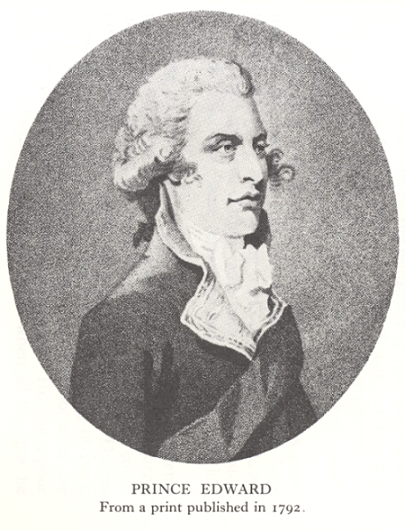
A 1792 Portrait of the Duke of Kent
Prince Edward,
Duke of Kent

(1767-1820):

"The Forgotton Son."


[Table Of Contents]


  • Introduction:-
  • Boyhood:-
  • Luneberg, Geneva, and the Runaway Prince:-
  • Gibraltar and Quebec:-
  • The Halifax Station, 1794-1800:-
  • Prince's Lodge, Bedford:-
  • Julie:-
  • Departure From Halifax:-
  • Gibraltar & Home To England, 1802-3:-
  • Final Remarks:-
  • Dates & Events During Prince Edward's Life:-
  • Notes.


  • [TOC]
    Introduction:-

    With this biographical sketch, we touch upon a very romantic story of early Nova Scotia. You may recall that, before her birth, Queen Victoria's father was stationed at Halifax to serve the King, his father, George the Third; first, as the Commander of the garrison at Halifax beginning in 1796, then, in 1799, as the Commander in Chief of British Forces in North America. He had a female companion who came with him from Quebec. To most she was simply known as Madame de St. Laurent, to her intimates, Julie. She was from an aristocratic family from France; but, not of royal blood. The prince and Julie were to live for a period of about five years at a lodge on Bedford Basin, near Halifax, owned by Governor John Wentworth. I have a picture of it, it was quite the spread. At one point, the Duke had the regiment dig out a pond in the shape of a heart which can be seen yet today: all for the love of Julie.

    Leaving Halifax in 1800 Prince Edward was to wait for further orders from the King. In 1802, he received his appointment as the Governor of Gibraltar. Julie went along and lived there with him. After a short stay Prince Edward came back to England after being abroad for many years; Julie continued to be with him, when in 1816 they moved to Brussels to live out their lives together. Then, the sad part of the story. The British government called Prince Edward home, away from Julie, so that he could marry a German Princess. After a very tearful departure -- they had an exclusive relationship for twenty-seven years -- Julie went off, some believe, to a convent in France to live out the rest of her days. Edward did marry the German Princess; and, in 1819, Victoria, the longest reigning English monarch in history was born to Edward and his German Princess.


    [TOC]
    Boyhood:-

    Edward was the fourth son of George the Third. He was born at Buckingham House, on the 2nd November, 1767. He was to have a great crowd of brothers and sisters. Prince Edward's relationship with his father1, throughout his life was not good -- it seems all the boys had a similar problem, but not the same as Edward. It might have all started over a clock at Kew Palace. It was a clock, as Roger Fulford tells of it2, which the King prized very much, it had come down to him from an uncle of Queen Anne. Apparently, Edward in a momentary fit of pique smashed the clock.3 The King finding out, punished Edward; what the punishment was and how it was administered, I do not know. However, it cannot be said that overall Edward had a difficult boyhood; sure, his father was cold, but there was nothing unusual about that given the age and the position of those who made up the royal family.4 At the tender age of nine, Edward was sent "to live in one of those delightful red brick houses on Kew green ... Till 1779 he shared this house with Prince William, and when Prince William went to sea, Prince Edward found himself, at the age of twelve, the sole occupant of a very comfortable establishment."5

    "Although at Kew the Princes passed out of the direct control of their mother, her rules and regulations had still to be obeyed. The children of King George and Queen Charlotte lived their lives to a code of rules. Every minute of the day was arranged for them, and although their routine was so simple and quiet this constant supervision turned them into strangely mature little men before they were ten." David Duff then proceeded to give an example of the rules their mother set out for what they should have for meals. Breakfast: "Simple milk or a basin two thirds of milk and one of tea" with "dry toast." Dinner: Before five: "Soup if they choose it, when not very strong or heavy, any plain meat without fat, clear gravy and greens. Fish when they please but without butter ..." For desert: "The fruit of a tart without the crust."6


    [TOC]
    Luneberg, Geneva, and the Runaway Prince:-

    At the age of eighteen years, in 1785, Edward went into the army, starting out at Luneberg in Hanover where he came under the supervision of Baron Wangenheim, who was described as "an arbitrary and inflexible governor" and "a mercenary tyrant."7 "No community of feeling could exist between himself and the baron. He had a governor instead of a tutor; a rigid master instead of a kind companion; a morose narrow-minded dictator instead of a considerate and friendly advisor."8

    On May 30th, 1786, Edward was gazetted Colonel in the army. In 1787, he was sent to Geneva. In 1790, "wearied out by the petty and perpetual espionage, thwarted on most occasions by the Baron; chafed by ever occurring annoyances arising from the position he had to maintain, with the stinted allowance assigned him, he resolved to visit England."9 Once in London, his brothers met him almost in secret. The problem was that their father did not know that Edward had run away from the Baron. A message was sent to the King that his son had returned home unexpectedly.

    "Dire was the wrath of the King, his displeasure was inexorable. Prince Edward had returned without his sanction, therefore he refused to see him, and in a few days sent him peremptory written orders under seal to proceed, within twenty-four hours, to Gibraltar, and only admitted him to his presence for a few ["cold and curt"] minutes on the night before his departure. ... [And this] after an absence of six years from his family ..."10
    Before making up his mind to send his twenty-two year old son to think things over on the isolated rock we know as Gibraltar, to act there in its British garrison as middling officer, a courtier spoke up in favour of the young prince, King George exclaimed: "Edward has returned to England without my consent or knowledge; he has left his post without leave. His presence here is an act of most daring and deliberate disobedience; and you call me to sanction it?"11

    Prince Edward set sail for Gibraltar from Southampton on January 30th, 1790.


    [TOC]
    Gibraltar and Quebec:-

    As the first year progressed on "The Rock," Prince Edward became "restless and unhappy." The officers noted that his health was not all that it had been. Then a change. In January of 1791, Prince Edward wrote one of his brothers, the Duke of Clarence.

    "I feel this want of resources perhaps less than any man, for I manage with the assistance of a little music, a few books, & a little small talk with four or five officers, ... Besides I have at present a young woman living with me who I wrote over to, to come from France to me, who has every qualification which an excellent share of good temper, no small degree of cleverness, & above all, a pretty face & a handsome person can give to make my hours pass away pleasantly in her company."12
    And so we see, Julie St. Laurent's entrance into the historical pages, in the hand of Prince Edward. It seems that he knew her before13 he first got to Gibraltar; knew her maybe for a very short period in Geneva, just before he ran away to his family in England in January of 1790. We do not know; except as we can see that Edward wrote to her in France, at some point in the year 1790 to come to him in Gibraltar.

    Prince Edward spent eighteen months this first time at Gibraltar. The events were more boring for the prince at Gibraltar then anything else. He had his Julie who attached herself completely to the prince. However, there were complaints about Edward that got themselves back to London. Chief among them being that he was keeping a French Lady under his roof. I do not know whether these complaints registered with those at Whitehall, or not. After all, Prince Edward was the better for it, -- a nice French Lady to keep him company at Gibraltar. In such a situation: there will be no excessive drinking, no whoring around and staying up late -- not for Prince Edward. No, his transfer to Quebec was because of his request; he had enough of the constraints of this almost island made of rock. He wanted a change of scenery; he himself put in for a transfer, anywhere in Europe would be OK. Why, the authorities could send him and his regiment off to Quebec, if that were to please the King. Apparently such a suggestion did register with the King. On June 24th, 1791, His Royal Highness Prince Edward set off from Gibraltar with his regiment, the 7th Royal Fusileers. On August 11th, a Fleet of His Majesty's ships, including the Ulysses and the Resolution arrived safely at Quebec.14 It was reported in The Times, on Prince Edward leaving for Quebec, that his retinue was "rather domestic than Princely; a French Lady, his own man, and a Swiss valet, composing his whole suit."15

    From the summer of 1791 to January of 1794, a period of two and a third years, Prince Edward and Julie St. Laurent were residents of Quebec. This was to be an interesting period in their lives. The Quebec society because of the predominant French population, was one that was different then that which the pair had experienced at Gibraltar and different from that which they were next to experience in Halifax. In a letter to his brother dated the 8th of July, 1792, Prince Edward wrote:

    "I must own that though this country [Quebec] is preferable to Gibraltar, by the liberty one enjoys of ranging about ... yet it is a sad tiresome séjour for any person who looks up to greater enjoyments than those of traineaux parties. I dread the next winter, as I am convinced that it certainly will be still more stupid & insipid than the last."16
    Though it is not my intention to review the Duke of Kent's life at Quebec, there is, however, one event in Edward's military life which needs mentioning, an event which placed Prince Edward into deeper difficulty than need have been, when, in 1802, he took over the command at Gibraltar as its Governor. The difficulty that Prince Edward consistently had was a difficulty which first raised its head when he was first at Gibraltar, 1790-1. At a young age, it will be remembered, Prince Edward had been sent to Germany to learn the hard tactics of a German officer. Such might work in shaping up German soldiers and Princes of the Royal Blood, but hard tactics, as Prince Edward was to find out, did not work on British soldiers. The signs of trouble that showed at Quebec did not lead to any abatement of the treatment extended to the ordinary soldier; things got that bad that the soldiers rebelled. Prince Edward took no time or trouble to reason with them; and by late winter or the spring of 1793, he had the ringleaders behind bars. A Court Martial followed along without delay and in the result three men were found guilty, one was acquitted for lack of evidence. The sentence for two of them was 500 and 700 lashes; the third was to be shot by firing squad. The man to be shot was named John Draper. His date for execution was to be on April 2nd. On that day the two men were whipped and Draper made to march to the place where he was to meet his death. The yard in which he was to be shot was a few miles out of town and along went the grim parade. Four men carried the black coffin ahead of Draper dressed in white for the grave; in behind was the regimental band playing their dirges; and then there followed the guard and Prince Edward in his full military uniform. David Duff described the scene: "The procession halted. The firing-party lined up. Draper was led out before them." While the firing squad wanted for the command, Prince Edward went to Draper, bound and ready to be shot. Prince Edward reminded John Draper of the terrible moment at which he arrived; he then told him he was pardoned and the parade marched back to the garrison with Draper as white as when he first set out behind his coffin.17

    Prince Edward's difficulty with his soldiers and the hard winters of Quebec drove him to look for another position. In December of 1793, he solicited an appointment under Sir Charles Grey, then engaged in the reduction of the French West India Islands; and, having been appointed a major general, Edward was ordered to proceed to the Islands in January, 1794. Edward left Quebec "immediately before his departure could be made public." Anderson continues: "He proceeded through the United States, intending to embark at Boston, and on crossing Lake Champlain, two of the sleds carrying his whole equipage, broke through the ice and were lost."18

    Julie left Quebec, it appears together with Edward, both of them, together with a contingent of soldiers and servants; all bouncing along over the winter snows atop sleighs being drawn, we suppose, by horses and where not available, by men and dogs. Madame St. Laurent's movements are hard to trace between Quebec and Halifax. She was bound for England while the Prince was off to fight the French in the Caribbean. She likely traveled with the Prince down the Lake Champlain route and either from New York, Boston or Portland (take your choice) she went on alone to Halifax to take a ship for England, one she had to wait for. At Halifax she spent "several weeks, waiting a passage to England." She spent her time with the Wentworths, who were much impressed with Madame St. Laurent. "She is an elegant, well bred, pleasing sensible woman -- far beyond most."19

    In the meantime Prince Edward was seeing action in Martinique and Guadalupe, and making a very good show of himself.20 The campaign in the French West Indies lasted but three months; it was to be the only active service that Prince Edward was ever to see. From there, in 1794, the Prince was ordered to go to Halifax and there to assume the command of His Majesty's Forces in Nova Scotia and New Brunswick with his headquarters at Halifax. Julie was not aware of Prince Edwards's progress, and, it can only be figured that she was of the view that he might be tied up in the Caribbean for more than just three months. Julie, having been "several weeks" at Halifax, boarded a packet for England on May the 10th, 1794, just a day before the naval vessel, Blanche hauled into Halifax Harbour with Prince Edward aboard, 12 days from St. Kitts.


    Picture of the Duke of Kent, c. 1794

    [TOC]
    The Halifax Station, 1794-1800:-

    Julie had sailed for England after just missing her prince. She had not been long landed there when a message got through to her that Prince Edward was at Halifax and was staying there to take up his new command. On the 19th of August, having left England on July 14th, Julie came in from sea to Halifax on the Westmoreland packet and had with her "five servants."21

    Halifax had not grown much since its founding in 1749. At the time of Prince Edward's arrival, in 1794, a census shows that the population at Halifax, I think exclusive of the military personal of both the army and the navy, stood at 4,897. It had not gone up much in forty years, when, in 1752, it stood at 4,249.22 Its fortifications were beefed up on account of the American Revolution; but -- "The peace of 1783-4 brought all activity to a standstill, where it remained about a decade. But the period of renewed warfare from 1793 to the great peace of 1815 saw the erection of many new fortifications at Halifax."23 The first few years of this build up was to be under the direct supervision of the Duke of Kent.

    "Starting in 1795, spending on Halifax's defences soared; in that year alone Prince Edward drew on the treasury for £100,000, and he continued to draw on the treasury for such amounts until Halifax's defences were transformed into an array of fortifications protecting the town and its seaward approaches. The collapsing fort on Citadel Hill was reconstructed, and Martello Towers (round stone towers of which one is preserved in Point Pleasant Park is a classic example) were built at strategic locations. George's Island was fortified and a new barracks built at the north and south sides of Citadel Hill."24
    It was plain to the Duke that his presence at Halifax was needed and there was much work to be done. He wrote his friend de Salaberry25 from Halifax, early on: "I shall undoubtedly remain here, for unless a positive order from His Majesty shall oblige the Commander of the Forces to reside at Quebec, Halifax is without dispute the place where for every reason headquarters should be."26

    Prince Edward's "reputation as a fusspot and a marinet"27 had proceeded him. "He had all that fussy attention to detail which invariably accompanies the officer who is trained for war but never tastes it, whose only experience of a battlefield is a rather tiring field day with his friends."28 The Duke had it ingrained in him, early, that it was necessary to see to the discipline of the soldiers under his command. Not long after first arriving at Halifax we see him taking the same sort of steps that he took at Quebec and at Gibraltar.

    "The Prince at once stamped this state of things [drinking and gambling] with his most marked disapprobation, and quickly put an end to it among the military, by parading the troops every morning at 5 o'clock, always attending himself. ... The prince never touched a card, and as the early parade compelled its votaries to retire early to bed, gambling as well as drinking fell into disuse."29
    Judge Brenton Halliburton of Halifax, in his reminiscences of the Duke of Kent many years later, wrote:
    "His Royal Highness's discipline was strict almost to severity. I am sure he acted upon principle; but I think he was somewhat mistaken in supposing such undeviating exactitude essential to good order. Off the parade, he was the affable prince and polished gentleman. At his table every one felt at ease; but while it was evidently his object to make them so, his dignified manner precluded the possibility of any liberty being taken by the most forward."30

    [TOC]
    Prince's Lodge, Bedford:-

    Wentworth in a letter to his agent in London reported on the first few weeks after the Prince and Madame St. Laurent were together again at Halifax in the summer of 1794:

    "He and his whole family, from six to twenty-six, are still with me ... Since her arrival they sleep at my little Country house, & come to town in the morning. To-morrow they commence dining there, as I have given him the House, furniture and farm, etc. during his stay in the Province. He still retains rooms in the Province house, with me, as it saves him the expense of furnishing [a] House [in town], and dines with me whenever he stays in town."31
    Wentworth built his cottage about six miles from Halifax on the west side of Bedford Basin which he called "Friar Lawrence's Cell." "The Prince took a fancy to the cottage and its surroundings; and soon after, with Sir John's leave, commenced the construction of a mansion, which soon grew to stately proportions."32 This place33 became known as Prince's Lodge and was occupied by the Duke of Kent and his Lady through the years 1794-1800.

    Let us turn once again to Akins:

    "The villa was built altogether of wood, consisting of a centre of two stories containing the hall and staircase, with a flat roof. There were two wings containing the Duke's apartments. In the rear was a narrow wooden building with pointed gothic windows, resembling a chapel, containing the kitchen and the offices, which extended some distance southward beyond the main building. ... The rooms were not spacious, and the ceilings low, which appears to have been the fashion of building in Halifax at the time."34
    Next we turn to McKenzie Porter:
    "The white wooden frame building was in imitation of the rococco Italian style. It had a flat roof surrounded by an ornate railing, long narrow windows, and a double-decked portico with lattice-work up which many coloured creepers climbed. Inside were a big ballroom and a large central hall, used for levees. Behind the house was another building in the Gothic style. This contained the guardroom, the kitchens, and Edward's private office. Opposite was a circular bandstand consisting of a gilded Moorish cupola mounted on Greek columns.
    Hidden in the woods of the grounds was a Chinese temple with strings of copper bells ringing as they were swung by the wind. A gravel path twisted tortuously through the natural woodlands. A balloonist drifting over the estate would have noticed that the path spelled "Julie." At points where it commanded a view of the [Bedford] Basin, there were seats under tiny shelters that looked as if they had been cut out with a cookie cutter. Among the rafters of these shelters little strips of hanging glass tinkled musically in the breeze. The pièce de résistance was an artificial brook, led into the grounds from a nearby stream, which tumbled over a series of pretty waterfalls into a lake. Edward had the lake's natural shape altered to that of a heart as a mark of his love for Julie. It was surrounded by Julie's private garden."
    35

    Picture of Alphonsine Thérèse Bernadine Julie de Montgenêt de St. Laurent, Baronne de Fortisson


    [TOC]
    Julie:-

    She had one of those very long names, which the French used, seemingly to give in one utterance a connection of the whole genealogy of the family together with a geographic location: Her full name was Alphonsine Thérèse Bernadine Julie de Montgenêt de St. Laurent, Baronne de Fortisson. Governor Wentworth described her as "an elegant, well bred, pleasing, sensible woman, far beyond most ... I never yet saw a woman of such intrepid fortitude yet possessing the finest temper and refined manners."36 The year of her birth is not exactly known, likely late 1760s, in France, Normandy, at St. Laurent-sur-mer, a name it seems she adopted for later use. Mollie Gillen was of the view that there was seven years difference in the ages of Prince Edward and her, with Julie being the older of the two.37 She was a person whose education shone through; she was kind, charming and amiable. She could speak and write in perfect English and French. She always treated Edward with the greatest of respect; and he did the same towards her. "With Madame he was always gentle and considerate, treatment earned by her own conduct. Always she behaved with a perfect and natural propriety that never embarrassed their relationship or fell short of his expectations."38 "Her friendships with women in Quebec," Mollie Gillen observed, and this comment would equally apply to her times at Halifax, England and Gibraltar, "were probably always private. She presided at the Prince's table among guests who were almost always male. The prince never attempted to insist on her public reception anywhere, and those ladies who refused to countenance a situation not open to social recognition were spared the embarrassment consequent upon her presence."39

    In Halifax there were those who were critical of the Duke's arrangement that he openly had with Madame St. Laurent. One was John Crosskill who was the captain of the government vessel, the Earl of Moira. She was a 2-masted vessel, a snow, which mounted 14 guns. She was used to transport important government officials and messages within the province and made runs to Boston; often she was employed in running down American privateers. Crosskill forbade his wife to attend any functions where Madame St. Laurent was to be in attendance. The story40 is that Crosskill's feeling in respect to the relationship that the Duke had with Madame St. Laurent was one that led to him being dismissed as the captain of the Earl of Moira in 1796. Ostensibly this was due to him not being a commissioned officer in the Royal Navy, and, so this the Duke explained, was the reason that Crosskill was replaced with a military officer, Captain James Fawson.

    Another in Halifax society who took exception to the Duke's domestic arrangements was Chief Justice Strange. To use Mollie Gillen's words he "spurned Madame. When an invitation to dine at Government House came to Mr Strange, he made it clear that he would only accept the invitation if the lady in question was not present. She accordingly absented herself and the good natured Duke apparently bore the nice-minded Chief Judge no ill feeling."41

    It is thought by some42 that Edward had children and put them out to foster homes. Others43 thought not as there is no existing evidence of children; to which those who suppose that there were children, respond that the evidence of these children was all carefully destroyed by the crown on instructions from Queen Victoria.

    A number of the writers assert that Julie was married when the Duke first met her. She had married Jean Charles André de Mestre, Baron de Fortisson and had a child by him, Mélanie. Tough to know when Edward first bedded Julie, probably after she was "smuggled" out of France together with her child and husband at the Prince's request to Gibraltar. While at Gibraltar their love affair developed under the nose of Monsieur de Mestre. He apparently had enough in Gibraltar to keep him busy and took no exception to the affair that blossomed between the Prince and Madame de Mestre. He, however, did not follow the couple to Quebec; his wife and Edward, with little Mélanie, departed for Quebec and Jean Charles André de Mestre dropped out of the picture.44

    That Julie St. Laurent was ever married to anyone, however, maybe just another one of those myths that have sprung up about this mysterious and beautiful consort to the Duke of Kent.

    "None of the stories are true. She did not retire to a convent in France, in Belgium ... She did not die ... in Quebec at the age 106. She was never married. She had no children at all, though she had at least three lovers. And by the last of these, though he left her to marry another, she was beloved until the day of his death."45

    [TOC]
    Departure From Halifax:-

    In August of 1797, the Duke wrote to de Salaberry from Halifax that he had been there for three years, "... next spring I shall be permitted to return to my country after an absence of thirteen years." In October he puts a qualifier on his statement"if peace is established, it is to be presumed that I will be recalled next spring; but if the war continues I fear no change for me is to be hoped for."46

    Well, Edward was not recalled as he thought he might in 1798. He did, however, leave Halifax that year for England. He had not planned to do so. He took a bad tumble with his horse on a Halifax street on the 8th of August. The whole weight of his moving horse pressed his leg against the hard street. He did not break any of his bones but he suffered from serious contusions. The Prince kept to his regular schedule for weeks thereafter but his leg continued to bother him. He consulted his doctors, one of whom had come from Quebec; and only after they had concurred that he should seek medical help in England did the Prince make plans to go there.47 He determined to document things carefully, as he remembered, well, his father's reaction to him arriving in England from Geneva without his leave. Finally, on Sunday morning, October 21st, Prince Edward went aboard H.M.S. Topaz (Captain Church), "with his suite," Julie included. The Topaz reached Portsmouth on the 13th of November. The royal family at Windsor were happy to see the son who had been so long away from home. It was not likely that Julie attended with Edward when he went up to Windsor; "though the prince's brothers were enchanted by her sparkle at private diner parties."48

    The Duke of Kent was motivated to return to England because of his health. Another concern of his was his long standing financial problems, ones that might be resolved by him personally setting out his case for additional funds. To maintain his "royal presence," Prince Edward spent as freely as the money lenders at London would allow. He was very fond of fine furniture, musical boxes, and ornate clocks; he liked horses; he liked carriages made in London and had them shipped to him; he liked, as befitted a high ranking military officer and a Prince of the Realm, all the accoutrements, dress and arms of a soldier.49

    Prince Edward spent the winter of 1798/99 in England making the rounds. In May of 1799, then 32 years of age, he was gazetted a General and within a week of that appointed Commander in Chief of the Forces in British North America. He sailed from England that summer on the Arethusa, Captain Wooley, and arrived at Halifax on September 6th. He was greeted with royal salutes fired from the batteries and from the ships of war which had bunting streaming from the mastheads and sailors on the yardarms.50 Julie, of course, was with Edward, and, so too, was Lady Francis Wentworth.51

    The Duke of Kent was to spend one more year at Halifax. He and his lady reoccupied Wentworth's lodge on Bedford Basin, and, we imagine, they followed much the same routine as had been established through the years 1794-98. I am not sure who or why the decision was made to bring Prince Edward back home to England. He was undoubtedly happy to return, especially after his taste of the royal life in England the winter before. Certainly the great events of the Napoleonic wars were unfolding spectacularly. In 1799, Nelson's victory at the Battle of the Nile reestablished Britain's hold on the Mediterranean and locked Bonaparte up in Egypt; and because of this the timid princes of Europe were encouraged to form the "Second Coalition": England, Austria, and Russia. The Russians drove the French out of northern Italy; Nelson aided the counter-revolutionaries in the south. It was thought, I suppose, that given these events, that there were any number of positions available for Prince Edward and which would put him closer to the royal hearth; though it was not clear as to what exactly he would be doing once back in England.52

    It was in August of 1800 that the Duke left Halifax for England for the last time: proceeding from Government House, "accompanied by the Lieutenant Governor, council, navel, military and civil officers, &c., and reached the ship under salutes from the citadel, artillery corps, and men-of-war, whose yards were manned. The people were on tops of houses and at windows to evince their interest. On Monday, August 4th, the 50 gun ship, Assistance sailed for England, receiving salutes from the batteries as she passed, and the Prince arrived at Portsmouth August 31st."53

    A couple of days after Prince Edward departed, there was to be a sorry scene on the Halifax Common, a scene that the Duke of Kent probably was most anxious to avoid:

    "On the 7 August [1800] a melancholy proceeding took place at Halifax. Eleven soldiers sentenced to death for acts of mutiny and desertion, were escorted with all solemnity behind the citadel by all the troops in garrison, viz., the Royal Newfoundland regiment, the Royal Nova Scotia regiment, 26th, 24th, 7th, and Royal artillery. The convicts were dressed in white, their coffins painted black, drawn on a cart before them. Two clergymen - Wright, (protestant), and Burke, (catholic) - attending them, a band playing some dirge. On the place of execution, eight were reprieved, and three who belonged to the Newfoundland regiment, were hanged at twenty minutes before 7, a.m."54

    [TOC]
    Gibraltar & Home To England, 1802-3:-

    On returning home Prince Edward, but 32 years of age, casted about for a meaningful position that he might take up as a prince. Months passed before something came up. His old boss, General Charles O'Hara at Gibraltar was ill. Prince Edward was appointed to succeed O'Hara as the Governor of Gibraltar. It was recognized at the time of Edward's appointment that O'Hara's administration was permissive or relaxed55 and that the typical vices of soldiers, where they had not been put under control in a timely and consistent manner, were more than just simply noticeable at Gibraltar. It seems that Prince Edward was told of this and that he should take the appropriate steps to bring the garrison back into line and the government would support him in his endeavours. Prince Edward received his appointment in March of 1802, and within a month departed Falmouth and reached Gibraltar on the 10th of May.56 On his arrival in Gibraltar, Prince Edward -- a familiar story -- was to find discipline to be at a very low ebb; and, so, he determined to shape things up. "A roll call was established at sunrise, and the men should attend regularly at meals, and that they should be in barracks after the firing of the second evening gun."57

    "Edward also insisted on uniformity of the appearance of sentries. All sentries were ordered to don or remove greatcoats at the command of the orderly officer, and not merely when they felt too cold or too hot. At daylight every day each member of a guard or a picket had to wash, untie his hair, comb it, tie it afresh, and brush his clothes to the satisfaction of the orderly officer."58
    Such steps as the Prince did take worked both at Quebec and at Halifax; they did not at Gibraltar. At length a mutiny broke out. The Duke met this with firmness, seizing the head mutineers. Ten were found guilty and three were put to death. The stories that certain jealous officers got back to England were not favourable to Prince Edward. On the 1st of May, 1803, having been recalled, Edward sailed for England arriving at London on the 26th. "He returned wounded and insulted ..." His brother, The Prince of Wales came to his defence:59
    "You send a man out to control a garrison all but in a state of open mutiny. You tell him to terminate such a disgraceful state of things. You assure him of the unqualified support of Government in his undertaking. He goes out. He finds matters infinitely worse than they were represented. The impending outbreak occurs. He quells it thoroughly. By way of reward you disgrace him! If you want to deter an officer from doing his duty, or desire to encourage a mutinous soldier, your tactics are admirable. They cannot fail to attain such a result. Edward may well complain. He was neither officer, nor man, if he were silent."60
    It would not appear that the King was unhappy with Prince Edward's actions at Gibraltar, at least, not as much as he was in times past. If the king was unhappy, then there was an amelioration, such that on the 5th of September, 1804, Prince Edward by His Majesty's command was promoted to Field Marshal.61 But that was it, Edward was never again active in the military, though for many years he continued to be the Governor of Gibraltar but in name only. A dozen years were then to pass for Prince Edward in England. These were domestic years with Julie. On September 3rd, Julie wrote a letter to her friends the de Salaberrys from Kensington Palace where she made the observation "clothes are really dearer than in Canada, and of course, I am obliged to appear always well dressed, in silk stockings, etc."62 We see from Prince Edward's correspondence that he was going back and forth to Windsor, presumably there to see his parents and his sisters. In December we see him writing from Kensington Palace, and how it is intended to have Christmas there with Julie, though in the same letter he makes reference to Julie's "house at Knightsbridge," which, of course, is in the same neighbourhood as Kensington Palace.63 On June 5th, 1810, we see Edward writing to de Salaberry: he wrote that he divided his time "between my poor sick sister at Windsor, and my unfortunate wounded brother in London ..."64 Hounded by his creditors to the extent that he was thinking of "selling his wines and mortgaging his plate," Edward determined to move to the continent as so many debtors did back in those days.65 In 1816, he and Julie took up residence at Brussels arriving there in July. "He took the largest house he could find in Brussels. For a year it was filled with carpenters, bricklayers, painters, glaziers, architects, embellishing it for a Prince of England."66

    As already observed, it was in 1816 that Prince Edward and Julie took up residence at Brussels. They may well have made that move years earlier but travel to Europe before 1815, the year that the war came to an end, was not possible. There at Brussels the pair seemed to have been very happy. McKenzie Porter:

    "With their small diner-parties, music whist, and occasional visits to the theatre, Edward and Julie were content. Edward's seven thousand pounds a year sufficed for their needs; the knowledge that his creditors were being steadily paid off was heartening; the Gallic air of Brussels proved a tonic to their spirits; and the assurance of a long peace seemed to promise them a restful middle age. Indeed Edward and Julie might have spent the remainder of their days in Brussels but for a calamity that, in the moment of their greatest bliss, tore them cruelly apart."67
    In 1818, Princess Charlotte, the only legitimate grandchild of George the Third, and presumptive heir to the throne, died in child birth. There then arose the thought, in spite of the many children that George the Third had, that the House of Brunswick might fail for the lack of an heir to the throne. Pressure was now coming on to certain of the Royal Princes to get busy, marry German Princesses, and have royal babies.

    It was but a few weeks after the death of Princess Charlotte that Edward and Julie were at breakfast in their home at Brussels -- we will let Robert Fulford tell of it:

    "... the Duke tossed her over the paper to read, while he opened his letters. Suddenly he was disturbed by hearing a gasp and a gurgle. For a few moments he thought that Madame was going to die: but, when she had sufficiently recovered, she pointed to the paper, where it said that it had become essential for the succession that the Duke of Kent should marry."68
    Julie and Edward up to this point, 1818, had been together for twenty-seven years.69 It was now expected, for dynastic reasons, that he should marry as soon as arrangements might be made. On the 19th of March, 1818, a scene unfolded. I imagine it to be a busy one, with a carriage waiting in the stone yard of their residence; it is overcast and a mist falls. Out the side door there comes the Duke with his Julie on his arm escorting her to the waiting carriage. No expression in either face; a hand up and the door is closed and with a tap to the driver the carriage is jolted to action by the matched horses and pulled out of the yard with a wet footman hanging on to the rear rail of the coach taking shelter best he can. Both Edward and Julie feared any words at this point would but shoo away the faint hope of a reunion in the future. To quote Mollie Gillen, "Madame made her exit from her prince's life with the dignity she had shown all through their relationship."70

    On the 24th of March, Prince Edward was in London, alone. The ministers of government had already selected a Princess for Edward to marry: Her Serene Highness, Mary Louisa Victoria, widow of the late Prince of Leiningen. The appropriate representations were made, and, on the 29th of May, 1818 the pair were married; first in Germany then a second ceremony in England to become The Duke and Duchess of Kent. They returned to Germany, and, before the year was out it was determined that the Princess was pregnant. They had made it across to England but weeks before, when, on May 24th, 1819, the Princess Alexandria Victoria was born and the House of Brunswick was saved. Prince Edward spent but the first few months with his little one, for, on January 3rd, 1820, he died at Woolbrook Cottage, near Sidmouth on the south coast of Devon. "A neglected cold, terminating in inflammation of the lungs." "Blisters, bleedings, cuppings and leeches were tried, and the invalid lost a hundred and twenty ounces of blood."71 A day before he died, Edward had made his will, directing that everything was to go to the Duchess of Kent and the Duke of Kent's seven month old child, Princess Victoria.72


    [TOC]
    Final Remarks:-

    There is the story set out by Duff73 as to Edward's charitable heart. This was in Gibraltar in the midst of all his troubles with the officers there and back in England. A soldier who had brought his family over to Gibraltar had set out in a small boat with his son to catch fish for his family. A storm came up; the boat upset; and the pair died. The widow, pregnant with another, received a visit from an officer who consoled her and played with the children for a while, on leaving he put twelve gold dollars in her hand. The next day he came again with gifts for all of them. The widow only knew that this was an officer she had no idea it with the Royal Prince, The Duke of Kent. After a few visits, the woman saw in a public parade that the officer that had been so generous to her and her fatherless family was none less than His Royal Highness, the Duke of Kent. On a further visit, one of the children addressed the officer as, "His Royal Highness." The Prince, though he continued to watch over the family, never paid them a visit again.

    The Duchess of Kent took herself and her baby up from Devon to London where the family took over. The cortège brought the body of Prince Edward to Windsor where he was buried in the Royal Vault. The Duchess had a set of apartments granted to her at Kensington Palace, there to spend quiet years raising her daughter Victoria.

    Julie, it is popularly believed, after she and Edward separated, went off to a convent in France to live out the balance of her days. This may be so, really there is so little we know of Julie St. Laurent. McKenzie Porter74 has it that she went, in time, to be with her family, the de Montgenêts, at St. Laurent-sur-mer on the Normandy coast. It is said that she eventually married Prince Prospero Colonna, a member of the Russian branch of an Italian family. They traveled to Louisianna where Colonna had family. From Louisianna they went to Quebec where Julie stayed on while her husband attended to his family affairs that brought him to Russia. On one such trip he died. Julie, it is said, continued to stay on in Quebec where she died, in 1872, at the ripe old age of 106. This is likely not true, as, Mollie Gillen has it that Julie was buried in the cemetery of Père Lachaise75, buried with her sister in a grave that is weathering, with moss and ivy having rendered the piece of ground unidentifiable.

    As for his connection to Nova Scotia, Prince Edward made his marks on Halifax, and will always be remembered. These marks on the ground can be yet seen today. There is the town clock on the eastern slop of citadel hill overlooking the city. The plans for its construction, made in England, were initiated before Prince Edward left Halifax in 1800, though its construction was not completed until 1803.76 Somehow it was an appropriate gift made by the Prince who had a life long fascination with clocks. There are the old fortifications, particularly the Martello Tower at Point Pleasant, these were the products of Prince Edward's mind. We have Prince Edward to remember for the construction of St George’s Round Church; for his residence on Bedford Basin at Prince’s Lodge where one of its outbuildings, the Music Rotunda, still stands on the shore with its gold cupola and white Greek columns.

    Prince Edward, however, was to leave an indelible mark on history by fathering the most successful monarch in English history. Princess Victoria was to become Queen of Great Britain (1837-1901). She succeeded her father's older brother William IV who reigned for seven years after George the Fourth's death. As a woman, Victoria was barred from succession in Hanover, so her accession in Britain ended the connection between the British and Hanoverian thrones. Victoria's reign was marked by her high moral character and extreme conscientiousness. During her long reign, the longest in English history, Great Britain was to come into a period of history which saw the rise of British influence throughout the world.

    _______________________________

    Found this material Helpful?

    _______________________________
    [TOC]
    Dates & Events During Wentworth's Life:-

    1767:
    § Prince Edward was born at Buckingham House, on the 2nd November, 1767.
    1773:
    § December, 1773: Boston Tea Party.
    1775:
    § April 19: Fighting erupts at Lexington and Concord.
    1776:
    § July: Declaration of Independence made by the British North American Colonies.
    1783:
    § September 3rd: The Paris Peace Treaty by which the hostilities between Great Britain and her colonies were brought to an end and which brought into being the independent nation of the United States of America.
    1785:
    § At the age of eighteen years, Edward went into the army, starting out at Luneberg in Hanover.
    1786:
    § May 30th, Edward gazetted Colonel in the army.
    1787:
    § Edward was sent to Geneva.
    1789:
    § At Paris, a political club or society meets in the old convent of the Jacobins (order of monks) to maintain and propagate the principles of extreme democracy and absolute equality; they became known as the Jacobins.
    § June: The French Revolution breaks out.
    1790:
    § Prince Edward runs away from Geneva to return to England.
    § Considering that he absented himself from Geneva without leave, the King, his father sends Prince Edward to Gibraltar to serve as an army offcier at that place.
    § Prince Edward set sail for Gibraltar from Southampton on January 30th, 1790.
    1791:
    § Having set sail on June 24th, on Aug 11th, a Fleet of His Majesty's ships, including the Ulysses and the Resolution arrived at Quebec with the 7th Royal Fusileers, commanded by His Royal Highness Prince Edward.
    1792:
    § The Napoleonic wars (1792-1815).
    § May 14th: Sir John Wentworth sworn in as Lieutenant Governor of Nova Scotia; he remained so for the next sixteen years, until 1808.
    § August 10th: A Parisian mob storm the Tuileries and take the royal family as prisoners. The "September massacres" follow.
    § With a force launched from Halifax, the British capture Saint-Pierre and Miquelon.
    1793:
    § January 21st: Louis XVI is beheaded; George III sent the French ambassador packing; Diplomatic relations were severed; France invaded England's ally, Holland; and, on February 1st, France declared war on England.
    1794:
    § January: Prince Edward, having been appointed a major general, was ordered to proceed from Quebec to the French West India Islands in order to assist Sir Charles Grey in his reduction of these French holdings.
    § May 10th: Julie takes a ship from Halifax to England.
    § May 11th: Edward arrives at Halifax from the West Indies.
    § June 14-28: Prince Edward does a tour of the province; by land to Annapolis Royal then over the Fundy to St. John.
    § Howe's victory of "The First of June" that arose as a result of the meeting of the English and French fleets off of Brest was to show to the world that England continued to hold on to her superiority at sea.
    1796:
    § The French conquer Italy, and Austria deserts Britain in her struggle against France.
    1797:
    § In January, with Bonaparte having successfully invaded Italy and Spain coming in on the side of France and Austria retiring from the war, France was left without an enemy on the continent, and England without an ally. England, fearing an invasion, withdrew her ships from the Mediterranean, which was thus to become a "French Lake" from January 1797 to May 1798.
    § Naval mutinies between April and June at Spithead and the Nore.
    1798:
    § Nelson re-enters the Mediterranean in May, 1798; and, in August Nelson destroys the French fleet at The Battle of the Nile.
    § Frances Wentworth was ill through the winter, indeed there was fear that she might die; she recovers but spends a number of months in bed. Hearing that her son Charles Mary, who was then in England, was not well, Frances, in the spring of 1798, sails for England.
    § October 23rd: The Duke of Kent is in need of medical attention due to a fall from his horse, on Sunday morning, October 21st, embarks, "with his suite," in the H.M.S. Topaz. The Topaz with the royal standard flying and with guns blazing from the men-of-war in the harbour and from citadel hill, sails on October 23rd; she reaches Portsmouth on 13th of November.
    1799:
    § May 17th: Made a duke, the Duke of Kent, Prince Edward was appointed the Commander in Chief of British forces in North America.
    § In Nova Scotia: The assembly meets on Friday, 7 June, 1799 (7th general assembly, 7th and last session). Governor Wentworth in his speech recommends quarantine laws to guard against "yellow fever"; he recommends the completion of the roads to Annapolis and Pictou.
    § September 6th: The Duke of Kent returns to Halifax in "the Arethusa, capt. Wooley, 43 days from England. As she came up the harbour, royal salutes were fired from the batteries and from the ships of war, whose yards were manned ..." In addition to Prince Edward, Julie and Lady Francis Wentworth were aboard the Arethusa.
    § October 30th: The Duke of Orleans, in the midst of a tortuous journey from the U.S. to France, calls over at Halifax. He and his two brothers, though prisoners, are entertained by Wentworth and the Duke of Kent, indeed, the Prince lends some money to the Duke of Orleans; afterwards, as King of France, Louis Philippe was to reminisce to the young Queen Victoria about her father and his kindness.
    1800:
    § June 23rd: At Halifax: "For sale, for term of years, as may be agreed on, a likely stout Negro girl, aged 18 years, good natured, fond of children, and accustomed to both town and country work."
    § "The Duke of Kent imported four horses of value, to improve the breed in the province."
    § August 4th: Duke of Kent leaves Halifax for England for the last time, arriving at Portsmouth on August 31st.
    § September 11th: The corner stone for Governor Wentworth's new house, Government House, is laid by Wentworth.
    1801:
    § "On the 4 February, the stables, coach houses and offices at Sir John Wentworth's villa, the 'Lodge,' were burned, and on the 8th a fire occurred in front of Government House, by which many houses and stores on Hollis Street were destroyed."
    § For a few months during the winter of 1800-01 there was formed a league against England; the league consisted of Prussia, Sweden, Denmark and Russia. This "was caused partly by the whim of the Czar Paul [and] partly by two feelings then prevalent in the Courts of Europe, fear of France and jealousy of English naval power." With Nelson's capture of the Danish fleet at Copenhagen in April, 1801, this league against England shortly came to an end.
    1802:
    § The Treaty of Amiens is signed and the war between France and England is ended leaving France supreme in Western Europe, and England supreme on the oceans of the world.
    § March: The Duke of Kent received his appointment as the Governor of Gibraltar; within a month departed Falmouth and reached Gibraltar on the 10th of May.
    1803:
    § Mutiny at Gibraltar. Prince Edward overseas the Court Martial. Eleven mutineers were sentenced to be shot, three were actually executed on January 4th.
    § War again: the Peace of Amiens comes to an end. A circular letter, dated 16 May, 1803, from Downing Street: "Unfavorable termination of the discussion lately depending between his majesty and the French government ... his majesty's ambassador left Paris on the 13th."
    § Green: "Amid all the triumphs of the revolutionary war, the growth of the British empire had been steady and ceaseless. She was more than ever mistress of the sea. ... She was turning her command of the seas to a practical account. Not only was she monopolizing the carrying trade of the European nations, but the sudden uprush of her industries was making her the workshop as well as the market of the world."
    § May 2nd: Prince Edward and his "large suite" aboard the Amazon at Gibraltar and arrived at Falmouth on the 27th. Prince Edward was then to begin "the journey into a limbo of official rejection in which he would never be given an opportunity to clear his name."
    1804:
    § "On the 11th of April 1804, a treaty was concluded at St. Petersburg. Five hundred thousand men were to be arrayed against France. Great Britain was to contribute ships and men and money. On the 9th of August, Austria signified her adherence. This was the Third Coalition."
    § War between Britain and Bonaparte-dominated Spain breaks out on December 12th, 1804.
    1805:
    § Charles, Wentworth's son moves to England.
    § October 21st, Nelson's victory at Trafalgar, by it both the French and Spanish navies were annihilated, and, the the danger of any invasion of England rolled away like a dream.
    § In December of 1805 the Battle of Austerlitz took place (Austerlitz is a place located in modern day Czechoslovakia). Napoleon decisively defeated the armies of Russia and Austria, each with its emperor at its head.
    1806:
    § On January 23rd Pitt dies.
    § Grenville, the foreign secretary since 1791, forms the government of "All the Talents" which was dissolved in 1807.
    § In September Fox dies in office.
    § In 1806 England abolishes the slave-trade (in 1833 slavery itself).
    1808:
    § In support of a Spanish rising, in July, Arthur Wellesley (later to become known as the Duke of Wellington) leads the first small British force of 9,000 men into the peninsula of Spain; a gate into the hostile fortress of Napoleonic Europe.
    1809:
    § Perceval becomes the English Prime Minister and Liverpool Secretary for War and the Colonies.
    1810:
    § George III is ill; his son, the Duke of Wales (1762-1830) takes over as the Prince Regent; in 1820, on his father's death, he becomes George IV.
    § The Wentworths move to England taking up residence at London.
    1811:
    § Austen's work, Sense and Sensibility.
    1812:
    § May, Prime Minister Perceval, assassinated.
    § Wentworth flees his creditors. Leaving behind his wife and child which he was not to see again, he takes refuge at Halifax.
    § On 18 June: President Madison and the American Congress declare war on Britain. There then follows: The War of 1812.
    § Byron Donkin builds (tin plate having been invented in 1810) the first canning factory in England, his principal orders coming from the Royal Navy for canned soups and meats used in the war against America.
    § Liverpool becomes the English Prime Minister.
    1813:
    § February 14th: Lady Wentworth (1745-1813), in her 68th year of age, dies in England.
    § During forty days in May and June, the British troops drive the French armies over the Pyrenees and out of Spain; Napoleon's back is broken by the military and diplomatic actions of Wellington and Castlereagh.
    § Napoleon retreats from Moscow and struggles to retain hold of central Europe.
    1814:
    § April: Paris is captured and Bonaparte abdicates.
    § December 24th: Treaty of Ghent signed.
    1815:
    § March 1st: Napoleon returns from Elba and the "Hundred Days" begin.
    § June 18th, 1815, the Battle of Waterloo.
    § Unemployed ex-servicemen walk the streets.
    1816:
    § In England, gold was declared to be the sole standard and full legal tender, and a new coin, known as the sovereign was put into circulation.
    § Men were put to death for serious crimes; and for certain of the less serious crimes the court would order that one of the convict's ears be cut off, -- one eared men were to be avoided.
    § Robert Owen publishes A New View of Society or Essays on the Formation of the Human Character Preparatory to the Development of a Plan for Gradually Ameliorating the Condition of Mankind.
    1817:
    § Civil wars (Simón Bolívar and the Latin American revolution) sweep over the Spanish New World in waves from 1812 to the early 1820s; driven by both the political theories of Rousseau and the disruptions of civil order in Spain on account of Bonaparte and the resulting peninsular wars.
    § November 5th, 1817, Princess Charlotte died.
    1818:
    § Unrest in England, with the Northern and Midland radicals causing sporadic violence and attacks on mills.
    § March, 19th: Edward and Julie separate.
    § May 29th: The Duke of Kent married Her Serene Highness, Mary Louisa Victoria, widow of the late Prince of Leiningen.
    1819:
    § May 24th: Queen Victoria is born.
    1820:
    § January, 23rd, Edward, Duke of Kent, aged 53, dies.
    § January 29th: George III dies, George IV (1762-1830) takes the throne. Due to his father's derangement he had been the Prince Regent since 1810.
    § April 8th: Sir John Wentworth, aged 84, dies at Halifax.
    _______________________________
    [TOC]
    NOTES:

    [1] "George III, with his narrow mind, his intriguing and cunning nature, his stubborn insincerity, his homely lack of dignity, his cheese-paring domestic meanness, his middle-class popularity and middle-grade intellect ... George was one of those hearty fellows who reveled in the obvious and hated subtleties, ate well, slept well, tended toward corpulence, took a large amount of horse exercise ... His wife Charlotte (of Mecklenburg-Strelitz) bore him no fewer than fifteen children, but he had to bear with a spouse who was as dull as she was respectable." [Chatterton's A Life of William Pitt, (Indianapolis: Bobbs-Merrill, 1930) p. 168.]

    [2] Royal Dukes (London: Duckworth, 1933) p. 150.

    [3] Edward was to have a life long fascination with clocks and music boxes; later in life he was to have a sizable collection of them. See, McKenzie Porter Overture to Victoria (Toronto: Longmans, Green, 1961) p. 88.

    [4] However there are those authors such as Lord Rosebery who were of the view that George the Third made his children's home a "hell upon earth"; he thought it his duty to reign over his children as a despot. "As a consequence, they escaped from his roof as soon, and returned to it as rarely, as possible." [Pitt (London: MacMillan, 1891) at p. 12.]

    [5] Royal Dukes (London: Duckworth, 1933) p. 150. William and his wild ways, it is to be noted, caused considerable concern for his parents such that they handed him over to the Royal Navy at the age of fourteen. "The Sailor King," King William IV occupied the throne for seven years just prior to the ascension of Victoria.As part of his career in the navy, Prince William visited Halifax, as the captain of his own warship, in 1786 and in 1787 in the 28 gun Pegasus, and then in 1788 in the Andromeda. It was during these visits, it is reported, that Lady Wentworth extended the comforts of her bed to the Prince.

    [6] David Duff, Edward of Kent: The Life Story of Queen Victoria's Father (1938) (London: Frederick Muller Ltd., Redwood Press, 1973) pp. 47-8.

    [7] See Anderson, The Life of Edward, Duke of Kent (Ottawa: Hunter, Rose, 1870) p. 4.

    [8] Erskine Neale, The Life of Field-Marshall His Royal Highness, Edward, Duke of Kent (London: Richard Bentley, 2nd Ed., 1850) p. 15.

    [9] Anderson, p. 6.

    [10] Anderson, p. 6.

    [11] As quoted by David Duff, Edward of Kent: The Life Story of Queen Victoria's Father (1938) (London: Frederick Muller Ltd., Redwood Press, 1973) p. 76.

    [12] As quoted by Mollie Gillen, The Prince and His Lady (Toronto: Griffin House, 1970) p. 21.

    [13] This letter of the Duke of Kent to his brother, the Duke of Clarence is proof of the fact that he knew Julie before 1791. There is additional proof of this: In 1818, Edward wrote that he and Julie were together for twenty-seven years. We will see where Julie and Edward were to part permanently at the beginning of 1818. This came about, as we will see, because of a crisis in the House of Hanover -- a distinct lack of royal babies. The crises came to a head with the death of the only grandchild, Princess Charlotte which occurred in November of 1817. That infers that Edward met Julie in 1790. In January of 1790 Prince Edward fled from Geneva! Thus it seems likely that they met at Geneva in the autumn of 1789. Prince Edward, a twenty two year old who had led pretty much a sheltered life to that point; and Madame St Lawrence a beautiful and sophisticated French lady who was then twenty-nine. [Edward of Kent: The Life Story of Queen Victoria's Father (1938) (London: Frederick Muller Ltd., Redwood Press, 1973) p. 246.]

    [14] Duff has them setting off for Quebec from Gibraltar on May 27th, 1791; and that he arrived, together with a navel fleet of six war ships [Duff names them at p. 99.], at Quebec on July 27th. Gillen, at p. 25, sets out the dates that I have used in my narrative.

    [15] As quoted by Mollie Gillen, The Prince and His Lady (Toronto: Griffin House, 1970) p. 25. Gillen, by going to the ship's list, identified three servants that made the crossing to Quebec with Prince Edward: Philip Beck, John Woolmer and Robert Wood.

    [16] As quoted by Mollie Gillen, The Prince and His Lady (Toronto: Griffin House, 1970) p. 57.

    [17] See Duff's Edward of Kent: The Life Story of Queen Victoria's Father (1938) (London: Frederick Muller Ltd., Redwood Press, 1973) pp. 111-2.

    [18] Anderson, The Life of Edward, Duke of Kent (Ottawa: Hunter, Rose, 1870) pp. 18-9.

    [19] Mollie Gillen quoted Wentworth, The Prince and His Lady (Toronto: Griffin House, 1970) p. 87.

    [20] At Martinique and Guadalupe, Prince Edward "headed several storming parties, on attacks on important forts ... and his daring bravery secured him general admiration ... and, as might have been expected, made him popular with the soldiers." See Akins, "History of Halifax City," NSHS, #8 (1895), p. 106; and see, Fergusson's introduction to the third volume of Diary of Simeon Perkins (Toronto: The Champlain Society, 1961) p. xxiii.

    [21] These are Gillen's dates, see p. 92. There are letters written by Prince Edward at Halifax during July of 1794 [see Anderson, The Life of Edward, Duke of Kent (Ottawa: Hunter, Rose, 1870) p. 23] which seem to indicate that Julie was at Halifax by mid-July?

    [22] Akins breaks the figure down: 1301 males over 16 years of age, 935 males under 16 years of age, 2209 females, 422 black. (See Akins, History of Halifax City, NSHS, #8, p. 103; Haliburton, vol. 1, p. 270; and Murdoch, vol. 3, p. 424.)

    [23] Piers' The Evolution of the Halifax Fortress (Halifax: PANS, Pub. #7, 1947) p. 21.

    [24] Brian Cuthbertson The Loyalist Governor (Petheric Press, 1980) at p. 76.

    [25] The de Salaberrys at Quebec befriended Prince Edward when he first arrived there in 1791; Edward and Julie were life long friends of the de Salaberrys. It was in 1792 that Edward and Julie became the Godparents to the youngest de Salaberry, Edward. There were three older boys: Louis (known as Chevalier), Maurice and Charles. The boys all benefited from their connection to Prince Edward. Well, maybe not. It appears they all had a chance to go to London to visit with Edward and Julie; in each case their education and promotion in the army was personally seen to by Prince Edward. Unfortunately these were years of war and two of the boys were shipped to India, that great graveyard of English soldiers; they both died there of dysentery. Edward, but twenty years old, was seen off by Edward and Julie as his troopship left for Spain. Edward was killed in the Battle of Badajos on April 5th, 1812. The surviving son fought his battles in Canada defending British rights against the rights of the United States of America. He is known as the hero of Chateauguay, a place where there unfolded an important battle with the Americans during The War Of 1812. For more, on the connection that the Duke of Kent had with the de Salaberry boys, see Mollie Gillen, The Prince and His Lady (Toronto: Griffin House, 1970) pp. 192-3.

    [26] See Anderson, The Life of Edward, Duke of Kent (Ottawa: Hunter, Rose, 1870) p. 32.

    [27] McKenzie Porter Overture to Victoria (Toronto: Longmans, Green, 1961) p. 89.

    [28] Roger Fulford's Royal Dukes (London: Duckworth, 1933) p.153.

    [29] Anderson, p. 42; for another account, see Neale, The Life of Field-Marshall His Royal Highness, Edward, Duke of Kent (London: Richard Bentley, 2nd Ed., 1850) p. 72 who was of the view that such an approach not only improved the military but also, by example, civilian classes of Halifax society.

    [30] In a letter to Sir John Hervey and as set out by Neale, The Life of Field-Marshall His Royal Highness, Edward, Duke of Kent (London: Richard Bentley, 2nd Ed., 1850) p. 74.

    [31] As quoted by Mollie Gillen, The Prince and His Lady (Toronto: Griffin House, 1970) p. 57.

    [32] Archibald, "Life of Sir John Wentworth," NSHS, #20 (1921) p.64.

    [33] Some said "Prince's Folly." See Anderson, The Life of Edward, Duke of Kent (Ottawa: Hunter, Rose, 1870) p. 42.

    [34] "History of Halifax City," NSHS, #8, p. 124.

    [35] Overture to Victoria (Toronto: Longmans, Green, 1961) pp. 82-3.

    [36] As quoted by Mollie Gillen, The Prince and His Lady (Toronto: Griffin House, 1970) p. 2.

    [37] The Prince and His Lady (Toronto: Griffin House, 1970) p. 95.

    [38] The Prince and His Lady (Toronto: Griffin House, 1970) p. 96. David Duff wrote, "They were a strange couple, he so solid, stiff, precise, and punctilious in spite of occasional flashes of humour, with a quiet but steady affection; she is so vivacious, bright, loving, and rather foreign 'in a way that sometimes upset the perfection of Castle Hill [their home in England],' caring for little in life save her 'beloved duke,' her friends, and her religion. She was part of his life; he was her entire existence." [Edward of Kent: The Life Story of Queen Victoria's Father (1938) (London: Frederick Muller Ltd., Redwood Press, 1973) p. 232.]

    [39] Mollie Gillen, The Prince and His Lady (Toronto: Griffin House, 1970) p. 41.

    [40] See, "Crosskill vs Kent"; by James F. Smith, NSHQ, Vol. #2:3 (1972).

    [41] The Prince and His Lady (Toronto: Griffin House, 1970) p. 103.

    [42] "Their first son, born in Quebec City, took the name of his foster-father, Robert Wood, and made his home in Canada. Their second son, Jean de Mestre, born during Julie's 1794 voyage from Quebec City to Halifax, was reared by Julie's mother in Martinique until he was seven. Then he was sent to Jesuit school in Philadelphia. Eventually he joined the French consular service in Australia. Mélanie, Julie's daughter by de Fortisson, lived with her mother in Halifax until 1798." (Porter, Overture to Victoria (Toronto: Longmans, Green, 1961) p. 92.)

    [43] David Duff thought not. "Rumour has it that the Duke of Kent had a family of nine children by Julie de St. Laurent. This is very doubtful." (Edward of Kent: The Life Story of Queen Victoria's Father (1938) (London: Frederick Muller Ltd., Redwood Press, 1973) p. 193.)

    [44] McKenzie Porter Overture to Victoria (Toronto: Longmans, Green, 1961) p. 22. Though he came back into the picture, later, when Prince Edward was sent to Martinique and Guadalupe. Behind the walls of one of the French forts was no other than de Mestre, who upon leaving Gibraltar (Porter has it at p. 72) joined the French army and was sent out to the French West Indies. De Mestre was killed in one of these battles, his head taken off by a cannon ball; tradition has it that it rolled, de Mestre's head, to the feet of Prince Edward. [See Mollie Gillen, The Prince and His Lady (Toronto: Griffin House, 1970) p. 4.

    [45] Mollie Gillen, The Prince and His Lady (Toronto: Griffin House, 1970) p. 8. These legends are dealt with by Mollie Gillen right at Chapter One. Of the Books written about Prince Edward and Madame St. Laurent, Gillen's is by far the best. She has her work well documented. At the back is an appendix in respect to the facts. She also did research into the Montgenêt family. In her work, Gillen set forth an exhaustive bibliography and gives numerous references. Where there is a conflict with the other authors, I preferred to take the word of Mollie Gillen.

    [46] See Anderson, The Life of Edward, Duke of Kent (Ottawa: Hunter, Rose, 1870) p. 51.

    [47] See, Murdoch, vol. 3, p. 172. The advice that the Prince received from a Dr. North then at Halifax was that he should return to England so to "take the waters of Bath." This we learn from the Duke himself in a letter to de Salaberry dated 15th of October, 1798. [See Anderson, The Life of Edward, Duke of Kent (Ottawa: Hunter, Rose, 1870) p. 56.]

    [48] Mollie Gillen, The Prince and His Lady (Toronto: Griffin House, 1970) p. 121. At p. 198, one will find this: "Though the duke's life as a royal prince had to exclude Madame (she never went with him to Windsor or Buckingham House, or to Court functions, or on the family visits to Weymouth), she did on at least one occasion meet the Queen and two of the princesses.

    [49] We see where Prince Edward lost the whole of his "equipage" when sleds broke through the ice of Lake Champlain, during January, 1794. He had placed an order after arriving at Halifax in 1794 with his suppliers at London to delver new equipage at a cost of £2,000, a very large sum in those days. This order was shipped in 1794 aboard the Antelope; but unfortunately the Antelope and its cargo never arrived as the vessel was captured by the French as a prize of war. A further order, his fifth was placed, and that too was lost due to enemy action; and a sixth order, same result. [See Anderson, The Life of Edward, Duke of Kent (Ottawa: Hunter, Rose, 1870) pp. 33 & 55.] To quote Anderson "on his appointment to the command in chief in B. N. America, he had ordered his seventh equipment to the value of £11,000, sterling, which was most thoughtlessly sent out in the month of October, in the Francis, which was wrecked [on December the 22nd] on Sable Island. Every soul on board perished, and ship and cargo were swallowed up by the insatiable sands." (Ibid., pp. 68-9.) Aboard the Francis was Prince Edward's household effects, which included "several valuable horses, and a most extensive library." (See NSHS #11, p. 133-5; and see Neale, The Life of Field-Marshall His Royal Highness, Edward, Duke of Kent (London: Richard Bentley, 2nd Ed., 1850) pp. 43-9.)

    [50] Murdoch, vol. 3, p. 180.

    [51] Porter, Overture to Victoria (Toronto: Longmans, Green, 1961) p. 95. Frances Wentworth, having been quite sick the previous winter, had sailed to England in the spring of 1798. In England, Frances met up with her son Charles Mary, who was then in England. I think that Julie and Lady Francis knowing each other well due to their time together in Halifax (1794-98), must have been great company for one another during the winter of 1798/1799 and during their 43 day crossing on the Arethusa.

    [52] The Prince continued on as the Commander of the Forces in British North America, with permission to be absent on leave.

    [53] Murdoch, vol. 3, p. 195; and see Akins, "History of Halifax City," NSHS, #8, p. 131. We see in a letter dated Kensington Palace, 28th October, 1800, to his friend at Quebec, de Salaberry, that he "arrived at Plymouth after a pleasant voyage of twenty-seven days." He visited with his father at Weymouth, were he "took advantage of hot sea baths." [See Anderson, The Life of Edward, Duke of Kent (Ottawa: Hunter, Rose, 1870) p. 70.]

    [54] Murdoch, vol. 3, p. 195. "Public feeling was against the Duke in this affair. It was thought that on the eve of his departure he should have granted a remission of the death sentence ... Three executions only a day or two after his departure, produced a disagreeable impression of His Royal Highness in the minds of the people of Halifax ..." (Akins, "History of Halifax City," NSHS, #8, p. 132.) The three executed, however, were guilty of the most serious crimes of mutiny and of firing upon their apprehenders. (See, Gillen, p. 134.)

    [55] Gillen, pp. 153 & 157.

    [56] Anderson, p. 84; Neale, p. 97.

    [57] Anderson, The Life of Edward, Duke of Kent (Ottawa: Hunter, Rose, 1870) p. 86.

    [58] McKenzie Porter Overture to Victoria (Toronto: Longmans, Green, 1961) p. 108.

    [59] The mistake that Edward made on his arrival at Gibraltar was to move too quickly to bring discipline in the ranks. He might have first started by bringing the officers over to his side. By closing down most of the liquor shops and putting the few remaining out of bounds, he not only upset the soldiers but those who ran the shops and those other officials at Gibraltar who had an interest in catering to the wants of soldiers; the impact reached to the highest echelons of the ruling circles at Gibraltar. For a development of this line of thought, see the quote in Porter, Overture to Victoria (Toronto: Longmans, Green, 1961), at p. 109.

    [60] Anderson, p. 89; and see, Porter, p 113. Actually, only a few were critical of Prince Edward in respect to the actions he took at Gibraltar as its governor. The key officers and the civilians were thankful that His Highness cured the soldiers of their bad habits which had developed before he arrived. His other brother, the Duke of York, was, towards Edward, "hostile, adamant, and unapproachable." (Gillen, p. 155.)

    [61] Anderson, p. 97.

    [62] Set out by Anderson at pp. 98-100.

    [63] Roger Fulford brings some clarity to all these residences which Edward and Julie had occupied during the years while in England between 1803 and 1816. There were four homes which it seems they kept going all at the same time: The Pavilion at Hampton Court; Kensington Palace; Knightsbridge, Madame's home; and, Castle Hill Lodge, the Duke's home. Fulford explains that Kensington Palace was the Duke of Kent's official residence "from whence his correspondence was addressed and where he received callers. Edward and Julie were the happiest when at Castle Hill Lodge which was located in Ealing, "a pleasant, low house surrounded by forty acres of park land. At the entrance there was always six footmen." There was a gardener and six under-gardeners. Once inside there were scores of man servants dressed in livery. There were hanging on sitting room walls bell ropes, each to call a particular servant. "The house was filled with musical devices, cages of artificial singing birds, organs with dancing horses, and musical clocks. At night all the corridors and halls were lighted with hundreds of coloured lights." When quests came to diner there was always a band playing. Porter set out, at p. 121, a list of the servants in Edward's household, the count is 37 and includes, in addition to the mandatory equerries and grooms, chaplains, physicians, surgeons, a dentist, and apothecaries . It should be no problem to figure out why, even with his princely pensions, the duke of Kent was perpetually in debt. (Royal Dukes (London: Duckworth, 1933) pp 184-7. 182.)

    [64] See letter set out by Anderson at p. 185. On May 31st, 1810, one of the Duke of Cumberland's household tried to murder the Duke. The Duke received six wounds; his assailant was killed, if not by the Duke then some other member in the household, though I think the official verdict was that the assailant had committed suicide. The sick sister was Princess Amelia, the King's youngest and most favourite; not long after Princess Amelia died.]

    [65] "He handed over three-quarters of his income to trustees ... who were to deal with his creditors as best they might, while he went to live abroad in Brussels on £7,000 a year." [Roger Fulford's Royal Dukes (London: Duckworth, 1933) p. 182.]

    [66] Fulford, p. 183.

    [67] Overture to Victoria (Toronto: Longmans, Green, 1961) p. 168.

    [68] Royal Dukes (London: Duckworth, 1933) p. 189.

    [69] We have seen earlier where David Duff worked out this statement of Prince Edward, that he was, in 1818, with Julie for twenty-seven years. "They parted at the beginning of 1818, although the crisis came in the autumn of 1817. That infers that Edward met Julie in 1790. In January of 1790 Prince Edward fled from Geneva! Thus it seems likely that they met in the autumn of 1789.(Edward of Kent: The Life Story of Queen Victoria's Father (1938) (London: Frederick Muller Ltd., Redwood Press, 1973) p. 246.)

    [70] Mollie Gillen, The Prince and His Lady (Toronto: Griffin House, 1970) p. 225.

    [71] Fulford, Royal Dukes (London: Duckworth, 1933) p. 198.

    [72] Edward's will is set out by Anderson at p. 235.

    [73] Edward of Kent: The Life Story of Queen Victoria's Father (1938) (London: Frederick Muller Ltd., Redwood Press, 1973) pp. 182-3.] His charitable intent is reflected, too in his approval of the work of Robert Owen, a contemporary of Prince Edward. David Duff reported (p.223) that the prince invited Owen over to Kensington Palace, and, after "much study and many long discussions with Owen" exclaimed, "I am in full and devoted convert to your philosophy in principle, spirit and practice."

    [74] McKenzie Porter Overture to Victoria (Toronto: Longmans, Green, 1961) p. 197-8.

    [75] See plate opposite p. 224, The Prince & His Lady (Toronto: Griffin House, 1970).

    [76] Prince Edward had ordered the army engineers to make up the plans. These plans were submitted to England for approval. The clock itself was made in England and shipped over. It arrived at Halifax in H.M.S. Dart on June 10th, 1803, and installed on October the 20th. (See Piers' The Evolution of the Halifax Fortress (Halifax: PANS, Pub. #7, 1947) p. 31.)

    _______________________________

    Found this material Helpful?

    Google
     
    Web www.blupete.com
    _______________________________
    [Up]
    [Biographies: 1600-1700 List]
    [Biographies: 1700-1763 List]
    [Biographies: 1764-1800 List]
    [Biographies: 1800-1867 List]
    [Introduction -- Book 1 (1500-1763)]
    [Introduction -- Book 2 (1760-1815)]
    [History Jump Page]
    [Home]

    Peter Landry
    (2004-2006)